In 2019 India took a monumental leap in the area of space exploration. India’s premier space agency, Indian Space Research Organisation (ISRO) announced it was sending astronauts into space, as early as 2022. The ISRO chief K. Sivan announced the establishment of India’s first Human Space Flight Centre (HSFC) to train astronauts and set up the necessary infrastructure for India’s first manned space mission - the Gaganyaan.
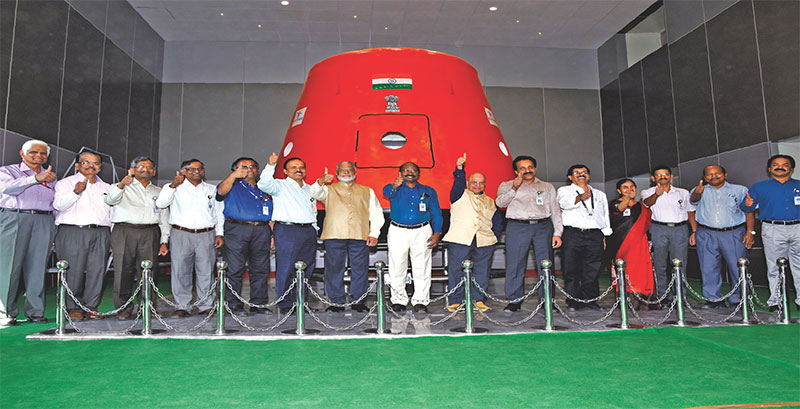
ISRO’s Gaganyaan module being revealed
He said the Gaganyaan programme approval will be a major milestone for ISRO, and a brilliant start to 2019. The programme will usher in a major expansion of ISRO, as the exercise will involve selecting the crew, training them for spaceflight, ensuring safe return to earth and creating life support systems for a successful mission. The ISRO chief also confirmed the date of India’s second mission to the moon, Chandrayaan-2, which will be before April-end.
Dr K. Kasturirangan, former chairman, ISRO inaugurated HSFC on 30 January 2019 at ISRO headquarter campus in Bengaluru. A full-scale model of Gaganyaan’s crew module was also unveiled at the event.
According to ISRO, the mission will be a major turning point for the organisation, which will be expanding its activities beyond engineering activities of launchers and satellites, and into the realm of developing and handling technologies to sustain humans in space.
“The HSFC will work full steam now. We must select the astronauts, train them, create and ensure livable conditions in space for them and later bring them back safely and rehabilitate them in their routine,” said Sivan.
The Gaganyaan module will be carried by India’s heaviest launch vehicle – GSLV Mark III – which became operational in November after its second successive flight in a row. It will have two non-crew flights in December 2020 and July 2021 for it to qualify for carrying astronauts into space.






 VIDEO
VIDEO