

Game Changers
Bayraktar drones have hogged the limelight in the recent weeks due to their spectacular performance in the ongoing war in Ukraine, including claims of their role in the sinking of Moskva, albeit in a diversionary role. The stunning success of an unmanned vehicle prompts the thought whether AUVs can cause similar disruption in maritime battles. The answer is yes, and technology today offers solutions to the impediments imposed by undersea medium.
The history of Unmanned Underwater/Undersea Vehicles (UUVs) began with the development of a vehicle developed by the US Office of Naval Research (ONR) which could dive to 3000 m and had an endurance of four hours. UUVs have been used widely for civil applications such as oceanographic and other scientific measurements, Search and Rescue (SAR) and industrial applications by oil and gas industry.
The success of UUVs in civil applications has been recognised by all navies and they are replacing manned platforms to avoid risk to personnel, and reduce per piece cost, with commensurate increase in numbers. The first time UUVs were deployed in a combat role was during Operation Iraqi Freedom for MCM operations off the Iraqi port of Umm Qasr. In 2004, the US Navy released its UUV Master Plan and set up its first UUV Squadron in September 2017. The importance that China accords to its UUV Programme was evident when the 70th anniversary military parade in September 2019 featured the Large Displacement UUV along with ICBMs and SLBMs.
UUVs belong to the family of Unmanned Maritime Systems (UMS), its sibling being the Unmanned Surface Vehicle (USVs). UUVs are of two types: tethered and non-tethered. Most of the earlier UUVs were tethered to the mother ship, with umbilicals which were kilometres long, through which electrical power, to and fro transmission of sensor data and control signals were exchanged. These are referred to as Remotely Operated Vehicles (ROVs). With improvements, largely in endurance, underwater communication, and navigation, UUVs became independent of the mother ship, and came to be called as Autonomous Underwater (or Undersea) Vehicles (AUV). In common parlance today the word UUVs means AUVs only. AUV is a far more challenging area than unmanned vehicles operating on or above surface at sea or land because of limited endurance and little scope for human intervention due to difficulties in underwater communication.
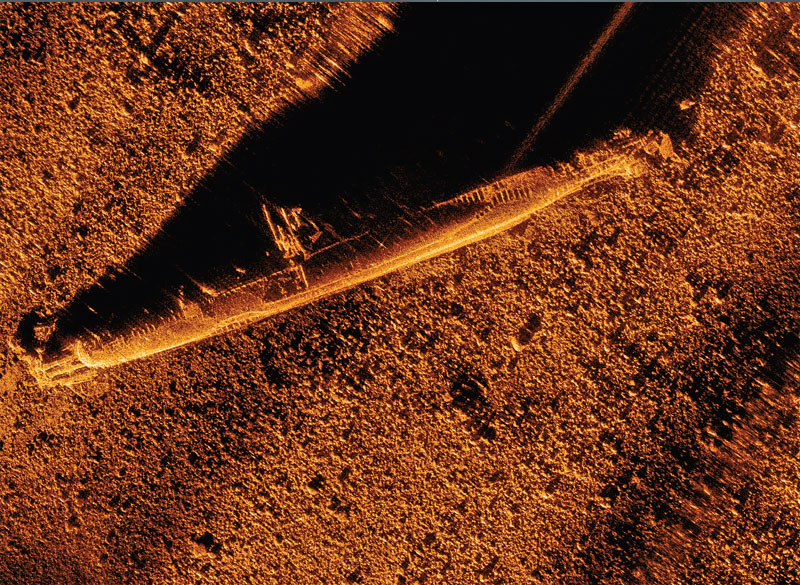
SAS tile mosaic, resolution 3cm taken by ECA GROUP’s AUV A18D underwater drone
The Janes edition on Unmanned Maritime Systems and AUVAC (Autonomous Undersea Vehicle Applications Centre) lists about 400 different makes of AUVs of various dimensions, function, and capability. In order to achieve standardisation within this wide range, they are categorised as follows:
AUV Technologies
Endurance: Endurance is a major consideration for AUVs due to its effect on extended vehicle missions. It is ironical that the endurance of Unmanned Aerial Vehicles (UAVs) far exceeds their manned counterparts, while that of most AUVs is a fraction of that of a submarine. Lithium-based batteries are most widely used since they have the highest energy density among currently available battery technologies. AUVs powered by Lithium-Ion batteries of the HWV Class have an endurance of three days while LDUUV class have an endurance of 15 days. The outlier is the US’s LDUUV–IP (Initial Prototype), called Snakehead, which has energy of 1800 KWh and claims an endurance of a whopping 70 days. Besides Lithium-Ion batteries, the other power sources are fuel cells and hybrid diesel/ rechargeable battery which can be fitted only on LDUUV and XLUUV class. The Korean AUV (ASWUUV-Anti Submarine Warfare UUV) is equipped with Fuel Cell which is designed for an endurance of 30 days. The US Navy’s XLUUV Orca has a dived endurance of 250 nautical miles which is comparable to conventional submarines, after which the vehicles charge the battery by snorkelling. It has a claimed mission endurance in excess of three months.
From an operational perspective, higher the endurance, larger will be the stand-off distance of the mother platform and lesser its vulnerability to enemy forces. This is more relevant in the case of surface ships. Submarines are the best platforms to launch AUVs, but due to smaller size of the AUV (which is constrained by the stowage arrangement on submarine), endurance will be lesser, and so will be the stand-off distance. However, the presence of the integral AUV as a forward sensor gives the freedom to the submarine to operate farther from the enemy than it would have to, without an AUV.
Subscribe To Force
Fuel Fearless Journalism with Your Yearly Subscription
SUBSCRIBE NOW
We don’t tell you how to do your job…
But we put the environment in which you do your job in perspective, so that when you step out you do so with the complete picture.






 VIDEO
VIDEO