

Future of Weapons
The 53rd edition of the show vividly illustrated the ever-growing technological gap between the United States and Western Europe in the arena of next-generation multi-role combat aircraft (MRCA) developmental efforts. While plans for a sixth-generation US Air Force (USAF) ‘Penetrating Counter-Air’ MRCA concept are well and truly advanced, in Europe there are two emerging new-generation MRCAs now at the conceptual design stage, these being the Dassault Aviation/Airbus Defence and Space consortium’s New Generation Fighter (NGF), and the ‘Tempest’ from a consortium comprising BAE Systems, Leonardo UK, MBDA UK and Rolls-Royce.
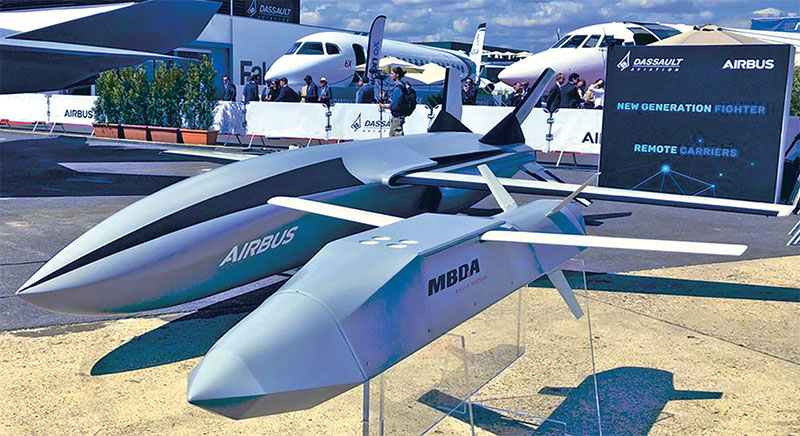
Remote-carriers from Airbus and MBDA
Since 2014, Boeing, Lockheed Martin, and Northrop Grumman have all unveiled sixth-generation MRCA concepts or artist’s impressions, which will translate into full-scale flying prototypes with transformational capabilities by 2040. Presently-underway developmental efforts stem from a 2016 US Air Force ‘Air Superiority 2030’ study, which concluded that the USAF would require a next-generation tactical Penetrating Counter-Air (PCA) MRCA for air superiority and air dominance, replacing the existing Boeing F-15 Eagle and Lockheed Martin F/A-22 Raptor, while complementing the USAF’s Lockheed Martin F-35A Lightning joint strike fighter. The PCA-MRCA represents one element (the air domain platform component) in the USAF’s Next Generation Air Dominance (NGAD) analysis of alternatives, which will likely encompass a future family of air superiority capabilities that will together allow the USAF to control the air and space domains. They will allow the USAF to operate in the anti-access/area-denial (A2AD) environment even in highly contested airspace. This family of systems and capabilities will include communications and intelligence, surveillance, and reconnaissance (ISR), and command-and-control systems, and a host of existing and future platforms and weapons, and include various means of delivering non-kinetic effects such as electronic attack and cyber-warfare. But the family is still expected to include a new, high-end PCA platform: a manned MRCA providing air dominance, air supremacy, air interdiction, and precision-strike. The projected PCA-MRCA will be expected to incorporate a high degree of stealth and sensor fusion and to be armed with very long-range guided-missiles and also directed-energy weapons (DEW) for self-defence. Artificial Intelligence (AI) will likely allow the aircraft to be a single-seater and it could even incorporate provision for optional manning. The PCA-MRCA will also operate in conjunction with remotely-controlled swarming drones.
All of this may well result in a long and complex development programme at high and relative rapid obsolescence, because adversarial capabilities and technology will inevitably move on in the time that it takes to develop and field a new-generation MRCA produced via a traditional large-scale programme, necessitating an early upgrade or an urgent replacement. But an alternative approach has been outlined, not least by Gen. Mike Holmes, Commander of the USAF’s Air Combat Command, who recently looked back at the ‘Century Series’ of combat aircraft of the late Fifties as a model of rapid turnover projects. These were rapidly developed and fielded, but they were expected to serve for a short time (seven to 10 years) before being withdrawn from frontline service. A modern counterpart to this strategy would allow an air advantage to be maintained, a process that cannot be static. The US would thus keep multiple development programmes active, shifting investment into the most promising and fielding upgrades to in-production MRCAs rapidly and frequently, and producing new platforms whenever they offered a significant advantage. These new aircraft could be less expensive to procure and sustain than today’s MRCAs because they would not be expected to last 30 years or 20,000 flying hours and would be produced in relatively small numbers, with overlapping programmes producing several new types in each ‘generation’.
Confusingly, the NGAD acronym used by the USAF is also being used to describe a separate US Navy analysis of alternatives. This covers the search for a replacement for the Boeing F/A-18E/F Super Hornet and E/A-18G Growler, with service entry in the following decade. The basic requirement is to better protect the US Navy’s aircraft carriers, which are becoming more vulnerable to China’s advanced long-range supersonic anti-ship cruise missiles and Russia’s air-launched hypersonic anti-ship missiles. The two NGADs are not related or connected, nor are there any plans to merge the efforts or to pursue a joint MRCA programme, since the two services’ requirements are distinctly different, although there could be some procurement of common systems and sub-systems to be integrated with both new sixth-generation MRCAs. The US Navy has thus far fought suggestions that it should simply procure a navalised version of the USAF’s PCA-MRCA. The US Navy does not want to pay for capabilities that it will not use, and it may pursue some commonality with the F-35C, which may result in a ‘cheaper’ F/A-XX (what the US Navy has provisionally dubbed its next-generation MRCA). While the USAF continues to place great emphasis on low observability to penetrate enemy airspace, the US Navy will not need its F/A-XX to penetrate enemy airspace and instead plans to use standoff precision-guided missiles (PGM) for deep-penetration missions or it will hand such missions over to the USAF. In addition, the US Navy wants to focus on increased range, because range is perceived to be a significant limitation for the current carrier air wing. It will also focus on speed. Stealth will play some part but is viewed as being just one element in a wider survivability equation. The US Navy is also working on ultra-lightweight armour and counter-DEW technologies.
Subscribe To Force
Fuel Fearless Journalism with Your Yearly Subscription
SUBSCRIBE NOW
We don’t tell you how to do your job…
But we put the environment in which you do your job in perspective, so that when you step out you do so with the complete picture.






 VIDEO
VIDEO