Unmanned military systems have been around for over a century. In recent years, newer upgraded versions have entered the market, making them the future solutions for all dimensions of warfare -- aerial, land and sea. They are being developed for both conventional as well as strategic purposes.
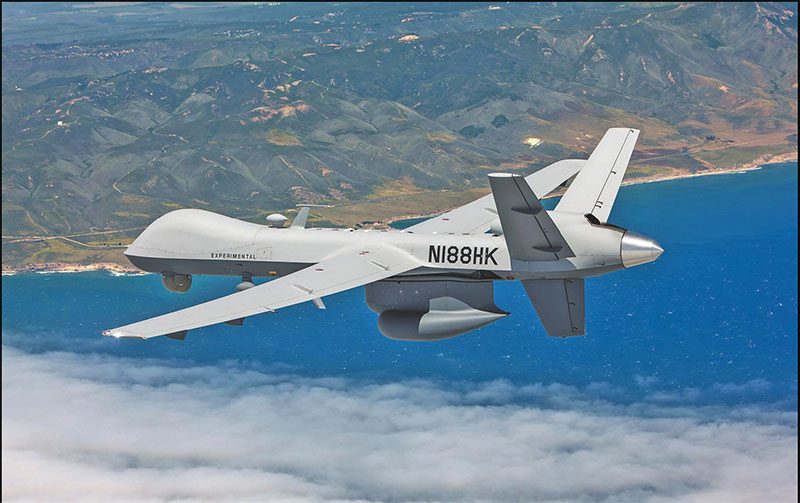
US Navy’s Sea Guardian drone
In addition to airborne and land forces, unmanned systems are now slowly becoming an integral part of naval forces across the world. For now, several types of unmanned naval systems including airborne, surface vessels and autonomous underwater vehicles suited with a combination of advanced naval sensing equipment and arms are being used by a handful of advanced navies to carry out a wide range of naval duties including key naval intelligence, surveillance and reconnaissance (ISR), early warning, gunship guidance, manoeuvre control, target detection, security, anti-ship and anti-submarine missions.
To monitor the ocean and other national assets, unmanned systems are becoming a vital solution for international maritime forces. Similarly, in order to stimulate maritime domain awareness (MDA) in the Indian Ocean Region (IOR), the Indian Navy has focused on acquiring these systems and exploring both indigenous as well as foreign options. In previous years, the navy often expressed the need for various types of unmanned naval systems comprising unmanned aerial systems (both fixed-wing and rotary), unmanned surface vessels (USVs) and unmanned underwater vehicles (UUVs).
Unmanned aerial vehicles (UAVs) are the most crucial systems in this segment, modernised with a wide range of combinations of payloads including high-resolution Synthetic Aperture Radar, EO/IR systems, ELINT, SIGINT and situational awareness systems, anti-surface and anti-ship munitions. The US Navy MQ-4C Triton, Sea Guardians as well as MQ-8B fire scout and PLA-Navy Guizhou Xianglong (Soar Dragon) are some of the most advanced maritime aerial systems unchallenged globally. Currently, the Indian Navy operates three squadrons of Israeli-made Haron and Searcher Mk II drones to conduct maritime duties, and is now looking to replace these systems with the latest ones. The Indian Navy’s need for unmanned maritime systems including tactical, MALE and HALE unmanned aerial systems is huge. It is evaluating these systems for diverse sea-based missions involving coastal/EEZ maintenance, surveillance in maritime climate, anti-piracy, anti-terrorism, search & rescue assistance, assistance in HADR, limited strike as well as anti-submarine role and enhancement of MDA exploiting marine AIS transponders.








 VIDEO
VIDEO