The Unmanned Aerial Vehicles (UAVs) have evolved from being primarily a surveillance and reconnaissance asset to hunter-killer roles. Over the years, UAVs have undergone a huge role expansion in employment with missiles
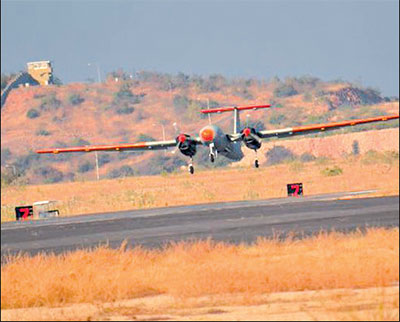
DRDO’s Rustom 2 UCAV during a flight test
being loaded on them to term them as Unmanned Combat Aerial Vehicles (UCAV). These can be used for targeting surface targets as also underwater submarines.
UAVs are great force multipliers, and there must be synergy between the three services to optimise their employment. They could be employed for multifarious tasks fruitfully. Presently, the Indian armed forces have limited numbers of these aerial vehicles and each service is looking towards its individual requirement. In as much as the army is concerned, the Herons are performing exceedingly well in surveillance missions in high altitude regions as also providing critical information to manoeuvre elements in our Southern deserts.
India’s UAV History
India’s first acquisitions were the Israeli Searcher Mark 1 in 1998. It had its limitations in terms of altitude ceilings, endurance, duration it can be airborne, and weight it could carry.
India’s armed forces have been operating UAVs for over 18 years. The Indian Army were the pioneers followed by the Indian Air Force (IAF) and subsequently the Indian Navy. At the outset, Defence Research and Development Organisation (DRDO) was tasked to produce a Catapult launched UAV which was developed by Aeronautical Developmental Establishment (ADE) Bengaluru and improved to meet user requirements. Most of the UAVs of the Indian armed forces were procured from IAI Malat, whose UAVs were in service with numerous countries.
The Indian Army initially obtained the Searcher Mark I, followed by the Searcher Mark II which could operate at an altitude ceiling of 15,000 ft and finally acquired the Heron which could operate at an altitude ceiling of 30,000ft.
The IAF immediately followed the army and acquired the Searcher Mark I followed by Searcher Mark II and acquired the Heron UAV prior to the Indian Army. The Indian Navy also acquired the Heron UAV which suited its long range off-shore requirement. Reports indicate that the IAF has lately acquired the Harop which is a UCAV.
Current Status of UAVs in India







 VIDEO
VIDEO