

Fuel to Fire
Srinagar: Stopping suddenly in the middle of a sentence which comprised a series of official platitudes of the kind one hears from all security personnel in Kashmir, the senior superintendent of police (SSP) posted in one of the volatile districts of south Kashmir starts to stare in the empty space in front of him. In the ensuing silence, he seems to be weighing something. Then, making up his mind, he looks directly at his interlocutor. The earlier official bombast is replaced by a helpless half-smile. “How long can we talk in abstract,” he says.
The silence lingers on. The tenor of the conversation has changed without warning. Just moments ago, the SSP was talking about how if the present pressure is maintained on the Kashmiris born in the Nineties, by 2025 peace will return to the troubled state because the post-Nineties generation would emerge. According to him, when the situation normalised in 2010, after a bloody summer that saw nearly 120 dead, there was a conscious effort by the state government to reach out to the people in an ameliorative manner — to help assuage the anger of the previous months. The police was also asked to become as invisible as possible so that people could get the sense of the situation returning to normal.
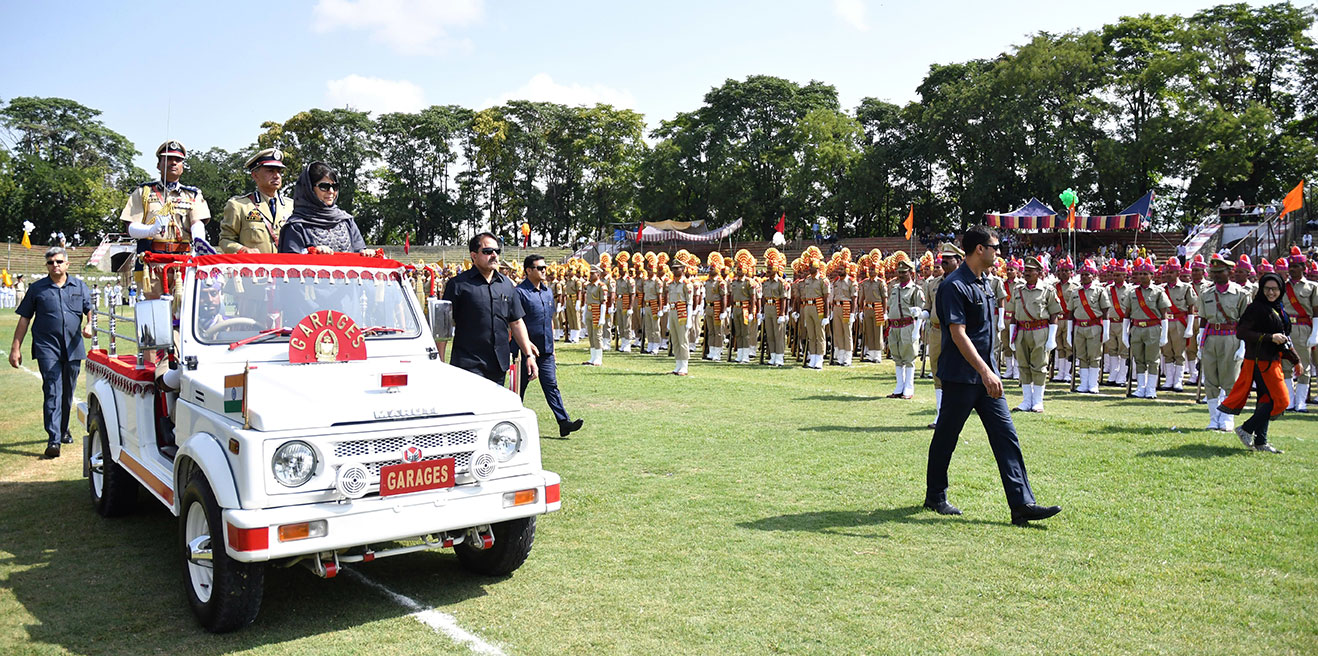
Taking Stock: Chief minister of J&K, Mehbooba Mufti, during Independence Day celebrations
“In hindsight, that was a mistake,” he had said before the pause. “We let the pressure up and the people thought that they had a free run. Massive radicalisation and recruitment drive started in the rural areas. Which is why when the situation erupted last year, it was driven essentially by the village folks unlike in the past, when insurgency was largely cities-driven.”
In a manner, he was echoing the sentiments of his inspector general, Kashmir range, Munir Ahmad Khan, who told FORCE a day earlier that, “The post-Burhan Wani agitation was rural-belt driven. This was a new development for us.”
Hence, taking forward his IG’s arguments, the young SSP indulged in some star-gazing, which is when something inexplicable happened to him and he felt silent. When he found his voice, the discourse had altered drastically. How long can we talk in abstract?
“These street protests, daily violence, radicalisation, infiltration, exfiltration… all of these are consequences of an underlying problem,” he says softly. It was as if his words had transformed his whole being. Despite his uniform and formality of the office, his demeanour now was that of a helpless person caught in a bad situation.
“We all know what the problem is, but we pretend that the main problem is violence, whether on the streets or by militants. And we keep churning out statistics about number of those who joined militancy, those who surrendered and those who were killed as if these numbers are the sum total of the Kashmir problem.”
What is the problem then?
“The problem is political,” he says, his voice rising a bit. “We are managers at the ground level. We can only manage the problem on the day to day basis. But eventually the problem has to be resolved politically.”
What about his deadline of 2025 when the issue is supposed to resolve itself with the arrival of the next generation?
He smiles, this time a bit sheepishly. “The next generation will emerge from the present generation. It won’t drop from heaven. Won’t it carry the burden of its history and experiences?”

The SSP seems to have broken some sort of an Omerta code. In the nearly decade and half that FORCE has been covering the Kashmir issue, never before had a member of the officialdom admitted to Kashmir needing a political resolution. Even when their choice of words was different, the message was always the same: That Pakistan was stoking trouble in the Valley, that only a few districts are affected, that majority of Kashmiris do not support militancy, that boys who pick up the gun are mostly into drugs and small-time crimes or are misguided people and that everything will be fine once the violence level is brought under control.
It is difficult to say how many bureaucrats actually believe what they say, as they seemed to be guided by the principal of not criticising the system while being part of it. In an informal conversation, managing director, Jammu and Kashmir State Power Development Corporation Ltd, Shah Faesal described the dilemma thus: “To me it smacks of hypocrisy. I am part of the State. I am supposed to be the change-maker. If I criticise the system then I am admitting that I am failing in my job of bringing about the change. In that case I should resign.”
Should one read more into this breaking of ranks, albeit off the record? Or dismiss it as chairman Muslim Conference, Professor Abdul Ghani Bhat always does? “In Kashmir, nobody speaks the truth. They only peddle half-truths or falsehoods. They deliberately create confusion, as confusion sustains the movement. For truth, you will have to learn to read their silences and side glances,” Bhat repeats himself for the nth time lest the message is forgotten.
Subscribe To Force
Fuel Fearless Journalism with Your Yearly Subscription
SUBSCRIBE NOW
We don’t tell you how to do your job…
But we put the environment in which you do your job in perspective, so that when you step out you do so with the complete picture.
 VIDEO
VIDEO