

From J&K | On the Wings of Prayer
On a chilly evening of November 15, my uncle and I went to visit the shrine of Hazrat Khawaja Abdul Rahim Qadri, locally known as Rah Baba Sahib, to attend a special gathering there. Rah Baba Sahib bears allegiance to the Qadiriyya Silsila (Sufi order). The shrine built in memory of Abdul Qadir Gilani or Jilani, a revered saint and scholar from Iran’s Gilan province, is situated in Srinagar’s downtown area. A much bigger one, built in remembrance of ‘Dastgeer Sahib’ or ‘Gous-ul-Azam’ Abdul Qadir Gilani, is located in Srinagar’s Khanyar locality. Unlike ‘Ameer-e-Kabeer’ Mir Sayyid Ali Hamadani—a scholar, poet and saint of the Kubrawiya order who came to Kashmir along with his spiritual companions and disciples—Abdul Qadir Jilani never visited Kashmir during his lifetime. Kashmir is often referred to as an alcove of Sufi saints.
Meanwhile, a group of dedicated elderly and young men, and kids had gathered inside the Rah Baba Sahib shrine. They had formed a sort of a ring, resembling a players’ huddle during a crisis situation with the hope of scripting a miraculous win on a sports field. They were reciting Kalimat. With moist eyes, the devotees and disciples were raising their hands up in the air while saying Dua. Even in this simple ritualistic act, Kashmir’s collective dispossession was discernible. Women devotees were present inside another section. The shrine has mosque attached, which has two stories (one to be used during the summer, another during winters). Inside the shrine the women have their reserved place.
My uncle has a grip over the Persian language and poetry. Many from Kashmir’s older generations are well-versed with Persian, Urdu and their mother tongue, Kashmiri. At one point in time, Persian was Kashmir’s official court language. It was later replaced by Urdu. It is another matter that many more languages have since been added to the region’s official languages’ list, especially after the events of 5 August 2019, when Jammu and Kashmir lost remnants of its semi-autonomy, special status, and statehood.
With profound interest in culture, heritage, architectural grammar and Sufism, my uncle’s desire was that I accompanied him for recording portions of Naatiya Kalam rendition in Persian during the mawlid gathering at the Rah Baba Sahib shrine on the 9th of Rabi’ al Thani (Hijri calendar). On 11 Rabi’ al Thani, the annual Urs of Abdul Qadir Gilani is observed. Since I am not dexterous at handling electronic gadgets, I had requested a tech-savvy friend of mine to do the recordings. Unfortunately, he got stuck somewhere and couldn’t attend.
As I began recording selective recitations, a notification popped up on the mobile phone screen: ‘An encounter between militants and government forces personnel has started in Srinagar’s Hyderpora area.’
I did not disturb my uncle. I did not tell him anything about the incident. He was engrossed in spiritual contemplation. At the end of the congregation around the Isha (night) prayer, we left for home.
As an aside, I prefer visiting shrines located in downtown Srinagar usually during early mornings. Some of the shrines and temples are architectural marvels. I find innumerable benefits in doing so. One, the exercise is cathartic; two, it humbles you and connects one to the roots; three, sometimes such visits result in heritage walks with friends through slender downtown alleys; and four, one also gets to relish the winter delicacy, Harissa. That is an icing on the cake!
Casually, while driving, I informed my uncle that some untoward incident had taken place in Hyderpora. He did not ask any questions for he was still meditating. The streets, however, wore a deserted look. He noticed too but ignored. Without much reflection, we thought that it could be a result of freezing temperatures during the late autumn evenings. Perhaps, people wanted to be home early to escape the hazards of nippy weather. At any rate, there is no concept of night life in Kashmir since 1989. There is darkness, though.
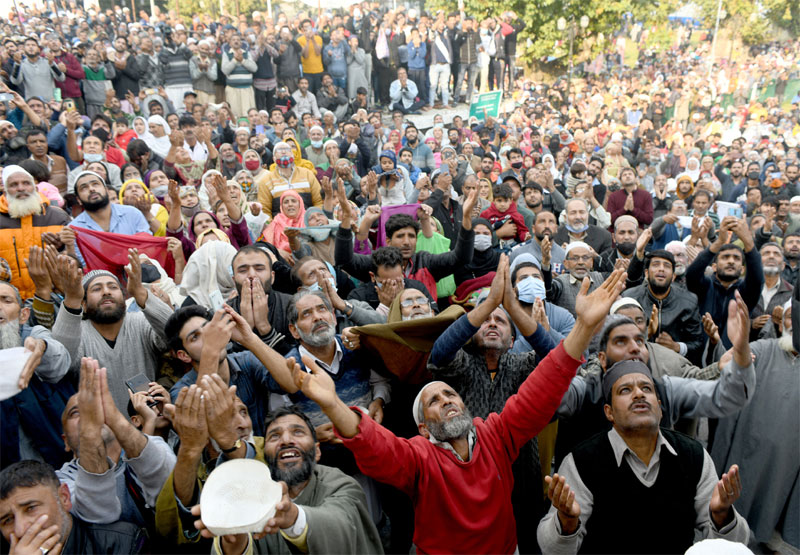
As more details emerged from the Hyderpora’s alleged gunfight, a staged one according to key eyewitnesses and the victim families, it was clear that something was amiss. The controversial shootout brought back the haunting memories of similar ‘staged gunfights’, or the ‘fake encounters’ as they are referred to, like the ones in south Kashmir’s Pathribal (March 2000; five civilians were killed and passed off as ‘foreign mercenaries’) in Anantnag; Chittibandi in north Kashmir’s Bandipora (February 2004; six civilians were killed); in parts of central and north Kashmir’s Ganderbal and Bandipora districts respectively (five civilians were killed and dubbed ‘foreign militants’); north Kashmir’s Machil (April 2010; three civilians from Nadihal in Baramulla were killed in frontier district of Kupwara); and Amshipora in south Kashmir’s Shopian district (July 2020; three civilians from Rajouri were killed in south Kashmir).
Subscribe To Force
Fuel Fearless Journalism with Your Yearly Subscription
SUBSCRIBE NOW
We don’t tell you how to do your job…
But we put the environment in which you do your job in perspective, so that when you step out you do so with the complete picture.
 VIDEO
VIDEO