

Force Multipliers|| May 2019
To possess a robust and reliable inventory of intelligence, surveillance, and reconnaissance (ISR) assets is the cornerstone of any major country’s defence arsenal. ISR capabilities not only augment war-preparedness but also serve as a vital component of conventional and nuclear deterrence. In India’s case, considering its geographical location, massive landmass, colossal coastline, and seemingly unending international borders, having capable ISR capabilities becomes paramount.
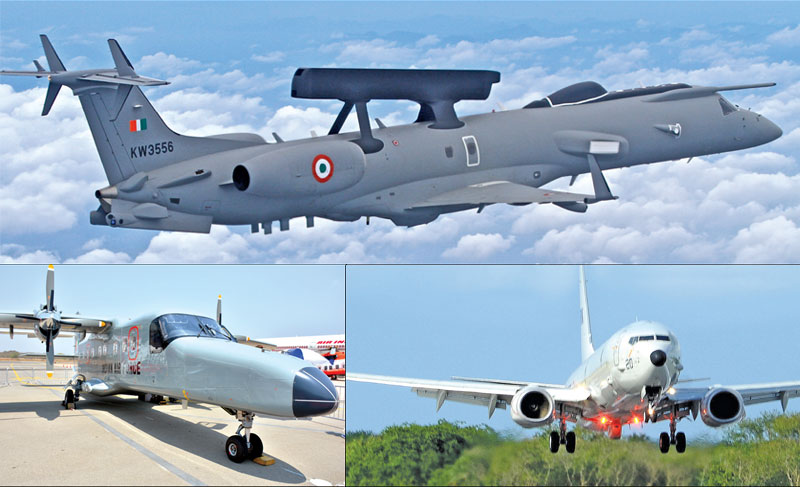
Clockwise from top: IAF’s Netra AEW&C; P-8I maritime reconnaissance aircraft; Dornier Do-228
As India’s armed forces undergo steady modernisation over the years, there has been an increased and pressing requirement of equipment that further bolsters the ISR capabilities of all three services. The ISR assets acquired and inducted by the Indian armed forces over the decades have ranged from airborne warning and control system (AWACS) and airborne early warning and control (AEW&C) aircraft to maritime reconnaissance aircraft (MRA) and helicopters to specialised surveillance and reconnaissance unmanned aerial platforms. Following is a low-down on what the three services currently possess in terms of ISR assets and what’s in the pipeline.
Indian Air Force
While the primary focus of any public discourse surrounding the IAF’s procurements revolves around getting new fighters, the pressing requirement for more ISR capable assets has been somewhat overshadowed as of late. These state-of-the-art surveillance, reconnaissance, and intelligence gathering systems form the foundation of the Command Control Communications Intelligence (C3I) capabilities of any modern air force. Considering the advancements in fighter aircraft technology and the ever-evolving nature of modern aerial combat, platforms like AWACS and AEW&C become vital in not only providing intelligence and surveillance of the battle-space but also effectively commanding and controlling the same. Quite literally being the ‘eye in the sky’, a multitude of countries are heavily invested in developing and inducting such platforms.
India first started looking into such platforms back in the Eighties when a requirement report of an indigenous AWACS platform was floated to the ministry of defence (MoD). Later, in 1991, Defence Research and Development Organisation (DRDO) sanctioned a project called the Airborne Surveillance Platform (ASP) and consequently, the Centre of Air Borne Systems (CABS) was established in Bengaluru. The ASP project envisaged the development of an indigenous radar fitted on the AVRO platform but the project was scrapped in 1999 following a crash. Later, in 2004, a new programme called the AEW&C was sanctioned by DRDO to CABS. The Operational Requirement (OR), however, could be finalised with the Indian Air Force (IAF) only in 2007. Accordingly, the AEW&C system was developed with Embraer-145 aircraft and with the support of consortium of other DRDO labs and private industries. The same was handed over to the IAF as Initial Operational Clearance (IOC) configuration during Aero India 2017. Presently, the IAF has two AEW&C aircraft while DRDO is testing a third to develop an advanced version.
DRDO’s AEW&C (codename Netra) system is a multi-sensor fitted on an Embraer-145 which serves as an airborne surveillance and command system for the IAF. It is also the first indigenous AEW&C system developed by DRDO and CABS. The platform’s Mission System Control (MSC) is the brain of the AEW&C system, as it fuses all the data from sensors and other systems to control the whole system. It assesses threats using data received from the on-board sensors and other sources and presents the Air Situation Picture (ASP). This ASP along with feeds from on-board sensors is used by the AEW&C to direct strikes and control own fighters to intercept incoming aerial attacks. India’s desi AEW&C system comprises a primary radar and a secondary surveillance radar (SSR).
According to Group Captain S. Awasthi, the Embraer-145 platform offers great endurance and is capable of flying for five hours at a stretch and it can fly for over nine hours with air-to-air refuelling. It can also patch with satellite-based platforms. While the Netra was developed to serve as an addition to the IAF’s existing Phalcon AEW&C, within a very short span, the Netra has become the IAF’s go-to AEW&C system. Even during the recent Balakot air-strikes, government sources revealed that the home-grown AEW&C played a pivotal role in guiding the IAF fighter jets attack the designated targets, especially since the fighters had turned off their radars to avoid detection.
Subscribe To Force
Fuel Fearless Journalism with Your Yearly Subscription
SUBSCRIBE NOW
We don’t tell you how to do your job…
But we put the environment in which you do your job in perspective, so that when you step out you do so with the complete picture.






 VIDEO
VIDEO