

FORCE is 19 | The Invisible Enemy
India faces threats to its security from external sources and those emanating from internal problems. Many of the internal threats like the ones in Jammu and Kashmir, Punjab and the Northeast have been actively instigated, aided and abetted by external agents. While some of these internal security challenges have been overcome, others continue to fester. According to an estimate, around 40 per cent of 773 districts of India continue to witness violence by insurgents. These include the Maoist-affected areas of central India and separatist elements in J&K and some north-eastern states.
It all started with the largescale migration of population and communal violence that followed India’s Independencee. The country since then has periodically witnessed eruption of large-scale communal violence.
It will be apparent to a discerning scholar of modern history that India has had to face a fresh internal security challenge almost every decade. The decade of 1950s saw separatist movements in Nagaland and Mizoram, followed by insurgent movements in Manipur and Tripura. Next came the Naxalbari movement in West Bengal. This has now spread to large parts of central India where tribal people are up in arms for restoration of their rights and control over their resources—Jal Jungle Zameen. The late 1980s also witnessed problems in the Gorkha Hills of Darjeeling in West Bengal. The Gorkhas felt aggrieved at the lack of development in the area and wanted more autonomy to run their affairs.
There was a period of strife in Assam the 1970s until mid-1980s, spurred by the foreigner’s issue. The Assam accord signed between the government of India and ULFA rebels brought the problem under manageable limits but the vexed issue of identification of foreigners continues to simmer and the process of NRC and the CAA has created its own set of problems.
During the decade of 1980s and 1990s India witnessed violent terrorism in Punjab which was aided and abetted by Pakistan. Widespread violence during this period resulted in deaths of several innocent civilians and security forces personnel. Punjab being a bordering state, the militancy there was by far the most dangerous threat to the security and integrity of the country. This was controlled finally by some resolute action by the security forces and political sagacity of the leaders. The construction of fence along the border with Pakistan in Punjab also played a major role by cutting off the logistics and finances of militants. That the militants lost out on popular support because of atrocities they perpetuated on the masses was an additional factor.
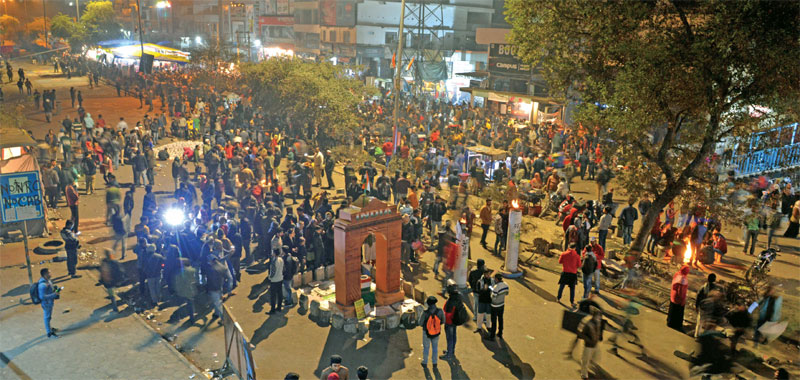
Demonstration at Shaheen Bagh
The situation in Kashmir, which perhaps was always simmering below the surface turned worst in 1989-90. One factor for sudden eruption of violence was widely perceived rigged elections of 1987. The situation was exploited by Pakistan and the militants were provided weapons, logistics and finances besides the leadership from foreign militants infiltrated through the difficult mountainous terrain along the Line of Control. The problem continues to fester and provides Pakistan with opportunity to exploit the situation and keep our military and financial resources committed to tackle the problem.
The modernists amongst the scholars of security are of the opinion that the traditional thinking that threats to security come only from military or military like acts needs to change and include non-traditional threats like the cyber terrorism, threats emanating from environmental degradation, pandemic like the COVID which continues to inflict causalities, money-laundering, organised crime, caste and ethnic tensions, regionalism and inter-state disputes etc. India faces both traditional and non-traditional challenges to internal security. However, for the purpose of this article, discussions will be restricted to internal security.
Subscribe To Force
Fuel Fearless Journalism with Your Yearly Subscription
SUBSCRIBE NOW
We don’t tell you how to do your job…
But we put the environment in which you do your job in perspective, so that when you step out you do so with the complete picture.






 VIDEO
VIDEO