For some time now, India’s Hindu right-wing has been raging about school and college textbooks glorifying invaders and not ‘our’ (read Hindu) kings. Mostly confined to alt-right blogs and social media platforms before 2014, this chatter has now reached mainstream media spaces where accusations fly thick and fast that Left-leaning historians deliberately wrote histories that made Indians feel ashamed of their past.
Through TV debates, op-eds, blogs, YouTube videos, Twitter threads, and Facebook posts, it is being increasingly underlined that India needs to mainstream a celebratory view of the past that privileges Hindu rulers over and above everyone else. History should instil pride in our past among our youth for Bharat to be true ‘vishwaguru’ in the future, they argue.
This is the core thought; it is possible to encounter it in various forms through different commentators: a right-wing author who loves to sermonise at literature festivals and TV debates about India having a ‘civilisational nationalism’ that goes back thousands of years, so history textbooks must accurately reflect this; a retired military officer whose hyper-nationalist rants come amid laments that our textbooks only show Muslims defeating Hindus; a right-wing journalist who talks about the need for a ‘truth and reconciliation commission’ like in some other post-colonial countries; or a social media influencer who claims that the British left India as they were scared of the Rashtriya Swayamsevak Sangh, but India’s historians, influenced by Marxist thought and Christian and Islamic evangelism, projected them as cowards and traitors.
It gets more and more bizarre if we start tracking every article, every tweet that talks about the need to rewrite Indian history. But all of this is couched in decolonisation rhetoric. We are told that our education and our minds need to be decolonised, and we need to look at our past as it truly existed and not how the Marxists ‘distorted’ it by being apologists for ‘Islamic’ invaders.
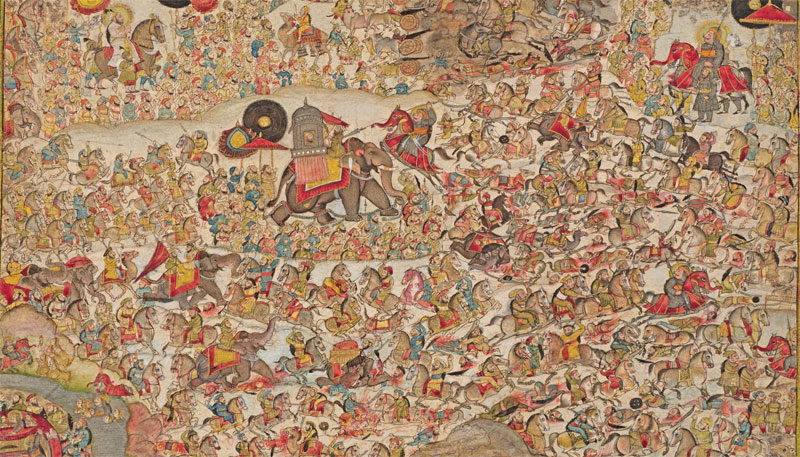
A painting probably by Chokha depicting the Battle of Haldighati (1576) between the Rana of Mewar and Raja Man Singh of Amber who was leading the forces of the Mughal Emperor, Akbar
We are told that these invasions destroyed our culture, but academic historians, following a nefarious agenda, gave a positive spin to it and showed that this only enriched Indian civilisation. This view imagines a pristine parent culture that got corrupted, and it produces a longing to revive that lost glory.
This isn’t empty rhetoric; recent reports about NCERT changing its syllabi and dropping chapters on the Mughals, removing references to Dalit authors, the 2002 Gujarat pogrom, etc., suggest that even though Bollywood actor Akshay Kumar’s film Samrat Prithviraj tanked at the box office, his appeal for the changing of textbooks was heard by the highest authorities of the land.
Those in favour of these changes claim all this was colonial knowledge that Indians were brainwashed with; only now the real, hidden history of the glorious Hindu civilisation of India that is Bharat will be revealed.








 VIDEO
VIDEO