States to set up Expert Special Cell
to speed up extradition cases
Subhashis Mittra
A robust mechanism is on the anvil to bring
under the ambit of law all offenders from beyond India’s borders. The
government has adopted a zero-tolerance policy against corruption, crime and
terrorism.
Union home minister Amit Shah said
this while addressing a conference on ‘Extradition of Fugitives—Challenges and
Strategies’ in New Delhi. Acting on the suggestion he made about a year and a
half ago, the Central Bureau of Investigation (CBI) has implemented the concept
of fugitive extradition on the ground.
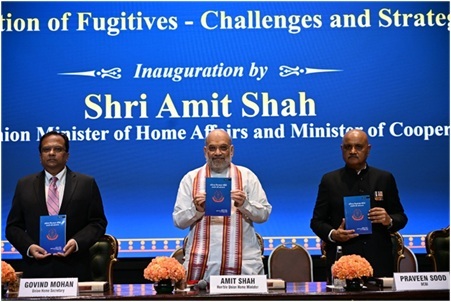
Amit Shah Refugees
As India is actively ensuring the
security of borders as well as strengthening the rule of law, said Shah, “We
must also adopt a zero-tolerance approach towards those indulging in such
activities from beyond India’s borders. It is our responsibility to bring all
such criminals under the purview of Indian laws and to create a robust
mechanism for this purpose.”
The home minister said that this
conference, with the provisions available under Interpol and three new criminal
laws, is a concerted effort to enable the presence of a fugitive criminal
before Indian courts and also provides a roadmap for achieving the same. “It
should be our collective resolve that no matter how cunning a criminal may be,
the reach of justice must be even swifter.”
The government introduced the Fugitive
Economic Offenders Act in 2018, which empowers authorities to confiscate the
assets of fugitives located in the country. More than USD 2 billion has been
recovered within just four years of the enactment of this act. Money laundering
laws have also been strengthened, leading to the attachment of assets worth
around USD 12 billion between 2014 and 2023.








 VIDEO
VIDEO