Last year, as the pandemic hit, several countries including India took to temporarily halting international and domestic flights. The reason for this was simple—airports are ports of entry, just as road and rail crossings are on the land border. Even though highly inconvenient for the travellers and airline operators, putting a temporary ban on air travel meant safeguarding the local population of each country by not importing potential Covid-19 cases from abroad.
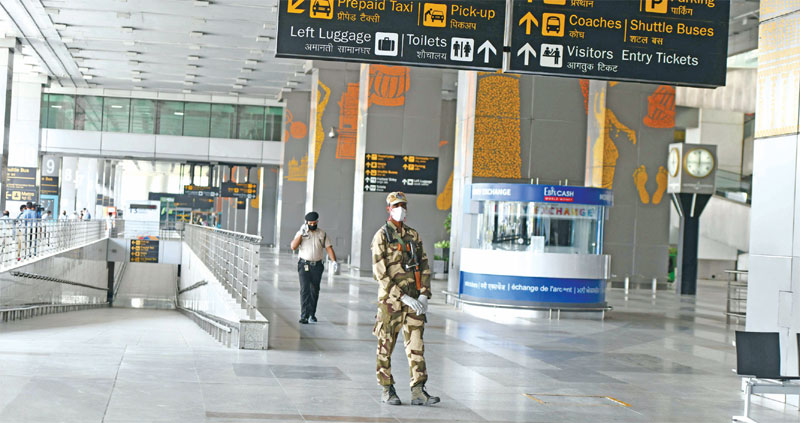
CISF personnel at the airport
As the cases stabilised and airlines were allowed take off again, a slew of safety measures came to be introduced. The state of aviation sector, however, is yet to see the earlier demand in most countries. This has led to severe distress in air and travel industry. In any case, the industry in general is sensitive to slightest changes in national policies and global situation, in addition to the volatility of fuel prices, high competition and perceived unstable sectors.
In India, as the second wave of the Covid-19 pandemic began wreaking havoc, domestic flights continued to function. However, the fear and apprehension regarding the virus kept people away from travel. Most airlines then ran at less than half their capacity. With tourism on halt, aviation sector just like other sectors bore the brunt of functioning but not attracting enough business.
In case of the airlines, the sustenance gets even more difficult because of the sky-high prices that the airlines operators are required to pay. No wonder, they often complain of the government’s lack of support in such times when the sector sees no business. This lack of support shows itself in several ways. The aviation turbine fuel (ATF), for instance.
The cost of ATF, which in amongst the highest in India, is one of the reasons why Indian airlines struggle to remain afloat. The ATF accounts for 35-50 per cent of the cost of running an airline in the country. Indian airline operators end up paying at least 40-50 per cent more on ATF, as compared to their counterparts abroad. The increase in fuel prices, leads to an overall increase in operational costs. Rising prices coupled with an uncertain demand forces airlines to limit operations only to specific routes, and ignore the ones that see lesser demand.
An instance that happened recently says volumes about the loss that the airlines are having to incur. The CEO of a Dubai-based company Stargems Group, Bhavesh Javeri, was the lone passenger on a 360-seater Boeing 777 Emirates aircraft from Mumbai to Dubai. Travelling economy, he had paid only his Rs 18,000 economy for the passage. The few other passengers on the flight had either cancelled or postponed their trips due to Covid-19.
While this may have been an odd case, ultimately, it is the flyer who has to pay for the high cost of operations. The ATF prices in February 2021 rose by the 3.6 per cent, compared to the previous fortnight. The increase in ATF prices is generally linked to a surge in international crude oil prices. This is in addition to the heavy taxes that are levied by the state and central governments.
In March, the civil aviation ministry had announced that it was working on the airline industry’s demand to bring ATF under the ambit of GST and had taken up the matter with the finance ministry. However, this is yet to see the light of day. With low passenger demand, some airlines either resorted to adding more freighters or converted passenger planes into cargo planes.








 VIDEO
VIDEO