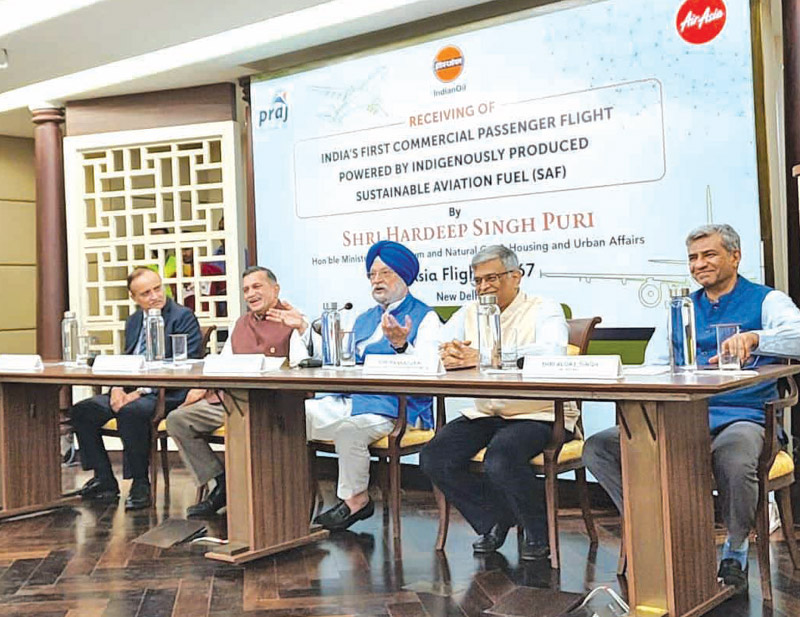
Significant developments have been taking place towards decarbonisation of India’s aviation sector with two Indian carriers, Vistara and Air Asia India, operating commercial flights using Sustainable Aviation Fuel (SAF) blends in May. The two carriers are not alone in their efforts to accelerate the use of SAF on commercial flights; in fact, all major Indian carriers now have ongoing efforts to minimise their carbon footprint and support a sustainable future for the aviation industry.
In recent years SAF production technology has grown significantly. Unlike conventional jet fuels, SAF is produced from renewable sources such as agricultural waste, municipal solid waste and forestry residues. The use of SAF blends in commercial aviation can reduce CO₂ emissions by as much as 65% over the fuel’s life cycle with the potential to reach 100% in the future. SAF is now recognised as having the most immediate and the greatest potential to decarbonize aviation over the next two to three decades.
While Vistara became the first Indian airline to operate a commercial domestic flight on a wide-body aircraft using SAF, Air Asia India (now part of Air India Express) achieved the distinction of operating the nation’s first commercial passenger flight using an indigenously produced SAF blend. It was SpiceJet which operated India’s first-ever BioJet Fuel powered flight in August 2018. The airline operated a De Havilland Canada Q400 regional transport aircraft on the Dehradun-Delhi sector for the test flight. India’s leading airline, IndiGo, is also on the SAF bandwagon, having operated a brand new A320neo on a ferry flight from Toulouse, France, to New Delhi in February 2022 using a 10 per cent SAF blend.
SAF remains one of the most important and useable key technologies available to government and industry in decarbonising aviation. But development and production of SAF are currently limited due to high capital costs and its reliance on technology that is yet to be proven at scale. While extensive use of SAF on commercial flights is still some time away, recent test flights by Indian carriers provide vital data on future commercial operations with SAF.






 VIDEO
VIDEO