As Covid-19 cases rose rapidly across India, authorities from different establishments swung into action to contain the virus. The Indian armed forces, too, began to contribute in different ways.
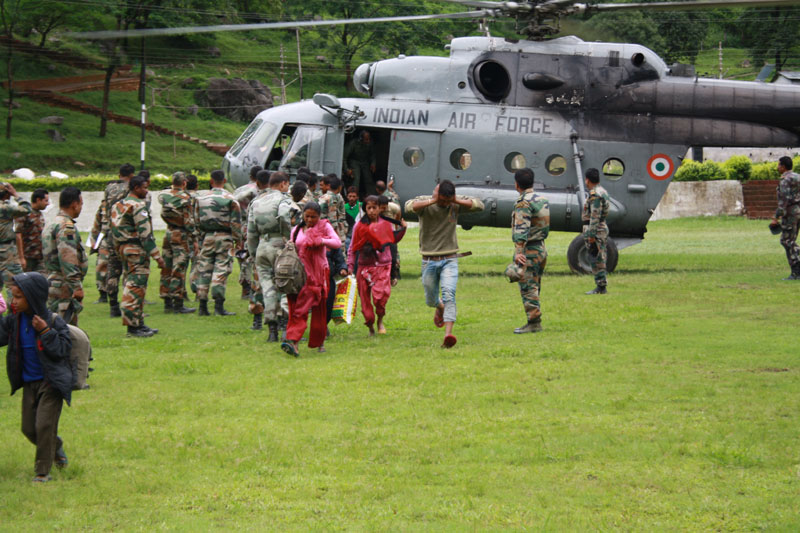
Operation Rahat
On March 19, when a fresh batch of 175 evacuees from Iran arrived in India, they were taken to the Army Wellness Facility in Jodhpur. Prior to this, a batch of 277 evacuees from Iran were also taken to this centre. These evacuees were closely monitored by the army medical teams. This was done under ‘Operation Namaste’ introduced by the Chief of Army Staff (COAS) General M.M. Naravane on March 17 to extend help to the authorities managing the crisis.
Meanwhile, Chief of Defence Staff (CDS) Gen. Bipin Rawat informed defence minister Rajnath Singh of the availability of 9,000 hospital beds in 28 hospitals of the army, navy and air force. Fifty-one military hospitals across India arranged facilities including High Dependency Units and more Intensive Care Units (ICU) beds.
Five viral testing laboratories at armed forces’ hospitals were also made available for civilians across the country. These are Armed Forces Medical College, Pune; Command Hospital at Central Command, Lucknow and Command Hospital of Northern Command, Udhampur; Army Hospital (Research and Referral), Delhi Cantt and Air Force Command Hospital, Bangalore. Six more hospitals were said to be readied shortly with the required resources.
The army has put up quarantine facilities in Manesar, Kolkata, Chennai, Jodhpur and Jaisalmer. The Jaisalmer facility is the military’s largest. Manesar is the first facility that was set up on February 1 and citizens who were evacuated from Wuhan were taken there.
The transport fleet of the Indian Air Force (IAF) supplied 60 tonnes of essential supplies, medicines and medical equipment to different parts of India. The IAF has put on standby 28 fixed wing and 21 helicopters in various parts of India for further assistance. They have been actively providing logistics support to civil authorities.
The IAF had earlier airlifted 25 tonnes of medical supplies like the Personal Protective Equipment (PPE) kits, hand sanitisers, surgical gloves from Delhi, Surat and Chandigarh to Manipur, Nagaland, Jammu and Kashmir and Ladakh.
The IAF’s C-17 Globemaster III carried out two overseas tasks of bringing back Indians and transporting medical supplies. The first trip it made was to China comprising crew, medical team and support staff carrying 15 tonnes of medical supplies to China and airlifted 125 Indians and few other citizens of ‘friendly foreign countries’ on its return. It also evacuated Indian citizens from Japan. It was sent to Iran, too, to bring back 58 stranded Indians (including 31 women and two children) and 529 samples for COVID-19 testing. The C-130J Super Hercules aircraft has ferried around 6.2 tonnes of medicines to Maldives.
The IAF has set up quarantine facilities in Dundigal near Hyderabad, Bangalore, Kanpur, Jorhat and Gorakhpur.
The Indian Navy has also been carrying out similar exercises. Six naval ships at Vishakhapatnam, Kochi and Mumbai have been taking supplies and medical equipment to India’s neighbours. Five medical teams were on standby for deployment in Maldives, Sri Lanka, Bangladesh, Nepal, Bhutan and Afghanistan. The navy has also set-up a quarantine camp at its base in Vishakhapatnam. It has also set up isolation facilities at its hospital INHS Asvini, Mumbai. Kochi Naval base, too, has been offering quarantine facilities for Indian nationals. Another quarantine facility is run by the navy in Mumbai.








 VIDEO
VIDEO