Combat Engineers are an important part of ground unit’s ability to move under fire. The capability to prepare the ground ahead for improved mobility along with fast fuel-efficient vehicles, effective logistics and precise navigation determine the tempo of ground operations especially with offensive doctrines such as that of the Indian Army’s.
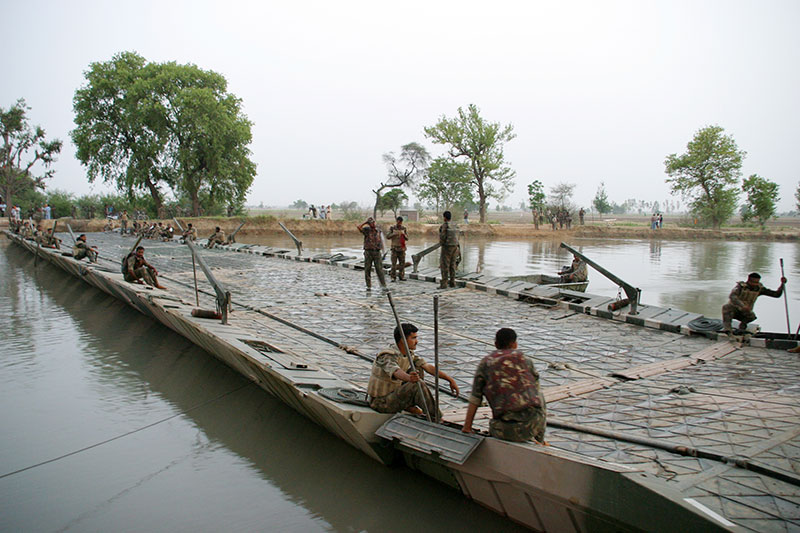
Army personnel building a bridge during Exercise Sanghe Shakti
This and disrupting the adversary's mobility by slowing, disorienting him and providing defensive positions for the holding units are major responsibilities of Combat Engineering units. Providing the most effective available equipment and training for these ‘First In, Last Out’ units will pay rich dividends in a wide variety of conventional and asymmetric conflicts.
Major General Percy Hobart was the pioneer in military engineering vehicles which were then called ‘Hobart’s Funnies’. Hobart’s Funnies consisted of flame throwers, demolition vehicles, recovery vehicles, dozer, ramp carriers, flails, fascine and assault bridge carriers by carrying out modifications to existing vehicles such as the Churchill, Centaur, Sherman tanks and the Caterpillar D-7 dozer. These variants were instrumental in clearing/demolishing obstacles, trenches, minefields, barbed wire, enemy troops in trenches and bunkers facilitate movement in moist soft ground. Since then the Soviet Union invested in such equipment which came as a rude shock to the Israelis during the 1971 war when the Egyptians used soviet engineering equipment to cross the Suez Canal. Western militaries also followed suit proving their importance in every war after that including the Gulf Wars.
The Corps of Engineers of the Indian Army, also called ‘The Sappers’, played an indispensable role in the 1971 war with Pakistan by facilitating mobility under fire. It currently uses engineering equipment from Poland, erstwhile Czechoslovakia, Russia, Germany along with home-grown systems.








 VIDEO
VIDEO