A large part of the People’s Liberation Army’s Ground Forces (PLAGF) organisational reforms have been enabled by new information warfare systems, including vehicles and terminals supporting the Integrated C4I Complex (ICC) that was developed in early 2004 and first introduced to the PLAGF across all branches in 2010. The successful development of the ICC was recognised with the state award for Scientific and Technological Progress Special Class, an award typically given to one to three projects of great significance to the country every year. The ICC unified hundreds of disparate C4ISTAR systems developed by different branches and departments of the PLAGF in the 20 years leading up to 2010, and has arguably contributed more to increasing the PLAGF’s combat effectiveness than any other system in recent memory. Within most Combined-Arms Brigades, C4ISTAR networks link every vehicle and select infantry such as forward observers and recce-scout elements together into a singular battlefield map accessible to all terminals. This allows all vehicles to constantly be aware of friendly positions and identified enemy positions as well as the status of all nodes, including their health, munitions count, fuel load, current orders, etc. The ground commander is able to seamlessly take in the battlefield picture, including recommendations from his staff and orders from above, and issue complex orders with a keyboard, a process much more efficient and accurate than traditional voice radio.
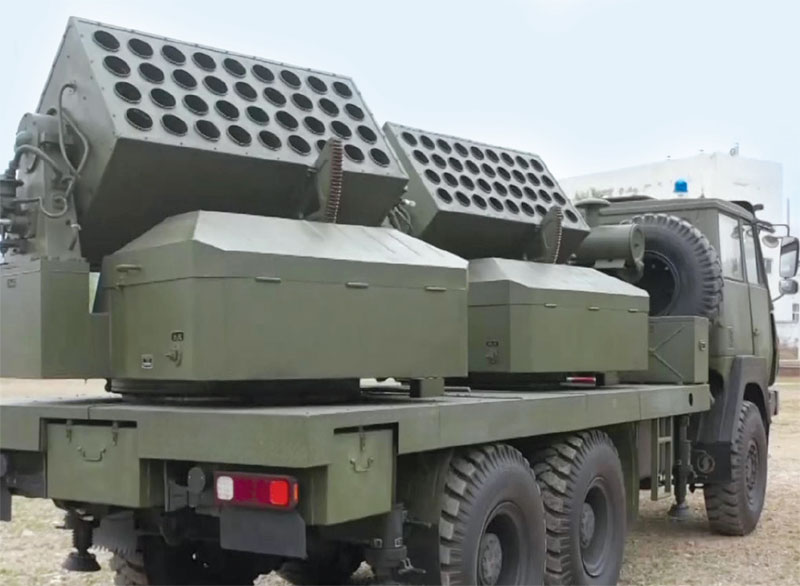
Battlefield Smoke Dispenser
Some Combined-Arms Brigades (CAB) have also compiled databases of the performance parameters of their systems and personnel in a variety of environments and situations. This helps units to construct more realistic training scenarios, make fairer calls during confrontation exercises, and find the most effective methods of doing things supported by empirical data. If the Brigade is subject to electronic attack, standard operating modes should be able to sidestep the disruption by frequency-hopping or other signals processing magic. If the attack is especially sophisticated or powerful, friendly EW assets—both organic and higher-echelon—can respond in the electromagnetic spectrum or use support measures to locate the source of the disruption and task fires with its destruction. Failing that, the network has the option to transmit simpler and more powerful packets that are difficult to obfuscate completely, up to and including Morse code. Wired communications can also be used between nearby stationary elements. As a last resort, signals flags are carried aboard every fighting vehicle in the Brigade.








 VIDEO
VIDEO