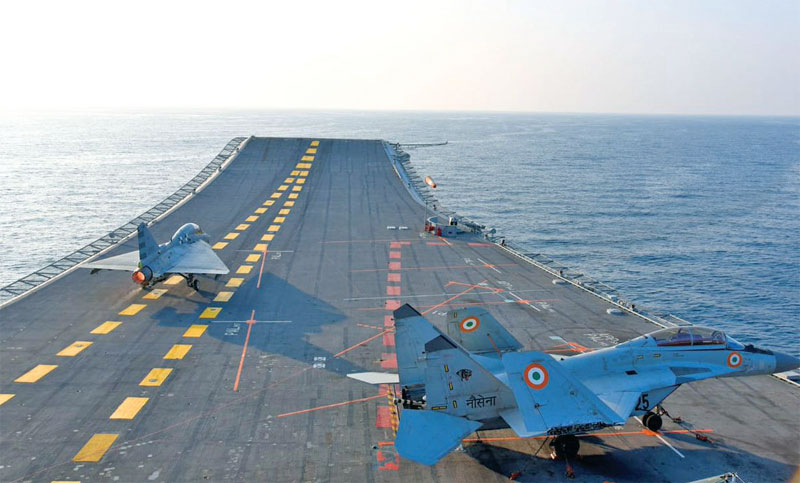
The shift of the Indian Navy’s focus from its Western seaboard to the Eastern seaboard has brought about a sense of alarm on its ability to counter the People’s Republic of China’s dramatic naval build-up. The Indian Navy, however, remains a battle tested force and has extensive experience in operating a mix of indigenous, western and Russian origin naval equipment in addition to being able to exercise with the strongest maritime forces in the region. That said, it still needs to hasten its acquisition of modern war-fighting assets to contain the People’s Liberation Army Airforce Navy (PLAAN) in any future conflict.
According to data shared by the ministry of defence, the navy’s revenue budget increased from 6.1 per cent in 2014-15 to 7.28 per cent in 2019-20, while its capital budget declined from 10.41 per cent in 2014-15 to 7.58 per cent in 2019-20. The pace of procurement of additional warships and submarines, carrier-borne fighters, naval helicopters and much more remains a matter of concern and could fall prey to competing inter-service requirements. Mindful of budgetary constraints, the navy has made a conceptual shift in its perspective-planning to focus on force levels as compared to the earlier focus on the number of platforms.
The navy receives the smallest share of defence spending amongst the three services, despite having to safeguard a 2.02 million square km Exclusive Economic Zone (EEZ). In addition to this it needs to patrol a large coastline of 7,516 km along with 1,197 offshore islands. Thirty-three per cent of the world’s bulk cargo and 66 per cent of its oil transit through the Indian Ocean Region (IOR), while 95 per cent of India’s trade by volume and 68 per cent by value are transacted by sea. Thirty per cent of India’s trade alone passes through the South China Sea.
Building Capability
The navy’s current ‘Maritime Capability Perspective Plan’ places a focus on capability acquisition instead of procuring greater numbers of maritime assets. The navy has plans to emerge as a 170 warship force by 2027 but this looks like a tall order, considering it has only 130 warships at present. There also remains a severe capability gap of Mine Counter Measure Vessels (MCMVs), Landing Platform Docks (LPDs) for expeditionary operations, survey ships and Diving Support Vessels, in addition to long overdue requirements to induct modern helicopters.
The navy’s fourth Scorpene Class submarine, INS Vela was commissioned into the Western Command in November. The fifth Scorpene is slated for commissioning in October 2022 with the sixth and final submarine of the P-75 programme, to be commissioned by end 2023. The P-75 Scorpene submarine programme is emblematic of the delays experienced in important defence programmes. Construction of six Scorpene class submarines by Mazagon Dock Shipbuilders Limited (MDL) was first approved by the Cabinet Committee on Security (CCS) in September 2005 and all six submarines will now be fully operational only by 2024, two decades after CCS approval. The P-75I programme to build six additional submarines also continues to inch along since 2008. MDL and L&T have been selected as the Indian Strategic Partners. Companies from five nations are competing for the tender - Naval Group (France), ROE (Russia), ThyssenKrupp Marine Systems (Germany), Navantia (Spain) and Daewoo Shipbuilding and Marine Engineering (South Korea).







 VIDEO
VIDEO