The Ladakh crisis has two narratives: Indian and Chinese. In the perception versus reality war, it will be a battle of nerves between Prime Minister Narendra Modi and President Xi Jinping, who having met 18 times, seemingly know one another. While stakes for both are high, obfuscation of reality by India could lead to wrong choices with serious geopolitical and military implications.
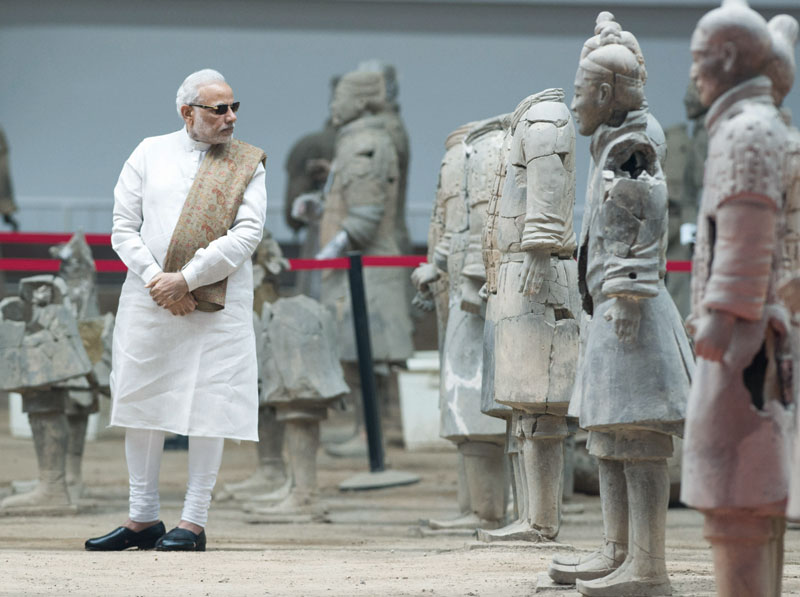
Prime Minister Narendra Modi on his visit to Terracotta Warriors Museum in Xi’an, China in 2015
Both Modi and Xi know that the 1993 Line of Actual Control (LAC) has unilaterally been consigned to the dustbin. And with it, all agreements — 1993, 1996, 2005, 2012, and 2015 — meant for peace on that LAC. China has replaced the 1993 LAC with its 1960 claim line as the new LAC in Ladakh. Given this, the PLA will not vacate the territories it has come to occupy in Galwan, Depsang, Hot Springs and Pangong Tso in Ladakh. Modi appears to have overcome these complications by creating a perception in India that the LAC remains inviolable, and no Indian territory has been lost to the PLA. It’s another matter that no one bothered to ask which LAC he was referring to — the 1993 one which was agreed between New Delhi and Beijing or China’s 1960 claim line.
The Modi government’s version is predicated on his two addresses in the span of 10 days — June 19 at the all-party meet, and June 28 Mann Ki Baat — where he unequivocally said that the battle of Galwan has been won. With the exception of the Congress and Communist parties, other political parties appear least bothered about the imbroglio. The majority in the media is happy parroting the official line. The retired military officers, with few exceptions, are cheering the government from the side-lines. Those contesting the official line are being labelled as anti-national.
At least domestically, India seems to have won the perception war against China. No one has asked the Prime Minister that if indeed no Indian territory has been lost, what have the talks at various levels — foreign minister, diplomats and military leaders — with China for the restoration of status quo ante been all about?
And if indeed no territory is lost, why has India broadened the ambit of the conflict from the Ladakh theatre to economics?
In a show of strength, the government has banned 59 Chinese popular mobile applications. Also, it is certain that Huawei 5G telecommunications will be prohibited from the Indian market. Never mind that legacy information and telecommunication technologies, power and defence grid equipment with India is of Chinese origin, as these companies have been the lowest bidders. Since no technical audits were done of equipment bought from the lowest bidders, nothing stops the Chinese (they would know the backdoors) from doing scalable cyber assaults.
In the current fit of nationalism, there is a clamour that all Chinese products should be banned in India, eventually leading to a complete stop on trade. This populism overlooks two critical issues: One, so entrenched are Chinese products in global supply chains that banning them will hurt India more than China, whose overall trade with India is two per cent of its global trade. And two, in the event of cascading effect owing to prolonged stand-off, total ban on imports from China would kill Indian MSMEs, disrupt the pharmaceutical industry and ruin the local economy in the hinterland.





 VIDEO
VIDEO