

Expensive Embrace
Geopolitics against common foe China has brought India and the US into a tight strategic embrace, which was on ample display during the recent state visit of Prime Minister Narendra Modi. The US needs India for global geopolitics while India wants the US for regional geopolitics.
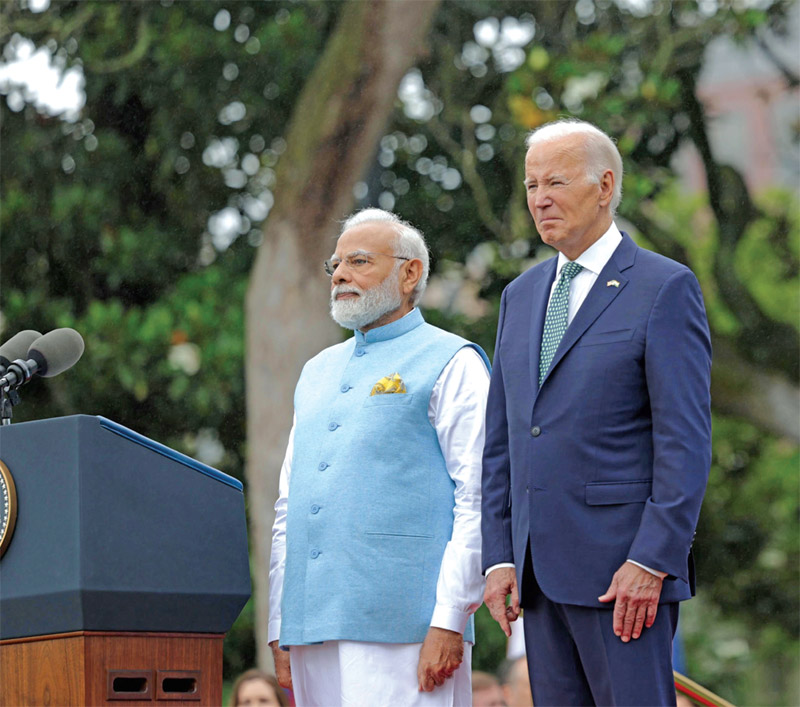
Prime Minister Narendra Modi with US President Joe Biden during his state visit to the US in June
India’s problem with China is not the border dispute but regional geopolitics. Foreign minister S. Jaishankar has conceded as much by saying that a multipolar world cannot exist without a multipolar Asia, implying that India and China should be assessed as regional power centres in the transforming world order. Similarly, the US, having identified China as its sole geopolitical competitor in this century (with the capability to match it in economy, technology, diplomacy and military) has failed to accept that its deterrence (military power) model of the Cold War is unsuitable against the Chinese geopolitical model based on global cooperation for prosperity.
Even in a fragmented world, the Chinese model cannot fail. Changing the game from free trade to weaponised trade by decoupling or de-risking value chains and supply chain networks from dependence on China (the world’s biggest trading partner) will only add to geopolitical tensions with the global economy heading towards recession.
It is no surprise that powerful European economies like France and Germany have cast doubts on the European Union’s (EU) wisdom (endorsed by the US) of de-risking instead of decoupling from China as emerging technologies like Artificial Intelligence (AI) covered under de-risking are dual purpose. While they are necessary for global prosperity to be ushered in by the fourth industrial revolution, which hinges on AI, big data, internet and cloud computing, the same technologies also have a definite role in new age robotic warfare. Thus, French President Emmanual Macron has sought an invitation to attend the upcoming Brics (Brazil-Russia-India-China-South Africa) summit in South Africa. This will be a major setback for G-7 economies and the Global North (first and second world industrialised nations) and a gain for the Global South (third world developing, less developed, and under-developed nations) led by China.
Unfazed by this and unmindful of the disastrous fallout of the Ukraine war on the global economic order led by the US dollar; the reluctance of its regional allies to openly confront China; and its own recent bitter experience of its top diplomat Antony Blinken being lectured by Chinese supremo Xi Jinping, which Washington, if it was not consumed by hubris, should have seen coming (more on this later), the US has decided to bet on India to build it as military bulwark against China in the Indian Ocean Region (IOR).
The long-term bet is based on the assumption that Prime Minister Modi will win the 2024 general elections and will not normalise India’s relations with China in this decade—the time it would take for deliverables promised by each side to take shape. The other assumption is that if push comes to shove, India, as claimed by its political and military leadership, will be able to take on the People’s Liberation Army (PLA) in a border war.
Ironically, the huge jubilation in India regarding the Modi visit missed the point that in the transactional arrangement India would end up giving far more, including its strategic autonomy, than it will get in return, which will be further accentuated by the US’ irrepressible urge (as seen during the 2005-2008 civil nuclear deal) to shift the goalposts.
So, what does the US want from India? It wants commonality of military equipment by slowly weaning India (the largest arms importer in the world) away from Russia, its traditional, affordable and trusted partner. It wants to improve Indian shipyards and naval dockyards to serve as temporary military bases for its assets (vessels of all hue including nuclear submarines and carriers) in the IOR. It also wants the Indian military (especially the navy) to do advanced exercises bilaterally and multi-laterally with the Quad navies for developing interoperability for combat in the IOR which India considers its backwaters. Since the character of war has changed with new age technologies, the US wants to pull up the Indian military to the technological level by the newly crafted India-United States Defence Acceleration Ecosystem (INDUS-X), which is part of the bigger Innovation on Critical and Emerging Technologies (ICET) framework whereby it will be able to operate within the US Indo-Pacific Command (INDOPACOM) defence network under its ‘integrated deterrence’ strategy by the end of this decade.
Subscribe To Force
Fuel Fearless Journalism with Your Yearly Subscription
SUBSCRIBE NOW
We don’t tell you how to do your job…
But we put the environment in which you do your job in perspective, so that when you step out you do so with the complete picture.



 VIDEO
VIDEO