The dynamic maritime environment with increased instabilities, deepening geopolitical and ethnic fault-lines, growing military capabilities and wide range of security challenges pose a combination of conventional and sub-conventional threats to India, at and from the seas, states the Annual Report 2016-17 issued by India’s ministry of defence (MoD). The report further says that these threats and challenges require the Indian Navy to remain effective across the entire spectrum of combat operations and constantly reshape itself to meet future challenges.
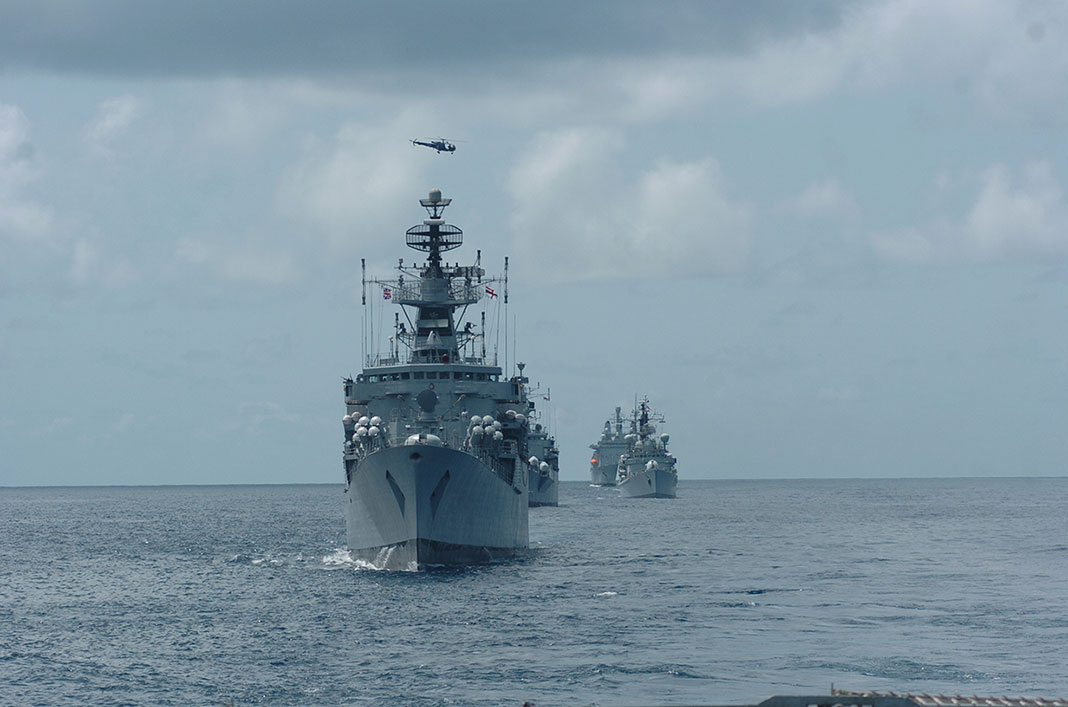
Joint exercises with foreign nations provide the Indian Navy with a platform to learn best practices from each other and to achieve new levels of proficiency to meet future challenges. In the last three years till August 2017, the Indian Navy has conducted 50 such exercises. These include 12 in 2014, 14 in 2015, 16 in 2016, and 8 till August 2017.
“Joint exercises are conducted to refine your procedures. Tomorrow, if you have to work together (with other navies), you will know how they work, what language they speak and understand, how much time they will take, and what are their capabilities and shortcomings,” said Indian Navy spokesperson, Captain DK Sharma. He also said that the joint exercises are done with like-minded people, a cluster of countries he termed as Friendly Foreign Countries (FFC).
According to Captain Sharma, joint exercises are conducted either with a stronger player — in which case you learn — or with the weaker one, who you provide with an opportunity to learn.
Since an exercise comprises different onshore and offshore activities and can vary in scale and complexity, the assets are chosen accordingly.
“The most desired platform is sent as per the requirement of the exercise,” said captain Sharma. “If we have to do a border patrol, we send an Offshore Patrol Vessel (OPV). For anti-submarine exercises, there are ships capable of doing anti-submarine exercises. Similarly, if there is a missile firing exercise, we will send missile-capable ships. For example, the aircraft carrier was sent for MALABAR and the stealth frigate for INDRA.”






 VIDEO
VIDEO