

Effect Over Destruction
The concept of Effects-Based Thinking and Effects-Based Operations developed during the planning for Operation Desert Storm in the August of 1990, though the terminology gained currency around 1999-2000.
In 1988, I was assigned to the Pentagon and ended up working in the Air Force Doctrine office. Four months later, Col John Warden joined as the new directorate chief. The organisational structure then was complex but very interesting historically.
Gen. Mike Dugan, who was the Deputy Chief of Staff of the Air Force for Operations, thought highly of Warden and brought him into the Pentagon. Warden was made the directorate chief of an organisation called War-fighting Concepts Development. Within the directorate of War-fighting Concepts Development were five divisions:
John Warden and I connected intellectually. We had the same perspective; and one of the principal shortcomings that we saw at that time from a military planning perspective was that even inside the Air Force, airpower was regarded as a support force for the Army. In fact, the commander of Tactical Air Command at the time, General Bob Russ, had made a statement that the two functions of Tactical Air Command were 1) Continental air defence; and 2) Support of the Army ground manoeuvre.
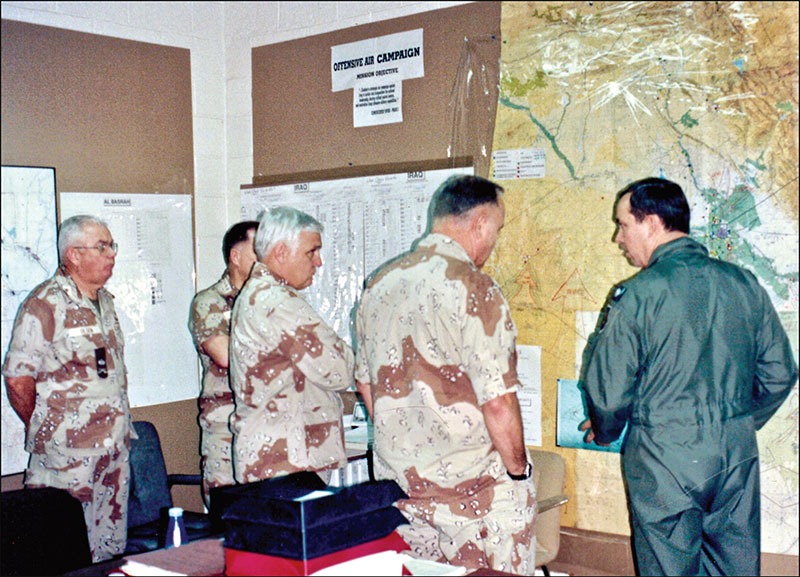
Lt Gen. David A. Deptula briefing Gen. Norman Schwarzkopf
John and I, particularly since I was in the doctrine division, were developing joint doctrine at that time. I was the Air Force action officer working on Joint Pub 3-01, which was joint doctrine for interdiction operations. At the time, the service representatives would meet together and we would discuss our different perspectives and what was most appropriate to include in joint doctrine. I worked with John on developing strategies, theories and ideas about the independent use of airpower. Not independent like just by itself, but thinking about airpower as a key force and not just a supporting force. We developed a lot of different plans and theories. One was called Battlefield Air Operations. This looked at airpower as a manoeuvre arm in the third dimension. You know armies like to draw these big maps with arrows on a two-dimensional map, so we viewed battlefield operations as something coming from the sky. It was a concept beyond close air support and beyond what was called at the time battlefield air interdiction — a concept that incorporated both as an operational level air manoeuvre arm.
Another initiative we came up with was a theory of Composite Training and Air Formations. Beyond that, I did a lot of additional study of what went on during World War II, the desired outcomes, and we began to talk about the importance of creating desired effects, and the importance of that kind of focus. It was an approach that moved beyond the traditional ground-centric view of attrition and annihilation as the only means to accomplish military ends.
With this background let us fast forward to August 1990. John Warden was on vacation on a cruise in the Caribbean. I was visiting my mom and my dad down in southern Florida when Saddam Hussein invaded Kuwait.
We both got back to the Pentagon very quickly. On August 6, we got together, just John and me talking about what could be done. I suggested to him that we should put together some air options. We were on the Air Staff, and in our system of organisation, it was not our responsibility to provide actual planning for contingency operations. That is the responsibility of the combatant commands, in this case the US Central Command. Nevertheless, I said let’s do some brainstorming and explore some planning options.
We met in the location of one of our divisions, Checkmate. We began thinking about the immediate options. In other words, what could we do to halt Saddam Hussein if he doesn’t stop in Kuwait? If he continues roving further into Saudi Arabia. What is the greatest amount of impact or effect we could have to halt his movement and get him to stop? So that was our original planning premise.
The next day, General Schwarzkopf, the commander of US Central Command, called General Dugan, the US Air Force Chief of Staff, who was out of town. General Loh, who was the Air Force Vice Chief of Staff, took the call and spoke with Schwarzkopf who told him that he needed some help. Schwarzkopf needed somebody thinking about a plan for how to use airpower against Saddam. Loh knew Warden and that we were doing some initial planning, but now we were officially authorised to continue planning by the combatant commander.
Subscribe To Force
Fuel Fearless Journalism with Your Yearly Subscription
SUBSCRIBE NOW
We don’t tell you how to do your job…
But we put the environment in which you do your job in perspective, so that when you step out you do so with the complete picture.





 VIDEO
VIDEO