Japan had the world’s attention when the country announced its National Security Strategy. Unsettling some feathers, the strategy is based on an understanding that Japan can be engulfed from threats posed by not only an over-(military)-powering neighbourhood but also from global threats in the form of a deteriorating climate and environment, wildfire-type spread of infectious diseases, and food and energy shortages.
Accordingly, the strategy states that Japan would need to focus not only on building its defence capabilities but also engage its comprehensive national prowess in diplomatic, economic and technological capabilities. While the full potential of Japan’s capabilities cannot be achieved in isolation, the strategy recognises that the country would need to foster partnerships with its allies and other like-minded countries as well as many other countries, international organisations and other relevant partners.
So how is Japan setting itself out to achieve the intentions stated in the country’s newly-minted national security strategy? Japan’s ongoing efforts reflect that the country envisages that the world is made up of two parts.
The first part comprises countries, mainly across the developed world, with whom Japan seeks to enhance and strengthen existing partnerships including newer alliances. For example, Japan and the United States agreed to expand their partnership into areas such as space, cyber and information security. Moreover, both the countries agreed to work in close coordination to enhance defence ties including helping Japan gain counter-strike capabilities. With a traditional deterrence alliance partner in the US, Japan has stepped outside its comfort zone to design a deterrence architecture which would involve other countries so as to facilitate Japan’s quest for self-sufficiency through self-extension. Accordingly, Japan not only has upgraded its relationship with Italy to the status of a “strategic partnership,” but would also launch a bilateral consultant mechanism for foreign and defence policy. Japan has also signed a Reciprocal Access Agreement (RAA) with the UK. It has also signed a RAA with Australia. These arrangements are in addition to the agreement which Japan finalised with Italy and the UK to develop next generation fighter aircraft by 2035. By going all out, Japan is hoping to form tighter alliances with allies and like-minded countries to form and inform an integrated deterrence strategy to disrupt and defend threats.
The second part comprises countries which (1) encircle those countries which Japan identifies as neighbourhood threats, particularly threats emanating from China, Russia and North Korea; and (2) are also countries comprising the Indo-Pacific region. For these countries, Japan seeks partnerships either through military so as to reinforce interoperability and strengthen defence cooperation, or through non-military such as extending financial and non-financial assistance in the form of e.g., overseas development assistance (ODA) and provision of advanced technological machinery for aiding say infrastructural development.
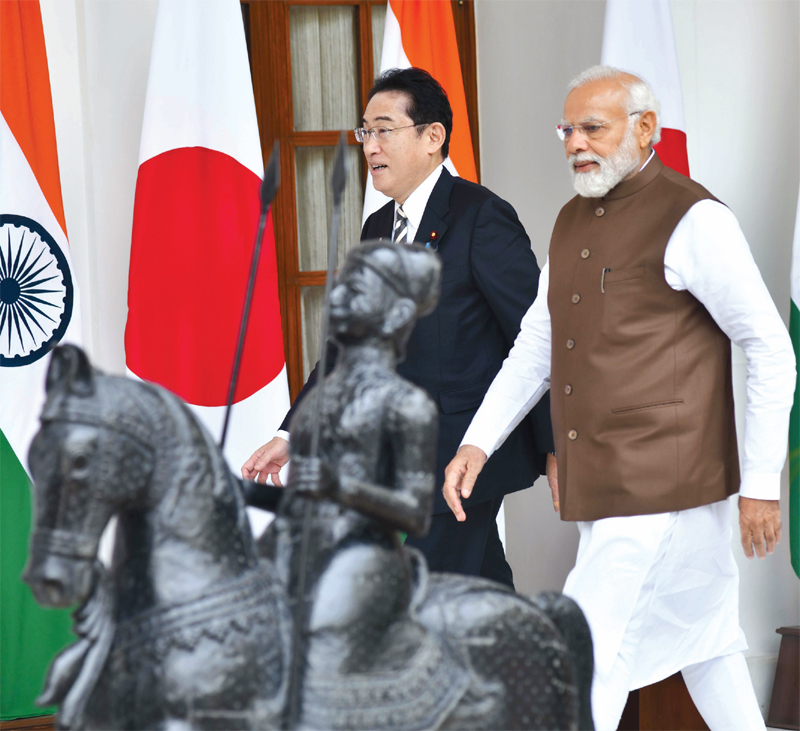
Indian Prime Minister Narendra Modi with Japanese counterpart Fumio Kishida
Tighter Alliances
From signing a military logistics Acquisition and Cross-Servicing Agreement with India to joining India in her multilateral defence cooperation such as the Malabar exercise, to conducting the first India-Japan bilateral air drill exercises, it is evident that under Quad or not, Japan is seeking tighter alliances with India, a country perceived to be a global south geo-political competitor to China.





 VIDEO
VIDEO