Hypersonic missiles travel at a speed of one mile per second or more—at least five times the speed of sound. They are able to evade and conceal their precise targets from air-defence networks until just seconds before impact. This leaves targeted countries with almost no time to respond. Additionally, such weapons are capable of destroying targets without any explosives, using their sheer kinetic energy alone. Hypersonic missiles also require a reconsideration of traditional second-strike calculations, as they have the potential to decapitate a nation’s leadership before it has the opportunity to launch a counterattack.
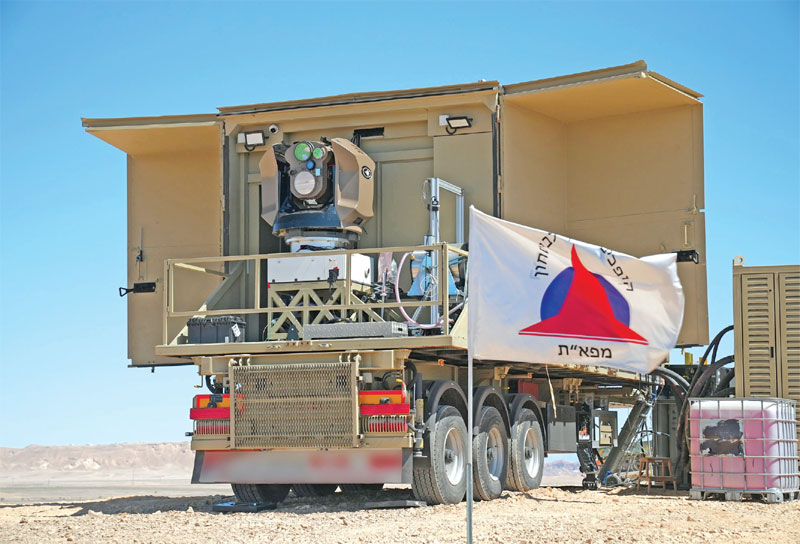
RAFAEL’s Iron Beam DEW
Consequently, a country facing a hypersonic missile threat must make the best of a bad situation, in other words being effectively forced to choose the lesser evil. It could authorise the military rather than the national leadership to conduct retaliatory strikes, but this would raise the risk of an accidental conflict. It could spread out its forces, making them more difficult to attack, but also rendering them more susceptible to sub-national seizure through a greater number of access points. It could deploy its regionally-strategic forces upon receiving the first warning of an attack, which would make crises exceedingly unstable. Finally, it could launch a pre-emptive strike upon its enemy. All of these choices invite trigger-happy state behaviour.
Given that the proliferation of current generations of ballistic missiles poses many of the same problems as the spread of hypersonic missiles, do the latter really present a unique challenge? For countries without ballistic missile defences (BMD), hypersonic missiles add relatively little in the way of a threat. However, an increasing number of countries are procuring missile defence systems, particularly against regionally-ranged threats. These systems could be effectively neutralised by hypersonic missile technologies.
The United States, Russia, and China are leading the race to develop hypersonic missiles, with Japan, France and India close behind. Japan, Australia, and Europe are all developing the component technologies, in some cases for ostensibly civilian purposes. Within six years, hypersonic missiles are likely to be deployed and potentially offered on the international market.
Is there no way to avoid a world with widespread hypersonic forces? Hypersonic technology itself offers hope, as it is extremely difficult to master. Igniting the engine of a hypersonic cruise missile has been compared to lighting a match in a 2,000 mile per hour wind. Moreover, the shape of the missile changes under the rigours of hypersonic flight, creating great challenges for flight control.
Hypersonic defence is a difficult but, ultimately, tractable problem. Relative to the legacy BMD systems, these new threats will require considerable change, to be sure, to include different defence architectures, new sensors in interceptors and doctrinal organisational changes as well as modified policy expectations for the defended assets list, much of which is already underway. The high supersonic, or hypersonic flight regime, beginning around Mach 5 corresponds to a set of aerodynamic and thermal phenomena that a vehicle undergoes in that regime.






 VIDEO
VIDEO