The commissioning of INS Vikrant, India’s first indigenously designed and built aircraft carrier on 2 September 2022, marked a red-letter day for the country. It not only symbolised India’s emerging maritime might and capability, but perhaps more significantly, it showcased the country’s technological and industrial skills. Prime Minister Narendra Modi, in his address on the occasion, rightly highlighted this achievement as a “testament to the hard work, talent, influence and commitment of India in the 21st century.”
Vikrant took 13 years and over Rs 20,000 crore (approximately USD 2.3 bn) to build from the time its keel was laid on 28 February 2009, by defence minister A K Antony and nine years from its launch by Ms Elizabeth Antony on 12 August 2013. The need for the carrier had been recognised in the 1980s itself though its planned size, configuration and nomenclature kept waxing and waning, coincidentally, with the vicissitudes of the Indian economy.
Finally, work on the ship got under way in right earnest in the first decade of the 21st century. Even though the chairman and managing director of Cochin Shipyard candidly acknowledged that “I don’t say 13 years is the best, we can definitely do better. But we must also understand that we were doing it for the first time, so I am not unhappy.” The criticism from various quarters regarding the time taken or the considerable increase in cost over the years is not entirely justified. One must appreciate that an aircraft carrier is an extremely complex system and since this was the first time an indigenous construction was being undertaken in the country, there was far more to it than just building of the ship.
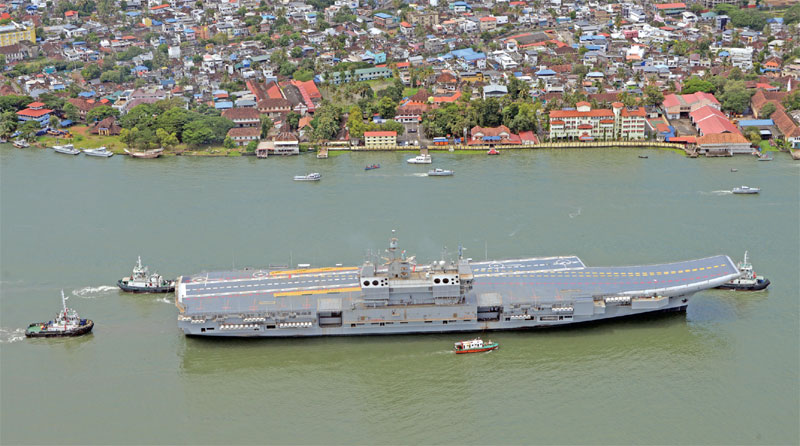
INS Vikrant
Home Grown
Firstly, unlike many other platforms that have been built for the first time in the country, there was little or no foreign involvement either in the actual build process or in the availability of a proven design. Therefore, at the design stage itself, this was the first ever attempt of its kind and must have led to numerous challenges being faced at every stage of the process and during its subsequent validation prior to the commencement of construction.
Secondly, it was not only about building the platform. The emphasis on indigenisation meant that the option to source proven equipment from foreign suppliers was very limited. In this case a full eco-system, including Tier 1,2 and 3 Indian sub suppliers, had to be identified and developed who understood the complexity of an aircraft carrier and had the ability to deliver equipment which met the exacting quality standards demanded by the platform. To put things in perspective, more than 100 Indian OEMs and MSMEs and over 500 contractors and ancillaries, besides the foreign OEMs, were involved in supplying the equipment. Qualifying these suppliers would have been time consuming and ensuring its completion within a limited time would have been equally challenging. Further, testing, acceptance and installation of the equipment on board the platform would also not have been an easy task since this was the first ever attempt. It is understood that there were delays in the delivery of some of the foreign equipment.








 VIDEO
VIDEO