Prasun K. Sengupta
Despite setting a target of exporting military hardware worth Rs 35,000 crore by 2025, India continues to and will continue to face an uphill battle in realising such lofty ambitions.
The value of export by public and private sectors, authorised by the ministry of defence’s (MoD) department of defence production (DDP), increased from Rs 1,940.64 crore in 2014-15 to Rs 8,4,34.84 crore in 2020-21. It hit a record high of Rs 10,745.77 crore in 2020-21, but plummeted thrice during this period in 2016-17, 2019-20 and again in -21. India’s defence exports for 2021-22 were estimated at Rs 13,000 crore, the highest ever, according to Sanjay Jaju, additional secretary (defence production) in the MoD.
The US was a major buyer as also nations in Southeast Asia, West Asia and Africa. “The private sector accounted for 70 per cent of the exports, while public sector firms accounted for the rest,” Jaju said. Earlier, the private sector used to account for 90 per cent but now the share of defence public sector undertakings (DPSU) had gone up, he added. While India’s defence imports from the US have gone up significantly in recent years, Indian companies have been increasingly becoming part of the supply chains of US defence companies like Boeing and Lockheed Martin.
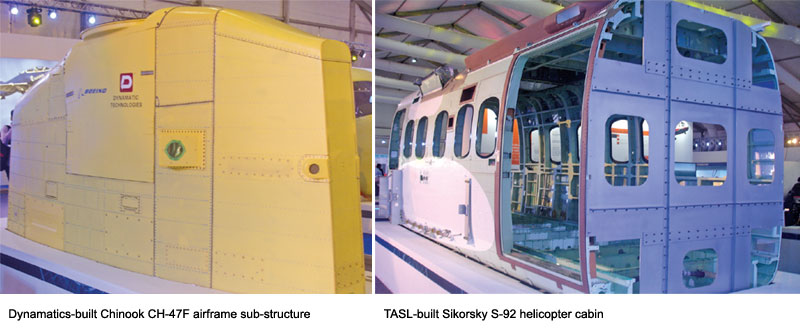
The bulk of the exports, achieved by the private sector over the past 12 years, are in fact the end-products of industrial sub-contracts secured from US-based original equipment manufacturers (OEM). These include the joint venture established in 2009 between the Hyderabad-based Tata Advanced Systems Ltd (TASL) and Sikorsky Aircraft Corp (now a subsidiary of Lockheed Martin) for producing cabins of the S-92 helicopter; the Tata Boeing Aerospace Ltd joint venture since June 2018 that has been producing AH-64 Apache combat helicopter fuselages; the Tata Lockheed Martin Aerostructures Ltd (TLMAL), a joint venture between TASL and Lockheed Martin that was created in 2010 and which currently produces 24 C-130 empennage (horizontal and vertical stabilisers along with leading edges and tip assemblies) assemblies annually along with centre-wing box components for the C-130J Hercules transport aircraft; and Bengaluru-based Dynamatic Technologies Ltd, which manufactures aft pylon assemblies and cargo ramp assemblies for the Boeing CH-47F Chinook helicopter, plus power and mission cabinets for all Boeing-built P-8 LRMR/ ASW aircraft.
Hardware Exports
Major military hardware exports from India in the past had included weapons simulators, tear-gas cannister launchers, torpedoes and their loading/launching mechanisms, alarm monitoring and control systems, monocular night-vision devices and binoculars, sonar suites for warships, wheeled armoured protection vehicles, weapons locating radars, HF radios, and coastal surveillance systems. The bulk of such hardware—sourced mostly from the MoD-owned DPSUs—was exported to Nepal and Bhutan. Myanmar was the beneficiary of 52 per cent of India’s total exports of military hardware, Sri Lanka (24 per cent) and Mauritius (13 per cent). Last January, India signed a USD 374.96 million contract with The Philippines--the single biggest defence export order to date, for the supply of three batteries of shore-based anti-ship variant of the BrahMos-1 supersonic cruise missile.








 VIDEO
VIDEO