

DefExpo 2022 | Effect-Based Purchases
Prasun K. Sengupta
The 12th edition of DefExpo 2022 held in Gandhinagar, Gujarat, revealed several shortcomings in the Indian Ministry of Defence’s (MoD) current L1-centric procurement processes that continue to pit the Buy Indian (India-designed-developed-make, or IDDM) category against the Buy & Make (Indian) category. This has caused severe delays in long-overdue planned procurements of the three services.

CVRDE-Developed 600hp Engine
So much so that in August and October 2021, the then Chief of the Army Staff, General M M Naravane (retd) had called for both a rethink and drastic overhaul of the L1 concept under which contracts are awarded only to the lowest bidder.
Light Tank Saga
On April 22 last year, the army, under Project Zorawar, issued a request for information (RFI) for procuring 350 new-generation light tanks in a phased manner along with a related performance-based logistics package, niche technologies, engineering support package and other maintenance and training requirements. This was to be a Make-1 (Indian) procurement category of the Defence Acquisition Procedure (DAP) 2020. While the RFI mandated that the Indian development agency retain the ownership of the design and technologies (intellectual property rights) for the platform, the army stipulated that the direct import of such tanks will be prohibited from 2025 onwards.
Meanwhile, the Defence Research & Development Organisation (DRDO) has been working with Larsen & Toubro (L&T) on developing a 25 metric tonne light tank under the ‘Make-1’ category in which the industrial OEM receives R&D funding to the tune of 90 per cent from the MoD. This is released in a phased manner based on the progress of the scheme as per the terms agreed between the user and the OEM. In April 2021, the army’s Directorate General of the Armoured Corps finalised its Preliminary Staff Qualitative Requirements (PSQR), which detailed the precise specifications of the tank. Thereafter, the DRDO’s Avadi-based Combat Vehicles R & D Establishment (CVRDE) was tasked with designing the end-product in November 2021, with a deadline of three years. The CVRDE-L&T team has been directed to complete the product development and user-trial phases by November 2024.
Jayant D Patil, who currently serves as adviser to L&T chief executive officer and managing director S N Subrahmanyan, said during the expo that the 25 metric-tonne tank, a completely ab initio design, will feature an unmanned turret containing an ammunition autoloader, will have a three-man crew, and its first prototype will roll out next June. The tank’s diesel engine and transmission will be bought off-the-shelf and are likely to be the MTU Friedrichshafen-built MT881Ka-500 8-cylinder water-cooled diesel engine rated at 1,000hp, and the SNT Dynamics/Allison Transmission X1100-5A3, both of which are already in use by the army’s L&T-delivered K-9 Vajra-T 155mm/52-calibre tracked self-propelled howitzers.
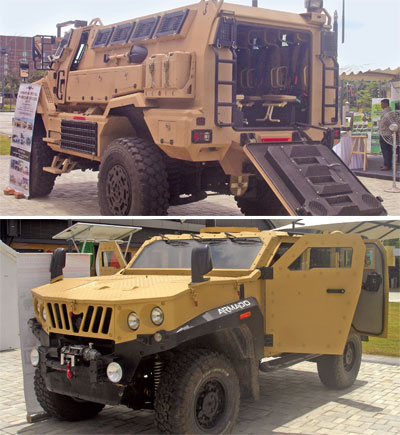
Kalyani 4 x 4 LAMV and Mahindra ALSV
Armoured protection will be modular with bolt-on armour plates providing protection of STANAG-4 level in the tank’s frontal 60-degree arc and STANAG-2 elsewhere. It will have a 105mm new-design rifled-bore cannon and a power-to-weight ratio of 30hp/tonne. At the expo, L&T showcased a scale-model of its light tank concept. But Patil clarified that while L&T is involved in such an R&D effort, it is not assured of any role in the bulk production phase, meaning the Indian process cannot place development and production contracts in on go. “Developed equipment has to undergo field evaluation trials and emerge successful for the induction clearance, and only then the production ordering process begins,” he explained.
Interestingly, the Kalyani Group’s Bharat Forge subsidiary was also showcasing a design of its light tank concept, albeit only through a video presentation. All of this raise a number of questions. If the light tank’s design and development efforts are totally indigenous by the CVRDE-L&T team, then why is it not coming under the Buy Indian (IDDM) category? Is it not bizarre that the MoD has accorded only a four-year timeframe for prototype development when the global norm is a minimum of six years? Is it even realistic to mandate a maximum combat weight of 25 metric-tonnes when OEMs from China the US, UK, Germany, Poland and South Korea that have already developed light tanks feature designs whose weights range from 30 to 38 metric-tonnes with power-to-weight ratios ranging from 25 to 33hp/tonne?
It is perhaps because of such unrealistic R&D expectations and timeframes, plus impossible to achieve performance parameters that encouraged Russia’s Rosoboronexport to state that it continues to offer its Sprut-SDM1 light amphibious tank to the army, while Israel’s Elbit Systems at the expo was promoting its Sabrah light tank solution based on the tracked ASCOD platform that is manufactured by Spain-based General Dynamics European Land Systems Santa Bárbara (GDELS). The 30 metric-tonne Sabrah comes equipped with a 105mm cannon and subsystems that include a proven optronic day/night sight, digital fire-control system, TORCH-XTM battle management system, E-LynXTM software defined-radio systems and life-support systems.
There was also no clarity from either the Indian or foreign OEMs exhibiting at the expo about the future course of action regarding the army’s futuristic requirement for a new-generation main battle tank (MBT), that is a Future Ready Combat Vehicles (FRCV), approximately 1,770 of which are planned for procurement in a phased manner, with envisaged service-induction by 2030. The FRCV family will comprise the futuristic MBT or FMBT and its supporting armoured bridge-layers and engineering and recovery vehicles.
Subscribe To Force
Fuel Fearless Journalism with Your Yearly Subscription
SUBSCRIBE NOW
We don’t tell you how to do your job…
But we put the environment in which you do your job in perspective, so that when you step out you do so with the complete picture.






 VIDEO
VIDEO