

Defence Minister Lays the Foundation Stone of Large Cavitation Tunnel at NSTL, Visakhapatnam
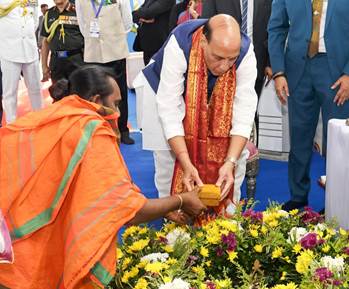
Defence minister Rajnath Singh, on 3 April 2026, laid
the foundation stone of the state-of-the-art Large Cavitation Tunnel (LCT)
facility at the Naval Science & Technological Laboratory (NSTL), a premium
laboratory of Defence Research and Development Organisation (DRDO) in
Visakhapatnam, Andhra Pradesh. The facility will significantly enhance India’s
naval research and testing capabilities, marking a major step towards achieving
technological self-reliance.
Addressing
scientists, researchers, and personnel at NSTL, the minister asserted that
India, with this initiative, will be able to design, develop and test its
equipment, systems and sub-systems
indigenously, utilising its own resources, and positioning itself as a
strong naval power and a leader in defence technology. “Until now, even after
successfully developing equipment, systems, and sub-systems, we often had to
look abroad for critical testing. This situation will now change. This facility
is not merely an infrastructure project, but an enabling system, which will
strengthen our capabilities in advancing propulsion systems, enable focused
efforts on noise reduction and further strengthen stealth capabilities. It will
serve as a foundational backbone for the design and development of submarines and
ships, supporting future advancements in naval engineering and maritime defence
systems,” he said.
Singh described the project as a
symbol of the success of Prime Minister Narendra Modi’s resolve of Aatmanirbhar
Bharat. He stated that the government’s determination to make India
self-reliant is intrinsically linked to the national security apparatus, and
despite challenges, the country has achieved complete Aatmanirbharta in various
sectors due to the concerted efforts of the domestic industry, academia, MSMEs,
youth, and researchers.
During the visit, the minister
was briefed about the NSTL projects/programmes by the secretary, department of defence
R&D and Chairman DRDO Dr Samir V Kamat.
Singh also visited the Seakeeping
and Manoeuvring Basin, where he witnessed an impressive display of advanced
underwater systems, including torpedoes, naval mines, decoys, and autonomous
underwater vehicles (AUVs).
A live demonstration of a swarm
of man-portable AUVs showcased India’s growing prowess in autonomous maritime
operations and next-generation underwater warfare technologies, underlining the
nation’s focus on future-ready defence systems. The minister also inspected
some of the vital products realised as spin-off technologies by the Naval
Systems Materials cluster labs post Operation Sindoor.
Singh commended NSTL for conducting research
and setting benchmarks in several areas, including torpedo systems, underwater
mines, decoys, and AUVs, thereby propelling India toward becoming a formidable
naval power. He also acknowledged the demonstration of swarm technology and
ongoing work in lithium-ion battery development, calling them crucial for
future warfare preparedness.
The minister urged NSTL to
continue working with dedication towards nation-building by bolstering the
security infrastructure of the country. “The systems and technologies boost the
confidence and morale of sailors deployed at sea. Reliable and robust
technological support significantly enhances the operational effectiveness of
the defence forces,” he said.
Chief of Defence Staff General
Anil Chauhan, Chief of the Naval Staff Admiral Dinesh K Tripathi, Flag
Officer Commanding-in-Chief, Eastern Naval Command Vice Admiral Sanjay
Bhalla and other senior officials were present on the occasion.




 VIDEO
VIDEO