

Defence Minister Calls for ‘Aatmanirbharta 2.0’ at Swavlamban 2026
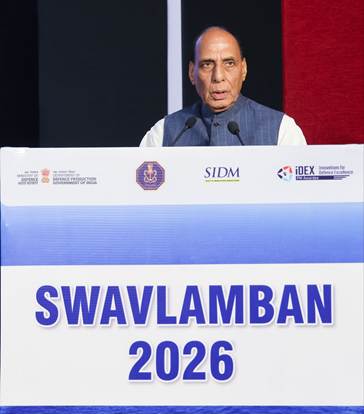
Defence minister Rajnath Singh called for ‘Aatmanirbharta 2.0’ in the defence sector, with emphasis on the development of top-end, state-of-the-art technologies, strengthening research & development (R&D), and building resilient supply chains to reduce import dependence and achieve technological superiority, thereby contributing to the vision of Viksit Bharat@2047.
He was addressing the fifth edition of Indian Navy’s Naval Innovation and Indigenisation Seminar, Swavlamban, in New Delhi on October 26. He emphasised the need to build on the gains of the first phase of self-reliance, stating that defence innovators with futuristic vision and scientific discipline could play the role of ‘impact players’ in pursuing more challenging technological goals.
Singh asserted that the progress achieved so far has created a strong foundation for the next phase, which must focus on advanced technologies and objectives that are considered difficult to achieve. He underlined the need to indigenously manufacture products that are cost-effective, operationally superior and globally competitive.
Singh described supply chain management as not just a technical issue but a strategic imperative directly linked to national security. He called for a dynamic roadmap that sets clear timelines for achieving self-reliance in each item, identifies the technologies to be developed and the industries that will drive their innovation, and outlines the resources required to achieve these objectives. “Supply chain dependencies arise from a limited domestic availability of certain raw materials, such as rare earth elements, and the absence of specific technologies within the country. While some external dependencies may persist until viable alternatives are developed or domestic resources become available, there is a need to prioritise critical areas for indigenisation,” he said.
He underscored the need to remain prepared against potential disruptions in supply routes, stressing that the assessment of buffer stocks and domestic production capabilities must be carried out in advance rather than waiting for a crisis. He identified R&D as central to addressing these challenges. Speaking about the inherent risks associated with research, he called for a change in attitude towards failure.
“While this risk aversion is, in one sense, natural, it also presents an opportunity. Can we develop funding mechanisms capable of supporting high-risk, high-reward projects? Can we attract more private sector participation in R&D, given its greater propensity for risk-taking? We must seriously consider how to advance in two key areas: engaging the private sector and fostering low-cost technologies. The private sector possesses a greater capacity for taking risks, while low-cost technologies allow us to achieve significant results through smaller-scale experiments,” he said.
Highlighting the contribution of iDEX in enabling start-ups and MSMEs to develop technologies that India previously imported, Singh stated that over 4,000 proposals had been submitted against 229 challenges issued by the Indian Navy, reflecting the depth of Indian talent and the enthusiasm of entrepreneurs.
Thereafter, saying that the demand for naval ships is steadily increasing in view of the evolving situation in the Indian Ocean Region, and since their construction is capital-intensive, Singh said that there is a need to explore ways to reduce costs while expanding domestic production. According to him, the next phase of Aatmanirbharta must focus not only on the quantity of indigenous products but also on their quality, efficiency and affordability. He emphasised that self-reliance must strengthen national security as well as economic resilience.




 VIDEO