

Compass | Talk East, Look West
India, Bangladesh, and the bull in the China shop
 Sudeep Chakravarti
Where does Bangladesh’s latest dalliance with China leave India in this regional ménage in which China is the persistent other?
Bangladesh did it artfully. For his first stop on his first overseas visit as prime minister, Tarique Rahman visited Malaysia on June 21-22. That deflected a dilemma common among smaller South Asian countries: Which country should a newly elected head of government or state visit first—India or China?
Rahman’s second stop? China.
He returned to Dhaka on June 26 with a bouquet of 13 MoUs with China. These range from cooperation on Chinese investment and trade, to education—including the introduction of Mandarin in Bangladesh’s school system—healthcare, boosting livelihood opportunities, and collaboration among think-tanks and media.
There was renewed buzz about Bangladesh acquiring up to 24 J-10CE fighters, the same 4-4.5 generation aircraft already in Pakistan’s inventory. A 110-acre swath of land near Mongla port in the Sunderbans delta earmarked for a special economic zone was formally signed over to China; it was allocated to India in 2015 but lack of progress for over nine years made it easier for the interim government of Muhammad Yunus to repurpose it. Moreover, China again made a strong pitch for aiding and implementing the Teesta basin redevelopment plan in northwestern Bangladesh—which could place a major project with Chinese involvement near the slim Siliguri Corridor that connects mainland India to northeastern India. China is already—and disturbingly—close in that part: In the saddle between Sikkim and Bhutan.
China also floated a trial balloon of a proposal to open a China-Bangladesh transport corridor via Myanmar. That project would need to pass through Rakhine State—currently contested by Myanmar’s junta and the rebel Arakan Army. But if one were to place near-future bets on India’s influence in the region versus China’s, the latter would for now be the surer option.
In contrast, India’s recent response to Bangladesh led with free-flowing anti-Bangladeshi rhetoric during general elections to the state assemblies of Assam and West Bengal over this past March and April. In addition, there are several recorded instances and attempts to ‘push in’ identified and suspected illegal Bangladeshi immigrants across certain sectors of the 4,096 km border the two countries share. This includes an admission by a chief minister of an eastern Indian state of the modus operandi of such moves—an unilateral and shambolic action that goes against established bilateral protocols. Then there is the aspect of regular killings of Bangladeshis at the border.
Another response: the formal resumption on June 28 of the issuing of tourist visas to Bangladeshis, ‘normalisation’ of a facility withdrawn by India in the wake of Sheikh Hasina’s ouster on 5 August 2024. India’s new high commissioner to Bangladesh, Dinesh Trivedi made the announcement on June 25, even as Rahman was being fêted in China. Bangladesh had resumed the issuance of tourist visas for Indians in February 2026.
While it is tempting to approach all of this with the usual move-and-countermove rubric, it might be productive to add the lenses of realism, attitude and, of course, optics.
There are some myths floating about in the Indian misinformation and disinformation space. One is about how, since the ouster of Sheikh Hasina in August 2024, Bangladesh has tilted firmly towards China. Some in media spoke of the ‘strategic shift’ signalled by Rahman’s China visit.
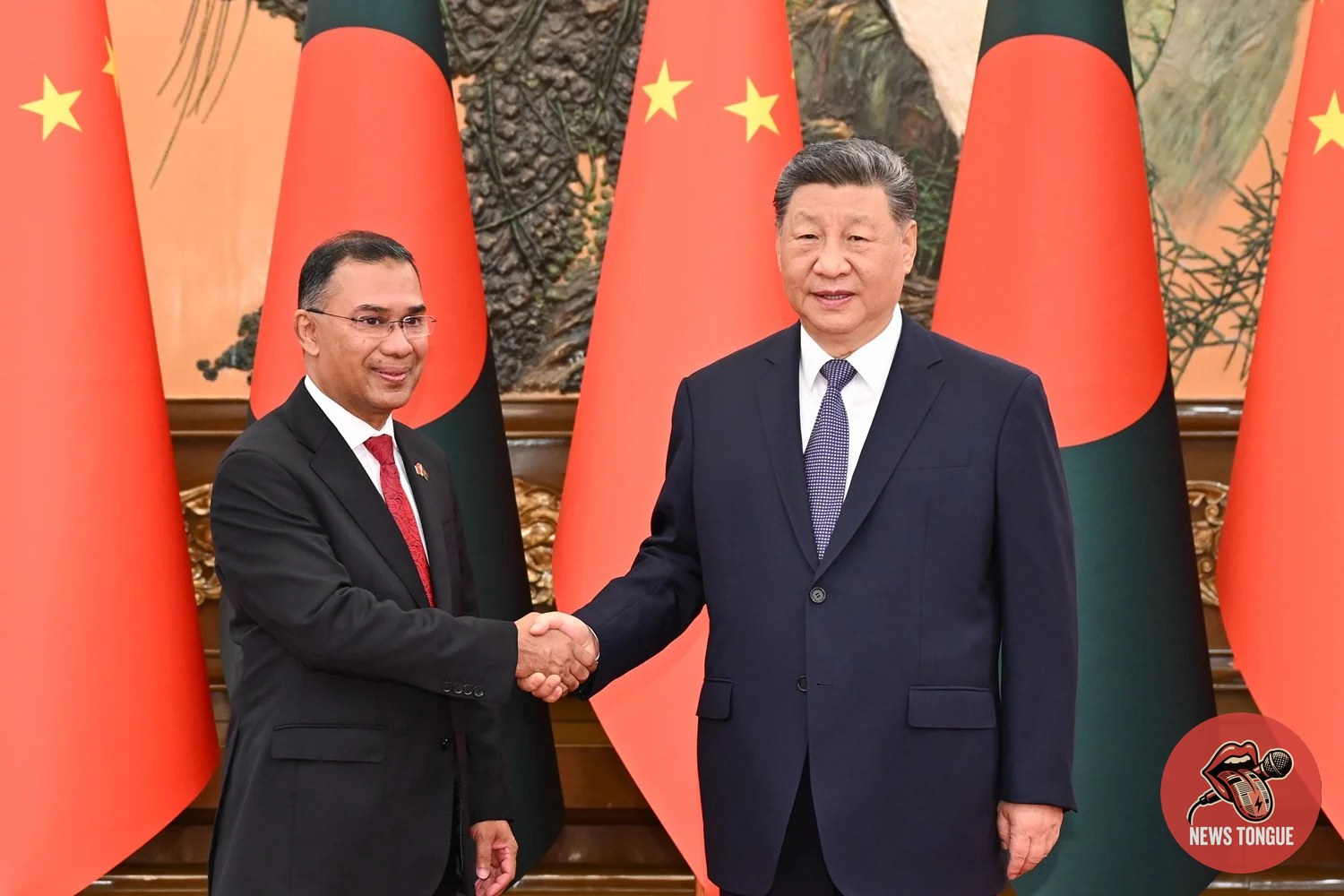
LOOKING EAST Prime Minister of Bangladesh Tarique Rahman spent four days in China in the last week of June,
his second foreign visit after Malaysia. In this picture, he is with Chinese president Xi Jinping
The correct assessment would be two-fold. One: With Sheikh Hasina removed as India’s regional foreign policy and strategy prophylactic, China’s longtime and significant presence in Bangladesh is in sharper relief.
And two: More than a strategic shift away from India, it is a transparent counterbalance and a message—we go where we can for maximum gains. For Bangladesh, that lies as much in cosying up to China as with cosying up to, say, the World Bank and International Monetary Fund for new and rescheduled loans, to negotiating with the European Union for continued duty concessions beyond Bangladesh’s LDC (Least Developed Country) graduation deadline of 2026, to convincing Japan for more project funding, and to negotiating with Malaysia to permit more Bangladeshi workers entry.
China has remained an integral part of Bangladesh’s political and economic equations for several years. In fact, this relationship was amped up during Sheikh Hasina’s continuous tenure as prime minister—on account of both kosher and riotously controversial electoral wins—from 6 January 2009 to 5 August 2024.
Bangladesh signed up for the Belt and Road Initiative (BRI) in 2016. It did so during the high-optics state visit to Bangladesh of China’s President Xi Jinping. During that visit, the two countries upgraded their relationship to a ‘strategic partnership.’ Bangladesh acquired several upgraded Chinese Chengdu J-7 fighter variants in 2013. Chinese investment in Bangladesh greatly increased during Hasina’s time; as did China-held debt. China’s bilateral trade with Bangladesh clocks in at an average of USD24 billion a year, double the average of India’s bilateral trade with Bangladesh—and with a trade surplus far greater than India’s. This trend continues.
Bangladesh’s large submarine-and-warship base in Pekua, north of the coastal resort town of Cox’s Bazar, and just north of the work-in-progress port and energy hub at Matarbari, was constructed with Chinese funds and expertise. It is now referred to as BNS Pekua, changed from BNS Sheikh Hasina—its name when the base was inaugurated by the now-deposed premier of Bangladesh in early 2023.
In December 2023, during a gathering to discuss China-Bangladesh ties at the Sheraton in Dhaka’s Banani business district, I heard China’s ambassador Yao Wen gleefully announce his country’s support for the Teesta project. It is a billion-dollar-plus endeavour to reshape the hydrological, agricultural, and livelihood aspects in Bangladesh’s Teesta basin, which that country accuses India of negatively skewing by its patchy sharing—and over-sharing during floods—of the Teesta’s waters. The river runs from Sikkim and into northern West Bengal before it decants into Bangladesh; it is one of 54 rivers from India that flow into Bangladesh.
Within months, India’s foreign secretary at the time, Vinay Kwatra, made a damage-control run to Dhaka. Among other things, he offered Indian expertise to fix the basin. He side-stepped the root issue of equitable sharing of the Teesta’s waters.
It is not the first time a senior diplomat has had to finesse matters. As foreign secretary, Harsh Vardhan Shringla visited Dhaka in August 2020 to convey a ‘personal message’ from Prime Minister Narendra Modi to Sheikh Hasina. Among other things, it was also to smoothen ties after a series of denigratory, communally charged, and ethnically incendiary remarks made by several top officials of the Bharatiya Janata Party against Bangladeshis. (As it would turn out, injury would follow insult, as India would soon renege on promised supplies of Covid vaccines to Bangladesh. China stepped in with its Sinopharm vaccine.)
Ambassador Wen is still pushing China’s case in Bangladesh. His successor will almost certainly be in the same so-called ‘wolf-warrior’ mould that China’s Xi-led diplomacy uses to combat competition across the world. High Commissioner Trivedi, a former Trinamool Congress loyalist who joined BJP in 2021, now has the task of first calming bilateral friction.
The point is that China has diligently applied itself across the political spectrum of Bangladesh without tying itself down to any one power structure. This equal opportunity expediency matched with a long-term, over-arching goal has escaped India’s diplomatic outreach in Bangladesh. The overwhelming impression remains of India standing by Hasina as she and her political and security apparatus ran riot for years; and then killed students, children, and protesters—and passersby and bystanders—during the protests over July-August 2024. India is seen as having supported her win in hollow elections and propping up what was in effect an elected monarchy.
High Commissioner Trivedi will have his work cut out. Besides enhancing the overall bilateral agenda, he will have to deal with the effects of Bangladesh-focused dog-whistling in Assam and West Bengal. Equally, the fallout from occasional statements by India-based Sheikh Hasina, who uses India’s pro-establishment media to voice her outrage in exile. And deal with the fallout of killings and push-ins at the border.
He will also need to deal with China’s influence in an atmosphere when Bangladeshi media, academia, and vast numbers of its public almost never critique China. That indicates China’s smooth operations and smoother optics.
And to think that China used its first United Nations Security Council veto in 1972 to block the entry of Bangladesh to the UN. This was in keeping with China’s steadfast support for Pakistan that was steadily ramped up through the 1960s and persisted throughout the turmoil in East Pakistan, and the genocide that began in March 1971, and only ended on 16 December that year with Pakistan’s capitulation to India in Dhaka. India helped to birth Bangladesh. China did everything to prevent it.
For those in India who are still reluctant to question India’s collective missteps, consider that today, China is among Bangladesh’s prime allies. China’s foreign ministry spokesperson Mao Ning posted on the X platform on June 26: ‘China supports Bangladesh in upholding national independence, sovereignty and territorial integrity and rejecting foreign interference.’
India remains suspect. Besides, it harbours a former leader of Bangladesh widely reviled in that country; several of its key leaders routinely belittle Bangladesh, insult Bangladeshis, and use such rhetoric as a key electoral plank.
Chew on that. Consider just how much India’s game has slipped with its key eastern neighbour for this to have happened. Consider the work required for India to reclaim goodwill in Bangladesh—besides securing its interests across South Asia.
Why blame Beijing for doing what New Delhi needs to do?
(Sudeep Chakravarti works in the policy-and-practice space in South Asia and the Indian Ocean Region. His column, ‘Compass,’ focuses on South Asian affairs and overlooked South Asian flashpoints)






 VIDEO
VIDEO