

Common Interest
India-Australia defence ties will play a major role in the growth of the Quad
 RAdm. Sanjay Roye (retd)
The Quadrilateral Security Dialogue, or Quad for short,—comprising India, Australia, Japan and the United States (US)—has travelled a considerable distance from its hesitant beginnings. Once viewed as a loosely aligned diplomatic experiment, it has become one of the principal mechanisms shaping the strategic environment of the Indo-Pacific. Yet the Quad remains deliberately different: it has no mutual-defence clause, no integrated command structure and no standing force. In this ambiguity lies its essence; and is both its limitation and its strength.
The Quad’s political durability derives from the fact that its four members do not share identical threat perceptions, alliance obligations or strategic cultures. India remains committed to strategic autonomy and does not wish to become part of an explicitly anti-China military bloc. Australia is a treaty ally of the United States (US) and is increasingly concerned about the military balance in the western Pacific. Japan faces direct pressure in its maritime approaches, while the US views the Quad as part of a broader effort to preserve strategic balance and deter coercion.
The next phase in my consistent opinion is to make the Quad more operationally useful without transforming it into an alliance that its members cannot politically or strategically sustain.
The May 2026 Quad Foreign Ministers’ Meeting in New Delhi offered a clear indication of this direction. The grouping reaffirmed four broad pillars: maritime and transnational security, economic prosperity and security, critical and emerging technologies, and humanitarian assistance and emergency response. It also announced the Indo-Pacific Maritime Surveillance Collaboration, an effort to coordinate surveillance and enhance information sharing initially in the Indian Ocean Region (IOR). The stated objective is to develop a common operating picture across the Indo-Pacific by building on existing maritime domain awareness (MDA) arrangements.
For India and Australia, this evolution is particularly significant. Their bilateral relationship is becoming the principal Indian Ocean axis within the Quad. The two countries are moving from periodic naval exercises and strategic dialogue towards a more structured defence partnership encompassing maritime surveillance, logistics, undersea-domain awareness, defence industry, professional military education and operational coordination.
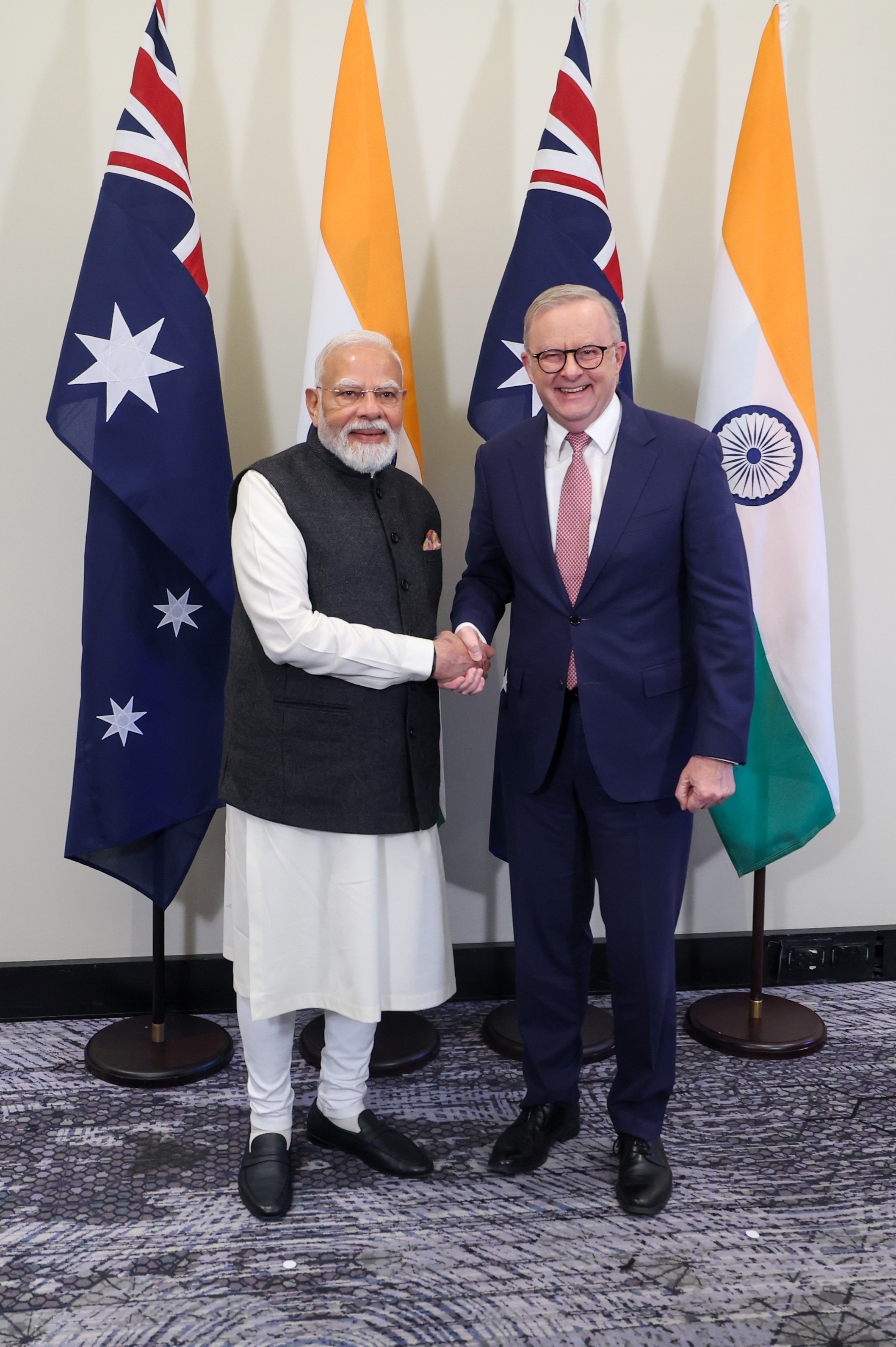
Prime Minister Narendra Modi with his Australian counterpart Anthony Albanese on 9 July 2026
on the sidelines of India-Australian CEOs Forum at Melbourne
Therefore, the trajectory of the Quad will be closely tied to the quality of the India–Australia relationship. Conversely, the bilateral relationship will derive much of its strategic value from how effectively it contributes to the Quad’s wider objectives.
Once a Tool for Political Signalling
The Quad’s early value was political. It demonstrated that four major democracies, each with significant maritime interests, could consult on regional security and express opposition to coercive attempts to alter the status quo. That signalling remains important, particularly at a time when maritime disputes, grey-zone activities, economic coercion and military pressure are increasingly normalised instruments of statecraft.
Political signalling alone cannot sustain strategic relevance. A grouping that is unable to improve the ability of its members and regional partners to monitor, understand and respond to events at sea will gradually lose credibility.
The Indo-Pacific is a maritime theatre in the most literal sense. The region contains the world’s most important shipping routes, energy corridors, undersea cables, port infrastructure and contested littorals. The security of the Indian Ocean cannot be separated from the wider Indo-Pacific because disruptions in one maritime region can rapidly affect supply chains, energy flows and military mobility elsewhere.
The Quad’s maritime agenda is consequently shifting from declaratory diplomacy towards practical cooperation. The IOR programme of the Indo-Pacific Partnership for Maritime Domain Awareness is being operationalised through India’s Information Fusion Centre–Indian Ocean Region (IFC-IOR) in Gurugram. The next step is to connect this effort with Australian, Japanese and American surveillance and information systems, while also engaging regional maritime agencies.
This does not mean creating a single, centralised command-and-control structure. Such an approach would be politically premature and operationally difficult. Instead, the Quad should develop a federated maritime information architecture—one in which national systems remain under national control but can exchange relevant information through agreed procedures, secure communications and common data standards.
India and Australia are well placed to lead this effort in the Indian Ocean.
India possesses geography, a growing network of coastal and island-based surveillance systems, a substantial navy and long experience in maritime information fusion. The IFC-IOR has already developed relationships with a number of maritime agencies and partner countries. Australia contributes high-end maritime surveillance, advanced data processing, long-range patrol aviation, satellite access, technical expertise and a strategic position linking the Indian and Pacific Oceans.
A useful maritime common operating picture must enable participating states to distinguish between legitimate commercial activity, illegal fishing, maritime trafficking, coercive coast guard manoeuvres, naval deployments, suspicious research vessels and activity directed against undersea infrastructure. It must also support rapid communication between operational headquarters and civilian maritime agencies.
This is where the bilateral relationship can become a practical foundation for the Quad. The India-Australia Defence Ministers’ Dialogue in June 2026 agreed to advance MDA through maritime patrol aircraft, explore enhanced undersea-domain awareness, increase operational-headquarters information sharing and work towards a common operating picture across the Indo-Pacific.
The challenge will be to move beyond the language of cooperation and determine the level of information that can actually be shared during a crisis. Peacetime information exchanges are relatively easy. The more difficult question concerns the classification, timeliness and reliability of data when a confrontation is unfolding.
A Maritime Partnership
India and Australia are natural maritime partners, although they have not always behaved as such. Their strategic geographies are complementary. India dominates the northern and central Indian Ocean, while Australia occupies the eastern Indian Ocean and the approaches to the Pacific. Both countries depend heavily on maritime trade, both are concerned about the vulnerability of sea lines of communication, and both have an interest in ensuring that smaller Indo-Pacific states are not forced into exclusive strategic dependencies.
The bilateral relationship has matured significantly since the elevation of ties to a Comprehensive Strategic Partnership. Defence engagement has expanded in scale and complexity, including reciprocal participation in major exercises and the development of enabling arrangements for logistics and military access.
The 2020 Mutual Logistics Support Arrangement created a foundation for greater operational familiarity. Its significance lies less in any expectation of permanent basing than in the ability to access each other’s facilities for replenishment, repair, training and exercises. Such arrangements become especially valuable in a geographically dispersed theatre where distance, sustainment and endurance can determine the effectiveness of military power.
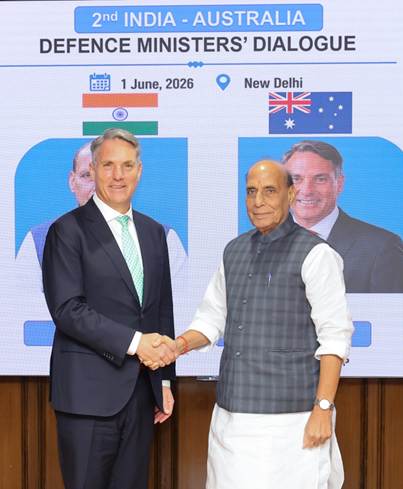
MUTUAL BENEFITS Defence minister Rajnath Singh and Australian deputy prime minister & minister for defence,
Richard Marles in New Delhi in June 2026 at bilateral Defence Ministers’ Dialogue
The relationship has also broadened beyond the navy. India has participated in Australia’s Talisman Sabre, and the two countries have increased engagement between their armies and air forces. In 2026, both sides identified further cooperation through Exercise Milan, Exercise Kakadu, Exercise Pitch Black, Exercise Austrahind, Operation Render Safe and the submarine rescue exercise Black Carillon. The bilateral Defence Ministers’ Dialogue also noted plans for the first Joint Staff Talks and enhanced participation by India in Talisman Sabre 2027.
This expansion is strategically useful, but the navy remains the principal instrument of bilateral convergence.
The Indian Navy and Royal Australian Navy already operate together with the US and Japan in Exercise Malabar. Australia’s participation in Malabar has helped create a framework for high-end naval interoperability involving anti-submarine warfare, air defence, surface warfare, maritime surveillance and complex manoeuvring. Yet exercises should not be confused with operational integration. Interoperability is developed through repetition, standardisation and institutional familiarity—not through a single annual event.
India and Australia should therefore build a layered exercise architecture.
At the highest level, Malabar should continue to test advanced maritime warfare and tactical interoperability. At the middle level, bilateral exercises should focus on operational headquarters, maritime patrol aviation, logistics, submarine rescue and the integration of naval forces with coast guard and civilian maritime agencies. At the lower level, smaller and more frequent activities should address boarding procedures, search and rescue, communications, disaster response, hydrography and maritime law enforcement.
This would provide strategic depth. A naval force does not become interoperable merely because its ships can communicate. It becomes interoperable when commanders understand each other’s procedures, when aircraft and ships can exchange reliable information, when logistics systems can support one another and when political authorities understand the implications of operational commitments.
The Australia-India Maritime Security Collaboration Roadmap should become the organising framework for this effort. The two prime ministers agreed in July 2026 to advance cooperation in information sharing, capability development, capacity building and operational coordination. They also welcomed a memorandum of understanding (MoU) between Australia’s Maritime Border Command (MBC) and the Indian Coast Guard (ICG).
This is important because maritime security is not exclusively a naval problem. Illegal fishing, maritime trafficking, environmental incidents, search and rescue, port security and grey-zone coercion often fall between traditional military and civilian responsibilities. A partnership that links navies, coast guards, maritime border agencies, port authorities and fusion centres will be more resilient than one based only on warship diplomacy.
The Undersea Domain
The most consequential area for future cooperation may be the undersea domain.
The Indo-Pacific’s undersea environment is becoming more contested and more strategically important. Submarines, seabed infrastructure, undersea cables, unmanned underwater systems and sensors will play an increasing role in surveillance, deterrence and military operations. At the same time, much of the region lacks the capacity to monitor activity below the surface.
India and Australia have different undersea capabilities and requirements, but this is precisely why cooperation is valuable.
Australia’s acquisition of nuclear-powered submarines through AUKUS will eventually provide it with substantially greater endurance, range and stealth. However, the benefits of such a capability will depend on the availability of trained personnel, maintenance infrastructure, industrial capacity, logistics and operational concepts. India, meanwhile, has longstanding experience in submarine operations, a growing interest in undersea surveillance and an expanding domestic defence-industrial ecosystem, although it faces its own challenges in fleet size, modernisation and indigenous production.
The two countries should avoid treating undersea cooperation solely as a question of submarine operations. The more immediate opportunities lie in maritime surveillance, seabed awareness, submarine rescue, anti-submarine warfare training, acoustic research, unmanned systems and the protection of critical undersea infrastructure.
The June 2026 Defence Ministers’ Dialogue specifically identified enhanced undersea-domain awareness as an area for exploration. It also noted Australia’s invitation for India to participate in Black Carillon, a submarine rescue exercise. Such cooperation is operationally modest but strategically significant. Submarine rescue requires common procedures, specialist training, compatible equipment and trust between crews. It also creates channels of communication that can later support broader undersea cooperation.
Undersea cables deserve similar attention. The Quad has recognised that cable systems are the backbone of the digital economy and has committed to improving their resilience through information sharing and infrastructure partnerships. India and Australia should develop a bilateral mechanism for mapping, monitoring and protecting cables and other seabed infrastructure across the eastern Indian Ocean.
This need not be framed as a military arrangement. It could begin with coordinated risk assessments involving naval, coast guard, telecommunications and energy authorities. Over time, it could include shared technical standards, repair protocols, commercial-industry liaison and procedures for investigating suspicious activity.
The central principle should be that the undersea domain is not invisible merely because it is difficult to observe. In strategic terms, ambiguity below the surface creates vulnerability. A state that cannot identify interference with its maritime infrastructure will struggle to deter it.
Defence Industry and Technology
The future of India-Australia defence ties will also depend on whether the relationship produces industrial outcomes. Political commitments and exercises can generate momentum, but durable strategic partnerships require a material base.
India’s defence-industrial priorities are shaped by the goals of self-reliance, technology absorption, domestic manufacturing and the reduction of external dependence. Australia is seeking to strengthen its sovereign industrial capacity while integrating more closely with allied supply chains. These objectives are complementary, but not automatically compatible.
The two countries have begun to establish the necessary institutional architecture. Australia conducted its first defence trade mission to India in 2025, and both sides have held defence industry roundtables and strategic discussions on research and materiel. In June 2026, the defence ministers agreed to begin developing a memorandum of understanding on the provision of defence articles and defence services.
The July 2026 annual summit went further, highlighting the significance of defence industry, research and materiel cooperation, and the possibility of a bilateral innovation framework linking government, industry, academia and research institutions.
The immediate temptation will be to seek a list of major platforms for joint production. That approach may be premature. The more productive starting point may lie in components, sensors, autonomy, electronic warfare, maritime communications, cyber resilience, propulsion support, maintenance and repair.
India has scale, engineering talent, cost advantages and a large domestic requirement. Australia has specialised research capabilities, advanced niche technologies, strong universities and access to allied innovation networks. Joint work in maritime sensors, unmanned systems, artificial intelligence and undersea technologies could produce useful results without requiring the two countries to agree immediately on a large, politically sensitive platform programme.
A successful defence-industrial relationship will require attention to five practical issues.
First, export-control and technology-release procedures must be made more predictable. Second, intellectual property arrangements must provide confidence to private companies and research institutions. Third, procurement agencies must identify projects with realistic timelines and clearly defined users. Fourth, small and medium enterprises must be integrated into the relationship, rather than leaving cooperation to large established firms. Finally, both sides must accept that not every initiative will lead to a commercially viable product.
Defence cooperation should not be measured only by the value of contracts signed. It should also be assessed by whether the partnership creates a more resilient supply chain, improves maintenance capacity, reduces single-source dependence and strengthens the ability of both countries to sustain operations during a crisis.
This is particularly relevant in the maritime domain. A warship’s combat value depends not only on its weapons and sensors but also on spares, software updates, dockyard access, ammunition, fuel and trained technicians. If India and Australia want genuine operational resilience, they must build cooperation around sustainment as much as acquisition.
The July 2026 Summit
Prime Minister Narendra Modi’s visit to Australia in July 2026 for the third India-Australia Annual Summit marked a watershed in the bilateral relationship. The two leaders issued a Joint Declaration on Defence and Security Cooperation, which elevated the partnership to a new level of ambition and practicality.
The declaration identified defence industry, research and materiel cooperation as a central pillar of the relationship. It committed both countries to:
• Establish a Defence Innovation Corridor linking government, industry, academia and research institutions.
• Develop a memorandum of understanding on the provision of defence articles and defence services.
• Strengthen maritime cooperation through a Maritime Security Collaboration Roadmap.
• Create a critical minerals corridor to secure supply chains for advanced manufacturing and defence applications.
• Enhance cooperation in cyber, critical technologies and supply chains through the Australia–India Partnership on Cyber, Critical Technologies and Supply Chains (AI-PACCTS).
The Defence Innovation Corridor is particularly significant. It provides a mechanism for connecting Indian and Australian defence start-ups, established firms, research institutions and innovation ecosystems. The corridor should focus on maritime sensors, unmanned systems, artificial intelligence, electronic warfare, cyber resilience and undersea technologies.
The critical minerals corridor is equally important. It connects Australian resource projects with Indian processing, manufacturing and end-user demand. The two countries committed to long-term mineral supply and offtake arrangements, joint investment, processing and value addition, and research and technology development.
For defence purposes, the priority should be to establish secure supply chains for strategically important materials such as lithium, cobalt, rare earth elements, nickel, graphite, titanium and vanadium. These materials support permanent magnets, batteries, aerospace alloys, radar and electronic-warfare equipment, space systems, sensors and advanced computing.
The AI-PACCTS arrangement expands the relationship beyond physical supply chains. It covers critical and emerging technologies, cybersecurity, digital resilience, supply-chain diversification, defence-related research and technology cooperation between governments, universities and industry.
The July 2026 summit also finalised an administrative arrangement enabling long-term Australian uranium exports to India for exclusively peaceful purposes under International Atomic Energy Agency safeguards. This is strategically related to the critical-minerals framework because it broadens India-Australia cooperation on energy security and resource resilience.
The defence-industrial partnership should now move from framework to implementation. The two countries should establish a formal project pipeline with five immediate outputs:
• Select priority minerals based on defence, clean-energy and industrial requirements.
• Publish a project register identifying mines, processing facilities, technology partners, investors and expected production dates.
• Create offtake mechanisms linking Australian projects with Indian battery, electronics, defence and renewable-energy manufacturers.
• Establish joint financing tools involving KABIL, Australian government agencies, export-credit institutions, development banks and private investors.
• Fund downstream processing in areas such as rare-earth separation, battery cathodes, permanent magnets, titanium alloys and recycling.
The existing CSIRO–Indian research programme provides a useful foundation, particularly in processing and metallisation. The next challenge is to move selected projects from research and due diligence into commercial demonstration and production.
Quad’s Strategic Limits
The Quad's future will not be free of constraints. The first is strategic divergence.
India’s approach to the Indo-Pacific remains grounded in strategic autonomy. It is willing to cooperate with the US, Australia and Japan, but it is unlikely to support language or mechanisms that make the Quad appear to be an Asian Nato. India also retains important relationships with countries outside the Quad and will resist any framework that limits its diplomatic flexibility.
Australia, by contrast, is deeply embedded in the US alliance system. Its defence planning is shaped by the requirements of alliance interoperability, long-range strike, intelligence integration and the emerging AUKUS framework. There will be circumstances in which Canberra expects greater alignment than New Delhi is willing to provide.
The second constraint is uneven capability and capacity. The US and Japan possess advanced military and technological capabilities, while India and Australia bring different forms of strategic weight. This creates opportunities for complementarity but also raises questions about burden-sharing, data access and operational leadership.
The third constraint concerns political continuity. Quad cooperation has survived changes of government, but it remains exposed to domestic political priorities. Economic pressures, elections, changes in threat perception or disagreements over foreign policy can slow implementation. The Quad must therefore institutionalise practical cooperation sufficiently to withstand political fluctuations without becoming so bureaucratic that it loses flexibility.
The fourth constraint is the risk of overextension. The Quad’s agenda now covers maritime security, critical minerals, energy, ports, undersea cables, artificial intelligence, telecommunications, health, disaster response and counterterrorism. This breadth reflects the fact that security is no longer confined to military power. But an agenda that covers everything can also become a mechanism that delivers little.
So, what should be the reasonable way ahead? The answer is prioritisation.
The Quad should concentrate on a limited number of initiatives with measurable outcomes. A common maritime operating picture, resilient port infrastructure, undersea cable protection, critical minerals, disaster logistics and secure communications are suitable candidates because they connect national interests with regional needs.
The grouping should also avoid imposing a rigid institutional model on Southeast Asian and Pacific partners. ASEAN centrality and Pacific regional leadership must remain more than diplomatic phrases. Regional countries are likely to support practical assistance, maritime training, disaster response and infrastructure resilience. They may be less receptive to initiatives that appear to divide the region into rival military camps.
India and Australia can help manage this tension. India’s political and developmental relationships in the Indian Ocean, combined with Australia’s longstanding engagement in the Pacific and Southeast Asia, give the bilateral partnership a valuable regional reach. Their cooperation should be presented not as an exclusive bloc but as a means of increasing the ability of regional states to protect their own maritime interests.
A Bilateral Engine for the Quad
The most realistic future for the Quad appears to be an operational network.
That network should consist of national capabilities linked through common standards, regular exercises, information-sharing arrangements, logistics agreements and trusted professional relationships. It should be capable of supporting regional partners during disasters, improving awareness of maritime activity and raising the costs of coercion without requiring automatic military responses.
India and Australia can provide the Quad with an Indian Ocean engine. Their priorities should include:
• Establishing a bilateral maritime common operating picture linked to the Quad’s wider maritime surveillance initiatives.
• Expanding cooperation between the IFC-IOR, Australian maritime agencies and regional fusion centres.
• Developing a joint programme for undersea-domain awareness, submarine rescue and seabed infrastructure protection.
• Creating a regular schedule of operational headquarters exchanges and Joint Staff Talks.
• Using logistics arrangements to support more frequent aircraft, ship and specialist-team deployments.
• Building defence-industrial partnerships in sensors, autonomy, electronic warfare, cyber resilience and sustainment.
• Linking naval exercises with coast guard, port-security and humanitarian-response activities.
• Expanding professional military education, wargaming and research cooperation.
• Developing common procedures for maritime law enforcement and grey-zone incidents.
• Supporting Indian Ocean island and littoral states with capacity-building that responds to their own priorities.
The bilateral relationship should also retain strategic ambition. It should not be reduced to a series of exercises or maritime patrols. The long-term objective must be to create the conditions under which India and Australia can make independent national choices while possessing greater collective resilience.
That distinction matters. Cooperation is not the same as dependence. A capable partnership should strengthen each country’s strategic autonomy by providing additional options, not by substituting one form of dependence for another.
Conclusion
The Quad is likely to remain one of the most important strategic groupings in the Indo-Pacific, but its credibility will be measured by the quality of maritime information it can generate, the speed with which it can support regional partners, the resilience of the supply chains it helps build and the degree of interoperability achieved among its members.
India and Australia possess complementary geography, converging maritime interests and a growing record of defence cooperation. Their relationship can provide the Quad with strategic depth in the Indian Ocean and connect Indian Ocean security with the wider Indo-Pacific. But this will require greater institutional discipline, clearer priorities and a willingness to address difficult questions about information sharing, technology access, sustainment and crisis decision-making.
Hence, usefulness will emerge from the maritime domain: from the ability to see more clearly, operate together, sustain forces farther from home, protect critical infrastructure and assist regional states without compromising their sovereignty. The bilateral partnership should therefore be treated not as a supporting element of the Quad, but as one of its principal operational foundations.
(The writer is a distinguished fellow at the Australia India Institute, University of Melbourne and serves on a number of corporate and think tank boards)




 VIDEO
VIDEO