

Cold Facts
Berlin: It is the autumn of 1806. A small group from the Noble Guards of Prussia walk to the entrance of the French Ambassador’s house. Standing at the entrance, they unsheathe their swords and sharpen them on the stone steps of his residence. The Ambassador is safe. Hurting him is not the intention. This public display is for the Prussian monarchs to symbolize the coming war against France.
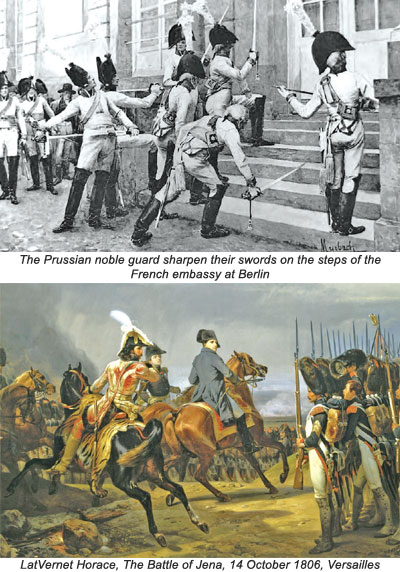
Prussia in 1806 included the eastern half of contemporary Germany as well as northern and western parts of contemporary Poland. These events took place before ‘national consciousness’ had taken root and therefore were intended for the Prussian royal elite.
Baron Marbot, a young French officer sent to Berlin witnessed this with nervousness. He had arrived a few weeks earlier bearing dispatches from Napoleon, now the Emperor of the French, for the King of Prussia. In Berlin, he witnessed this souring of mood among the Prussian elite. Now, he hastened back to Paris bearing a hand-written response from the Prussian King.
Upon arrival, he was ushered in Tuileries Palace where he handed over the letter to Napoleon. Upon hearing about the event in Berlin, Napoleon exclaimed, “The insolent braggarts shall soon learn that our weapons need no sharpening.”
Europe, 1806: The turn of eighteenth to nineteenth century had been tumultuous for Europe. The arrival of modernity signalled by the French Revolution had upended centuries of equilibrium. With it, war was unleashed with Republican and later Imperial France under Napoleon, who as the ‘Emperor of the Revolution’, arrayed against the monarchies of Europe.
These wars commenced in 1792 had reached a critical juncture. By the end of 1805, the French had defeated the combined armies of Austria and Russia. Austria sued for peace while the Russian army hastened back to Russia. As a result, the French gained a new set of allies in Germany where Napoleon eventually replaced a millennia old Holy Roman Empire with a new entity, the ‘Confederation of Rhine’, with himself as its Protector. While Great Britain was distracted from European affairs embroiled in a conflict in South America, Prussia had not engaged in these wars since a brief intervention in 1792.
In spite of these victories, the strategic situation of France was not favourable for war. The French populace was weary of continuous warfare of last decade and a half. Thus, Napoleon sought peace with both Great Britain and Russia throughout 1806. He went even as far as offering the Prussian occupied territory of Hannover, given by him to Prussia earlier in 1805, to Britain as part of peace negotiations.
On the other hand, court intrigues guided Prussian strategy. The Prussian King cherished the secret hope that Napoleon will remain deterred by the prestige of the Prussian Army and that at some point, he would offer favourable terms. The Prussian Court remained a hotbed of intrigues with some advocating war while others arguing for the status quo. The news of Napoleon’s secret offer of Hannover to Great Britain gave the anti-French faction the upper hand. The Noble Guards put up the display of sharpening their swords to reflect this turn.
Consequently, Prussia mobilised its armies on 9 August 1806 while coming to an understanding with Russia. It would later issue an ultimatum on 26 September 1806 demanding a French withdrawal from Central Germany.
Napoleon met the prospect of war with Prussia with utter disbelief. He had earlier written contemptuously in a letter to his minister that, “The idea that Prussia could take me on single-handed is too absurd to merit discussion”. Out of caution, however, he had left the French Army stationed in southern Germany throughout 1806. He suspected possible double-dealing by Prussia. The eventual rejection of peace proposals by Russia on 3 September 1806 strengthened Napoleon’s suspicions of a new secret anti-French coalition.
Subscribe To Force
Fuel Fearless Journalism with Your Yearly Subscription
SUBSCRIBE NOW
We don’t tell you how to do your job…
But we put the environment in which you do your job in perspective, so that when you step out you do so with the complete picture.

 VIDEO
VIDEO