Even as India believes that it is in a strategic competition with China over leadership of the Global South (developing, less developed and underdeveloped nations), South Africa chose Chinese President Xi Jinping and not Prime Minister Modi for state visit during the recently held 15th BRICS (Brazil, Russia, India, China, South Africa) summit in Johannesburg. In the summit where all members are equal partners without veto, it was not lost on the G-7 (western industrialised nations led by the US) nations, that China was the key determinant of the accomplishments of this summit, and that their own influence over Global South had diminished substantially owing to decades of neglect.
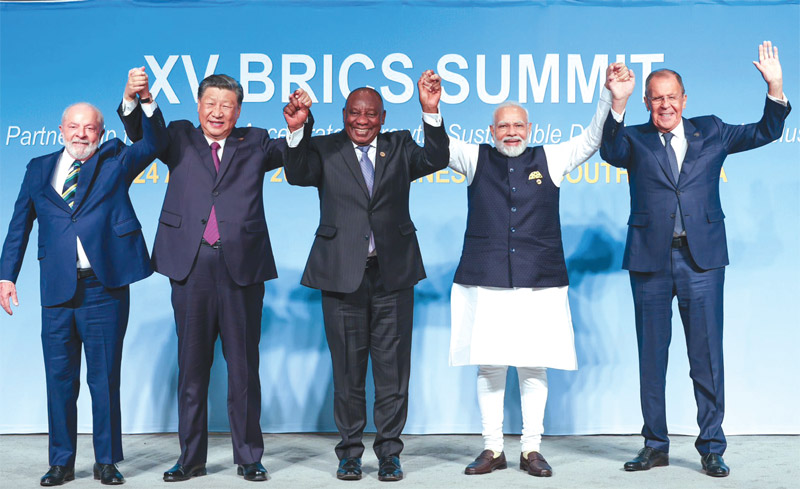
The biggest unsaid gain made by China was the deft shifting of its global geopolitical game’s (based on common prosperity and cooperative security) centrality from ASEAN in east Asia to the 54-nation African continent. Unlike east Asia where geopolitical divisions between ASEAN, and deterrence (military power) contestation between the US military and the PLA had assumed centre-stage, the African continent had rejected the US and western nations’ power games (based on military power). This explains the attendance of some 35 African nations at the Johannesburg summit as South African invitees.
Therefore, while the BRICS summit was focused on Xi Jinping’s Global Development Initiative (GDI), it was not surprising that it was followed up by Xi’s Global Security Initiative (GSI) through the third China-Africa Peace and Security forum held in Beijing starting August 29. It was attended by 50 African nation. The GDI and GSI complement one another. While the GDI is about common development and prosperity in accordance with UN’s 2030 Sustainable Development Goals (SDGs) by win-win solutions, the GSI is about cooperative security by managing conflicts and keeping the world at peace. For example, the focus of the China-Africa Peace and Security forum was on peacekeeping (maximum Chinese peacekeepers are in the African continent), counterterrorism, cyber security, humanitarian aid, and military education. Thus, in contrast to the French forces fighting in its former colonies of Mali and Burkina Faso, the People’s Liberation Army (PLA) is providing training, self-defence weapons, and military education to accomplish security through development. By its presence in African nations, through cooperative security, the PLA can secure Chinese infrastructure, interests, and people working there.
The big story at the summit was the BRICS Plus with six new members from the Middle East, Africa and South America—Saudi Arabia, UAE, Iran, Egypt, Ethiopia, Argentina—joining from 1 January 2024. However, the missed story is that despite political and ideological differences, many nations of Global South are queuing up to join the organisation which is just 15 years old. They hope, and perhaps rightly so, that collective and interdependent prosperity will cap differences, such as the ones between Saudi Arabia and Iran or between Egypt and Ethiopia over Nile waters and so on.
There are three reasons for this clamour for BRICS.
One, the Global South nations want prosperity by new economy, which is a mix of physical and digital economies by use of Artificial Intelligence and big data. China can give this;


 VIDEO
VIDEO