

China Pushes the Boundary
All is not well for India. Its distracted army, preoccupied in counter terror operations, was taken by surprise when the PLA, starting May 5, carried out well-planned and deftly-executed multi-prong deep incursions (three to five kms) across north Sikkim and east Ladakh. It not only occupied Indian territory but also audaciously built concrete defences on it. That the Indian Army was surprised by the PLA manoeuvre showed its total obliviousness to the ground reality.
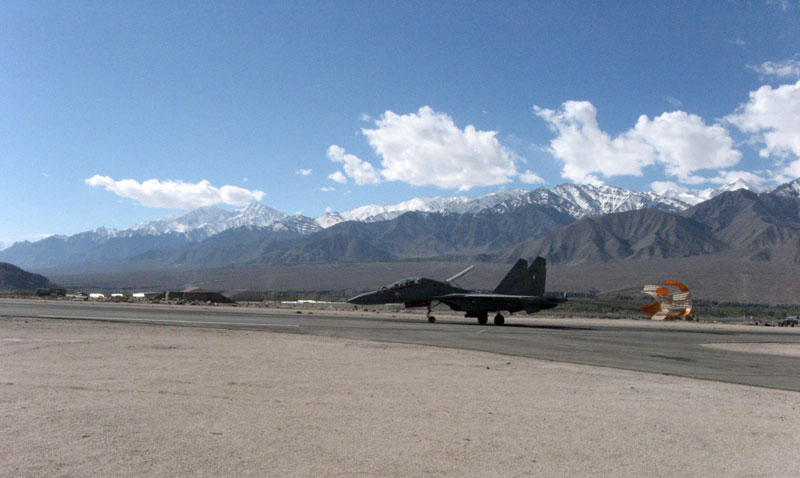
RARIFIED CLIMES Though Su-30MKI now operates from Ladakh,
it has been overtaken by new capabilities of PLA Air Force
The world knows that consequent to the ill-handled 2017 Doklam crisis by India, the PLA had, in its Western Theatre Command tasked for the 3,488 km Line of Actual Control (LAC), since winter of 2017-2018, located, at least, two group armies, three air force bases, and one rocket force base. With a total of 13 combined arms brigades, support arms, support services, border guards and armed police, the number totalled over 200,000 soldiers in Tibet Autonomous Region (TAR). They have created excellent habitat, military ecosystem and have been conducting realistic combat training. Given the increased forces-in-being threat, the Indian Army should be prepared for more similar surprises instead of blaming the intelligence services.
The recent display of PLA power was probably sanctioned by vice chairman, Central Military Commission, General Xu Qiliang. Number two to the commander-in-chief, Xi Jinping, he, a former PLA Air Force (PLAAF) commander was the architect of the 2015 military reforms and is responsible for interoperability between the PLA and Pakistan military through joint combat exercises between the three services.
The Indian Army should also not be caught napping on the increased threat to the Siachen glacier it has been holding since April 1984 at huge costs of men and finances. Speaking at a webinar organised by the Institute for Defence Studies and Analyses (IDSA) on May 15, the army chief General M.M. Naravane, in the context of two-front war, said, “It is a possibility. It is not that it is going to happen every time. We have to be alive to all contingencies which can happen.”
He probably had a localised two-front war in north Ladakh (from Siachen to Sub Sector North, SSN) in mind. His ill-informed predecessor, and now the Chief of Defence Staff, General Bipin Rawat had on 21 October 2019 advised the defence minister Rajnath Singh to open the Siachen area from the base camp to Kumar post for tourism. Announced within weeks of the tectonic development of 5 August 2019 which reconstituted the state of Jammu and Kashmir into two union territories of Jammu-Kashmir and Ladakh, it would have irked both Pakistan and China. Especially Beijing, whose two successive protests on the creation of Ladakh UT, thereby changing the status quo, had fallen on deaf ears in New Delhi. The present PLA intrusions are a consequence of that. Plus more, as we shall see.
With the PLA now moving in strength in the Galwan valley (not a disputed area until now), it, along with the Pakistan military, is well poised to hem in the Indian Army on the Siachen glacier from two sides -- the Pakistan Army on the west and the PLA on the east. What makes a localized two front war a real possibility is that (a) both partners have achievable political objectives and military aims; (b) they have been doing combined combat training since 2011 in air (Pakistan Air Force-PLA Air Force’s Shaheen exercises) and on ground (Pakistan Army-PLA Army’s Warrior exercises) since 2013, interestingly, across north Ladakh, which includes Siachen; and (c) have capability, capacity and political will to achieve their objectives.
Held in October (close to the border with north Ladakh), the month-long Shaheen-VIII joint exercise was reportedly most advanced. According to PLA commander, Xin Xin, “The Shaheen series joint exercises started as one-on-one dogfight, but now it has evolved into systematic mock battles featuring more war planes, multiple military branches which include ground forces that deploy missiles and electronic counter-measures.” Another commentary on this exercise noted that there were two opposing teams: Red team comprising the PLA Air Force, and Blue team constituted of PLAAF and Pakistan Air Force. The scope of such exercise does not require elaboration.
Subscribe To Force
Fuel Fearless Journalism with Your Yearly Subscription
SUBSCRIBE NOW
We don’t tell you how to do your job…
But we put the environment in which you do your job in perspective, so that when you step out you do so with the complete picture.






 VIDEO
VIDEO