

China is the Threat
Pravin Sawhney
In his first article since retirement, Gen. M M Naravane (retd) has exposed the Indian army’s lack of understanding of present and future wars. This is worrying, especially when the People’s Liberation Army (PLA) is at the forefront of the new war, both in terms of its science (technologies) and art (war concepts).
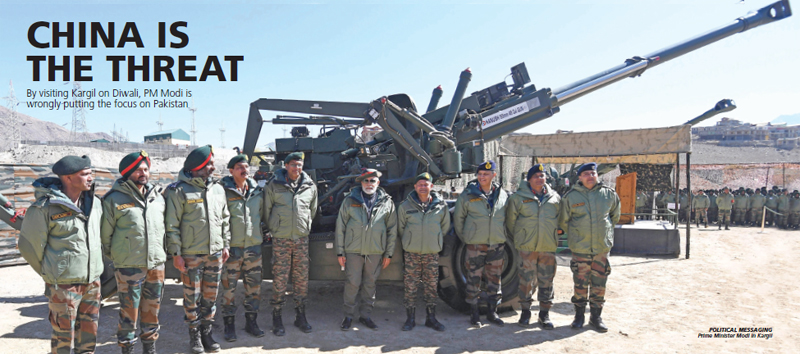
The PLA is not only India’s main military challenge and has occupied our territory since April 2020, it also threatens ‘reunification’ of Arunachal Pradesh with Tibet. The US, in its 2022 National Defence Strategy, has called the PLA the ‘pacing challenge’ capable of matching its military’s emerging technologies, war concepts, and defence ecosystem. Yet, the Indian Army remains oblivious to the PLA’s threat.
This is evident from Gen. Naravane’s (retd) article in which he uses generalities to touch upon disparate weapons platforms (which are inconsequential)—not present and future technologies—and draws lessons for the Indian Army from the Ukraine war. The fact is that the threat of war that India faces from China will be unprecedented. I will explain in eight points that Gen. Naravane (retd) needs more clarity on technologies which will shape the present and future wars.
Character of War
First, he writes ‘it is near impossible to predict the character of future wars.’ This is not correct. Since 2010, the US military knew that the character of war (how war would be fought) was changing rapidly. Its second offset strategy capabilities had been matched by the PLA. These included superior intelligence collection platforms, battle networks which connect sensors, command post for decision-making and shooters (which the PLA calls operational systems), and precision, guided and stand-off munitions. The PLA can close the kill chain or the OODA loop (Observe, Orient, Decide, Act) as quickly as the US military. The PLA can launch standoff precision attacks at long ranges as good as the US military with its indigenous mortars, rockets, missiles and artillery projectiles most of which were guided. Coupled with increasing miniaturisation, guided weapons brought unprecedented lethality at long ranges. Moreover, the PLA has developed an industrial base and ecosystem for the largest inventory of land-based missiles in the world.
By 2010, the PLA had made the US military’s Network Centric Operations (which were first showcased by it in the 1991 Operation Desert Storm against Iraq) redundant since it could do ‘systems destruction warfare’ to destroy US battle networks by kinetic (land-based missiles) and non-kinetic (cyber and electronic warfare). This would disrupt, destroy or incapacitate US military communications at all levels.
To meet the PLA’s growing challenge, the Pentagon announced the third offset strategy (to offset PLA’s capabilities) in 2014. This involves the use of artificial intelligence (AI) in all aspects of warfare. Today, the US military and the PLA are competing in autonomous robotic war, called integrated deterrence and intelligentised war respectively. This has changed the character of war once more.
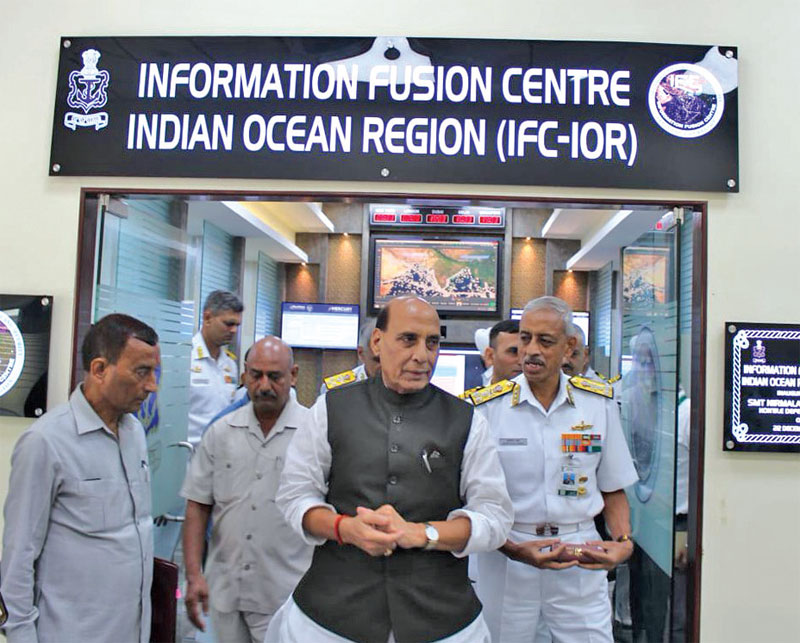
Defence minister Rajnath Singh in Kashmir during Shaurya Diwas
Meanwhile, once the PLA developed capabilities to contest, compete, and combat with the US military in the space, cyber and electromagnetic spectrum (EMS) battle spaces, it declared them new war domains in its 2014 military strategy. Next, China did structural reforms in 2015 and created two formidable organisations. The first is the PLA Strategic Support Force (PLASSF) comprising cyber, EMS, space and ‘three warfare’: public opinion warfare, psychological warfare (colloquially called wolf diplomacy) and legal warfare. The other organisation is the PLA Rocket Force (PLARF) comprising nuclear and conventional land-based missiles.
The 2015 reforms were to be accomplished in five years. At present, the PLA has capabilities to destroy the Indian military’s communications at all levels of war and render various headquarters and formations blind and deaf leading to chaos in the chain of command. The Indian military has insignificant capabilities in cyber, EMS and space. The reality is that without competitive capabilities in these domains, the war will be lost quickly. The PLA calls this the informatised warfare. If the US and western militaries are aware of the twice changed character of war in the last 12 years, why is the Indian army unaware of it?
Domains of War
Two, skipping military strides made since 2010, Gen. Naravane (retd) is fixated on the era of ‘drones or quadcopters’ (weapons platforms) which have ‘military applications and used for everything from surveillance to kamikaze attacks.’ To put things into perspective, all quadcopters (helicopter with four rotors) or Unmanned Aerial Vehicles (UAVs) are drones, but all drones are not UAVs since they include unmanned systems in air, ground, sea and undersea which are piloted remotely or autonomously.
All drones use technologies in five domains of war. Drones cannot operate in an environment without good control over EMS and cyber. Drones cover the domains of space (for GPS communication), land and air. Thus, drones have an operational role between peer competitors like India and Pakistan, or the PLA and the US military. Not between the PLA and the Indian military since it would be impossible for Indian drones to breach the PLA’s Anti Access Area Denial (A2AD) firewall on the LAC, which includes cyber, EMS, counter-space, laser, and microwave weapons capabilities. Laser power weapons, which are scalable, can take out UAVs and microwave weapons can burn and destroy electronics. There is no mention of cyber, EMS and space in Gen. Naravane’s article.
Moreover, drones swarm are still at a formative stage. The 75 drones swarm demonstrated by the Indian Army on January 15, 2021, when Gen. Naravane (retd) was the Army Chief, was a stage-managed exercise. The then army commander, Lt Gen. Raj Shukla (retd), is on record saying that a retired air force officer, Sameer Joshi, who claimed to swarm drones, did 15 rehearsals before the actual demonstration. “The biggest concern was that no drone should fall on the audience…,” Lt Gen. Shukla (retd) said during a talk at the United Services Institution. As far as the payment was concerned, according to Lt Gen. Shukla (retd), the “Army Design Bureau paid Joshi Rs 200 crore” for the demonstrations and future orders even as the technology has not matured.
Subscribe To Force
Fuel Fearless Journalism with Your Yearly Subscription
SUBSCRIBE NOW
We don’t tell you how to do your job…
But we put the environment in which you do your job in perspective, so that when you step out you do so with the complete picture.






 VIDEO
VIDEO