

Change with Times
Technological advances alone do not constitute change. The most dramatic advances in military operations over history have been borne of ideas—ideas about warfighting, organisation and doctrine. The Army's most critical asset will not be technology; it will be critical thinking’
—Association of the United States Army, Torchbearer National Security Report (Arlington, Virginia: Institute of Land Warfare, Association of the United States Army, March 2005), p 21)
A recent book published by the Stimson Center South Asia Programme, The Wellington Experience: A Study of the Attitudes and Values Within the Indian Army, should serve to stir up a hornet’s nest within the Indian establishment in general and in the Indian military in particular?
In this article, I argue that this book must provoke serious thinking about many archaic aspects of the Indian military in general and the Indian Army in particular. The text must get read ‘critically’ by the Indian military leadership. The government must seek to address the shortcomings highlighted to ensure a contemporary and well-prepared military,
Much needed change and transformation requires impetus. Operational Level processes need to be developed; single-service capabilities need fusion into a joint synchronised system. Seeking and achieving strategic objectives requires modern techniques to be adapted. Proper combined arms education and training eludes the Indian military despite certain realignments in DSSC, Wellington and other inter-service training establishments.
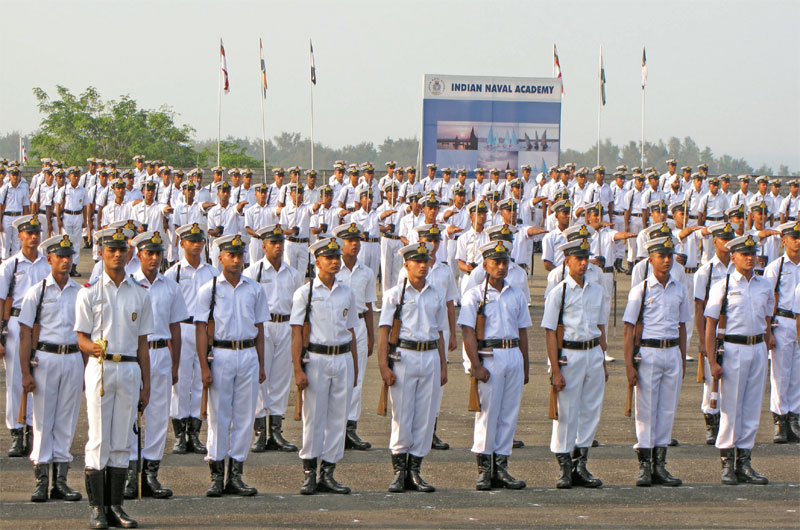
Cadets at Indian Naval Academy
Whither Professional Military Education?
I have had a five-year exposure to Wellington as a student, Directing Staff (DS) and as Chief Instructor (Navy). I have been witness to much that happens and does not happen within its ‘training establishments’ and have written and published a series of articles on the subject that in some ways echoes what Colonel David O. Smith’s enquiry lays bare. In writing this and other pieces on the topic, my intention has also been to further pragmatic exploration and force a ‘transformation’ from an excessive focus on training to the adoption of serious education.
The Army Training Command (ARTRAC) webpage highlights the need for ‘Mind Over Matter’. But beyond this play with words, the website goes onto espouse a focus on training: ‘No soldier or officer should ever lose his life or limb in combat because he was inadequately trained. That is the essence of training in the Indian Army.’ The necessity of a focus on education (as distinct from training) to buttress advanced strategies and build on various other areas is a shortcoming that affects most of what ails the Indian military.
Cultural Bottlenecks: Col Smith points out that specific socio-cultural bottlenecks and organisational dynamics hamper the Indian military. The study focuses on a minority group of discerning ‘20-per cent’ motivated, high-achievers. This group is aware of various shortcomings and moderate corrections to different degrees. But at large, the Indian Army, given its size and rigid hierarchical structure, has been resistant to change with adverse implications on its efficiencies.
Need to Introspect: I endorse such a view despite a detailed understanding of various notable traits like esprit de corps and endless valour that characterises the Indian Army and the Indian soldier. There is a need to introspect and foster change in an institution that we revere, often as the force of last resort.
I hope that even if earlier reports such as the Henderson-Brooks-Bhagat report or the Kargil Review Committee reports or even my previous writings on the subject have not provoked this, the publication of The Wellington Experience must serve as a wakeup call.
Scholarly Perception: Early in my tenure as the CI (Navy), a statement made by M.R. Srinivasan, former Chairman of the Atomic Energy Commission, had forced me to introspect on the ‘instructional method’ at Wellington. When Srinivasan was informed about my three-tenure ‘rite of passage’ through the portals of Wellington, he remarked that I must undoubtedly be affected by ‘inbreeding’. The Indian military streams a majority of its Commanders and leadership through the Defence Services Staff College at Wellington, and the chances of deleterious and recessive traits, such as inadequately developed cognitive abilities need redressal.
Subscribe To Force
Fuel Fearless Journalism with Your Yearly Subscription
SUBSCRIBE NOW
We don’t tell you how to do your job…
But we put the environment in which you do your job in perspective, so that when you step out you do so with the complete picture.






 VIDEO
VIDEO