

By Invitation | T’was a Great Victory
Every spring, as the weather improves, Russians start to venture outside to enjoy the warming sun, or perhaps to open up their Dachas or to prepare vegetable gardens for planting. There is also the long May holiday to anticipate. This year however is different. Like almost everywhere else in the world, Russia has been hit by the Coronavirus, or COVID-19. It means people are asked to stay in their flats and not go out except for necessities, like groceries, prescription etc. It is a time of worry, frustration, aggravation, perhaps of encounters with police enforcing the quarantine. In short, this year the May holiday is not going to be a holiday at all, at least not as it usually is. The traditional 9 May celebrations, the parade in Red Square and the marches around Russia of the Bessertnyi polk are postponed. President Putin has indicated that these events will be held as soon as the Corona danger has passed. For now, anyway, instead of streets and parks full of people, remembering the brave deeds of veterans and of their own family members, public places will be empty. Russians will be respecting the quarantine and staying at home.
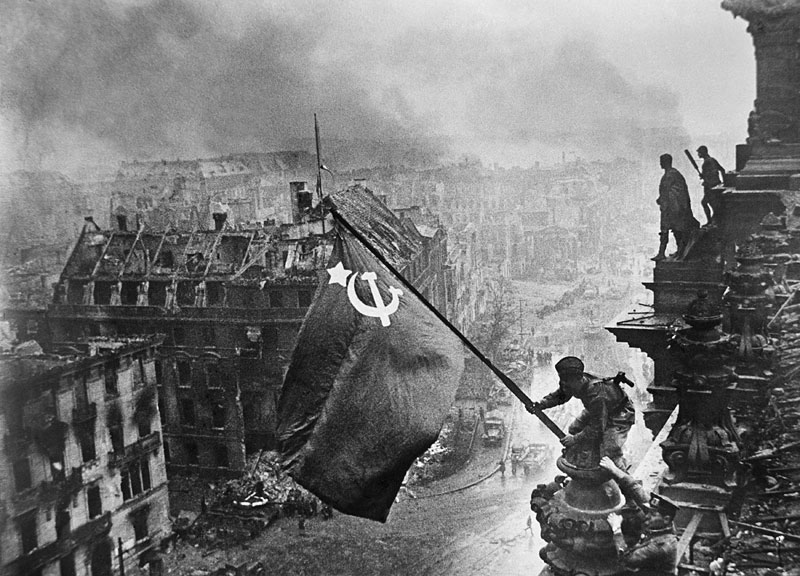
The victory banner over Berlin. Photo courtesy: Russian Information Centre
That does not mean that anyone should forget the meaning of 9 May and why Russians celebrate it. For most Russians, May means the Victory Day. On that day in 1945, Marshal Georgii Konstantinovich Zhukov, commander of the 1st Belorussian Front, which had stormed Berlin, received the German unconditional surrender. The Great Patriotic War had gone on for 1,418 days of the most unimaginable violence, brutality and destruction. From Stalingrad and the northern Caucasus and from the northwestern outskirts of Moscow to the western frontiers of the Soviet Union to Sevastopol in the south and Leningrad and the borders with Finland, in the north, the country had been laid waste. An estimated 17 million civilians — men, women and children — had died, although no one will ever know the exact figure. Villages and towns were destroyed; families were wiped out without anyone to remember them or mourn their deaths. Some 10 million Soviet soldiers perished in the struggle to expel the monstrous Nazi invader and finally to track it down in Berlin at the end of April 1945. Red Army dead were left unburied in a thousand places along the routes to the west or interred in unmarked mass graves. There having been no time for proper identification and burial. Of the male children born between 1922 and 1924 in the USSR, three out of a hundred survived the war. Most Soviet citizens lost family members. No one was left unaffected.
The Great Patriotic War began at 3:30am on 22 June 1941, when the Nazi Wehrmacht invaded the Soviet Union along a front stretching from the Baltic to the Black Seas with 3.2 million German soldiers, organised in 150 divisions, supported by 3,350 tanks, 7,184 artillery pieces, 600,000 trucks, 2,000 warplanes. Finnish, Italian, Romanian, Hungarian, Spanish and Slovakian forces, amongst others, eventually joined the attack. The German high command reckoned that Operation Barbarossa would take four to six weeks to finish off the Soviet Union. In the west, US and British military intelligence agreed. Besides, what force had ever beaten the Wehrmacht? Nazi Germany was the invincible colossus. Poland had been crushed in a few days. In April 1940, the Anglo-French attempt to defend Norway was a fiasco. The Germans walked into Denmark. In May, the Wehrmacht attacked in the west, Holland disappeared and Belgium hurried to quit the fight. France collapsed in a few weeks. The British Army was driven out of Dunkirk, naked, without guns or lorries. In the spring of 1941, Yugoslavia and Greece disappeared in a matter of weeks at little cost to the German invaders.
Wherever the Wehrmacht advanced in Europe, it was a walkover… until the day German soldiers stepped across Soviet frontiers. The Red Army was caught flatfooted, in halfway measures of mobilisation, because Soviet ‘boss’, I.V. Stalin, did not want to provoke Hitlerite Germany. The result was a catastrophe. But unlike Poland and France, the USSR did not quit the fight after the expected four to six weeks. The Red Army’s losses were unimaginable, two million soldiers lost in the first three and a half months of the war. The Baltic provinces were lost. Smolensk fell and then Kiev, in the worst Soviet defeat of the war. Leningrad was encircled. An old man asked some soldiers, “Where are you retreating from?” There were calamities everywhere. But at places like the fortress of Brest and in hundreds of unnamed locations, road junctions, villages and towns, Red Army units fought on often to the last soldier. They fought out of encirclements to rejoin their own lines or to disappear into the forests and swamps of Belorussia and the northwestern Ukraine to organise the first partisan units to attack the German rear. By the end of 1941, three million Soviet soldiers were lost (2/3rd being POWs who the Germans allowed to starve to death); 177 divisions were struck from the Soviet order of battle. Still, the Red Army fought on, even forcing back the Germans at El’nia, east southeast of Smolensk, at the end of August. The Wehrmacht felt the bite of the battered but not beaten Red Army. German forces were taking 7,000 casualties a day, a new experience for them.
Subscribe To Force
Fuel Fearless Journalism with Your Yearly Subscription
SUBSCRIBE NOW
We don’t tell you how to do your job…
But we put the environment in which you do your job in perspective, so that when you step out you do so with the complete picture.






 VIDEO
VIDEO