The Indian armed forces have been steadily modernising their inventory, equipment, and vehicles over the last decade. The armed forces have been procuring equipment and vehicles from a plethora of sources including Indian manufacturers. With the growth in defence budgets and spending over the years, there is a pressing need for efficient equipment and vehicles. The aforementioned spending must be in the direction of efficiency i.e. acquiring/producing what is urgently required for modern Armoured Personnel Carriers (APCs) and Armoured Fighting Vehicles (AFVs) among other armoured vehicles.
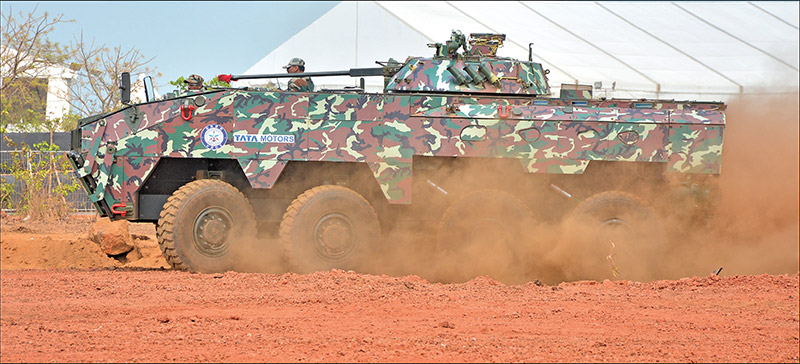
Live demonstration by Tata Kestrel during DefExpo 2016
Modern APCs, AFVs, and recovery vehicles are what the armed forces, including the paramilitary forces stationed in sensitive regions, need at this time. While India has a number of APCs and AFVs in operation, they have not been successful in all regions of operation. This has prompted a pressing requirement for new and improved armoured vehicles.
India is looking to procure modern APCs and AFVs from foreign companies such as Rosoboronexport, General Dynamics, Finmeccanica, BAE systems, Renault, and even Tata Motors which wants to produce the 8x8 Kestrel APC. Whilst procurement is still on the checklist, indigenisation is also on full swing with a host of new APCs, AFVs, and other armoured vehicles being produced in India by companies like Kalyani Group, Mahindra, and Tata Motors.
Tata Kestrel 8x8
Tata Motors developed its own wheeled APC, the Kestrel. The vehicle was first unveiled in February 2014 during DefExpo 2014 in India. The Kestrel is an 8x8 wheeled armoured amphibious vehicle optimised to offer more survivability, all-terrain performance and increased lethality. The architecture of the Kestrel is modular with interchangeable snap-in modules. This means its customisable and can be configured to play the role of a CBRN (equipped with chemical, biological, radiological and nuclear protection) reconnaissance (recce) vehicle. It can also be configured to be an APC, ambulance, missile carrier, or a command post, a field headquarters used by the commander of a military unit. The Kestrel can be a support vehicle for engineers working in the field, and given the times we live in, it will surely be used for anti-insurgency and anti-terrorist operations.
The monocoque of the Kestrel comprises a welded armour steel hull with applique and inner composite spall liner and depending on the configuration, it can withstand threat levels ranging from Stanag I to Stanag IV. Stanag standards are a NATO standardisation agreement covering the standards for ‘Protection Levels for Occupants of Logistic and Light Armoured Vehicles’. Stanag I dictates that the vehicle should be able to withstand hand grenades, unexploded artillery fragmenting submunitions, and other small anti-personnel explosive devices detonated under the vehicle. Stanag IV states, among other parameters, that the vehicle should be able to withstand a blast of a 10kg mine under either each tyre or under the vehicle. Interestingly, the protection modules of the Kestrel can be replaced in the field, increasing or decreasing protection levels as per the mission requirements. The belly has a blast guard that can provide up to Stanag III level protection. This makes the Kestrel a much better option than the current Casspir in operation.







 VIDEO
VIDEO