India is a maritime nation. Geographically, it owns an EEZ of 2.02 million sqkm dotted with over 1,300 islands, has seabed rights over 75,000 sqkm, a coastline of 7,516 km and 14,500 km of inland waterways. From a political economy perspective, 77 districts across nine coastal states and four coastal Union Territories are home to 18 per cent of India’s population. From a commerce perspective the maritime sector accounts for 95 per cent of India’s trade by volume and 77 per cent by value. Its maritime infrastructure assets include 12 major and 187 non-major ports. Our oceans and water bodies produce about 12 million metric tonnes of fish every year and hold 46 per cent and 61 per cent of recoverable reserves of crude oil and natural gas respectively.
Geopolitically, India is a key player in the Indian Ocean Region (IOR) which is home to about 33 per cent of the world’s population across 38 sovereign states. India also has research territories and outposts in the Arctic and the Antarctic and has made sizeable investments for hydrocarbon exploration in various countries. In the wider Indo-Pacific region, India is on every high table of international associations and groupings where trade, commerce and maritime affairs are always on the agenda.
However, when evaluated against global indicators India’s record as a maritime nation is not encouraging. India ranks as the 16th largest maritime nation. With a share of about 3.2 per cent of global GDP and about 4.5 per cent of global EXIM trade our shipping and shipbuilding credentials do not yet make the mark. On a positive note, we have plenty of headspace to grow. Clearly, the current situation must be recalibrated to be aligned with India’s target of becoming a USD five trillion economy.
Imperatives for Improvement
History informs us that every great power possessed a vibrant shipbuilding industry and operated best in class ships that helped maintain a continued and unimpeded access to resources, commodities and markets which are the vital pillars of a nation’s economy. A vibrant shipbuilding industry contributes significantly to the economy and security of a nation as it directly impacts national GDP, generates demand in various upstream industries such as steel, aluminium, electrical machinery and equipment etc., and downstream sectors such as infrastructure and marine services. The multiplier for job creation is upward of 36-50 times the shipyard strength. These domestically built ships, in their voyages are a living testimony to a nation’s industrial capability and might.
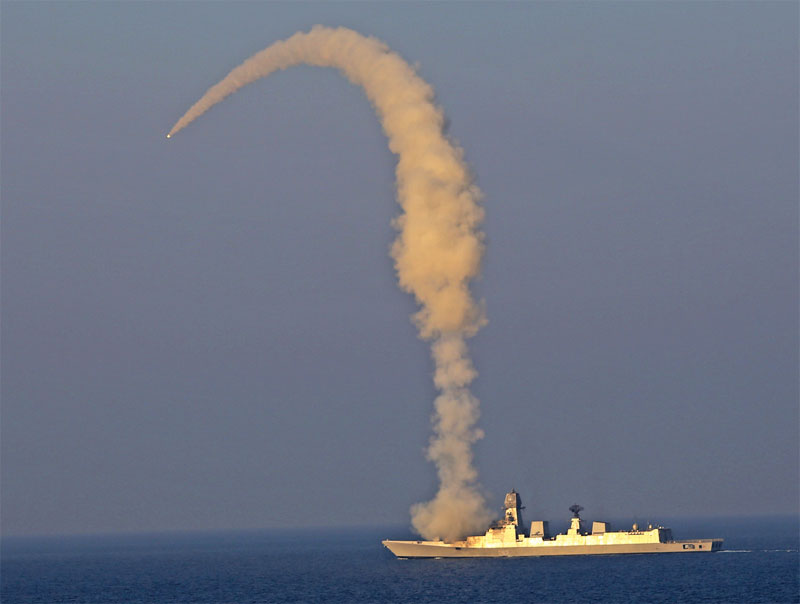
BrahMos Missile being launched from INS Kolkata
Yet, only seven per cent of Indian export-import (EXIM) cargo is carried on Indian ships. India’s mercantile fleet amounts to only 0.1 per cent of the global fleet. Further, India is forced to relax cabotage as indigenous capacity to carry the potential cargo of more than 300 MMTPA coastal cargo is very limited. As a result, India pays out about USD50-60 billion for imports on foreign hulls.
Whilst India has developed a national capability to design and build nuclear submarines and aircraft carriers unfortunately it does not yet design or build Car Carriers, VLCC Products and Crude carriers, Container ships, LNG ships, Dredgers, Deep Sea Fishing Vessels, Oceanographic vessels and modern riverine transports which are vital for the balanced growth of the economy and national security. A long-term streamlined approach to procurement and maintenance of 45 ships would have been transformative for the Indian shipbuilding industry.








 VIDEO
VIDEO