

Bottomline | The Spirit of Wuhan
 Pravin Sawhney
If the US highest military officer, the Chairman of the Joint Chiefs of Staff Committee were to issue a military threat to China on the South China Sea, an appropriate response from the People’s Liberation Army (PLA) would have been assured.
When India’s Chief of Defence Staff, General Bipin Rawat recently said that the military option was on the table if India-China talks on Ladakh fail, there was deafening silence from the PLA.
The reason was simple: Discerning observers of new age technologies understood that either General Rawat was grandstanding, or was simply out of his depth on the changed character of warfare. The huge gap between the technologies and the concept of operations or the art of war-fighting between the PLA and the Indian military could perhaps be explained by the analogy of the 1991 Gulf War. The war lasted 43 days of which the ground war was a mere 100 hours, essentially a mopping up operation. The Iraqi Army’s elite Republican Guards battle-hardened in the decade long war with the neighbouring Iran were beaten by the US technology without a fight.
The world, especially the PLA, was dumbstruck by the US’ new concept of warfare pivoted on stealth, guided munitions, stand-off ranges, and above all battle network centricity (real time connectivity between sensor, shooters and command post). The PLA was quick to understand that it did not have the technology, scientific-industrial infrastructure, and finances to match the US military’s technological superiority.
But it could develop ‘systems destruction warfare’—capability to cripple US battle network’s command, control, communication, and intelligence systems—to deny or delay information to the enemy which is crucial for timely decision-making in war. This was sought to be done by both non-kinetic and kinetic means, namely, by focussing on cyber and electronic warfare, and missiles (ballistic and cruise) capabilities. By early 2000, the PLA’s ‘assassin’s mace’ capabilities meant to incapacitate the enemy, suddenly and totally, by denying him information, instead of fighting him directly, had caught the US military’s attention.
A bigger shock awaited the US military when by 2012, it realised that the PLA had become a peer competitor in Artificial Intelligence (AI) and 11 new age disruptive technologies poised to reshape warfare and geopolitics while ushering in the fourth industrial revolution for prosperity. These technologies are microelectronics, cyber, 5G wireless communications, space, hypersonic, directed energy weapons, autonomy, network communications, missile defence, quantum technologies, and nuclear triad. In certain technologies like 5G, AI and quantum, China was suspected to be ahead of the US. This resulted in the US announcing its Third Offset strategy in 2014 to focus on robotics, autonomy and human-machine fusion. The Third Offset strategy, meant to meet China’s challenge, was testimony to the PLA’s technology driven upward trajectory for war-fighting.
Unfortunately, Indian military leaders fixated on Pakistan and counter-terror operations for 30 years since 1990, not only missed this revolution in military affairs, but also failed to fully appreciate the burgeoning challenges on the Line of Actual Control (LAC) with the PLA. In this, they were in good company of the Indian diplomats who continued to dismiss China’s purposeful moves—military reforms, focus on non-contact technologies, militarisation of Tibet Autonomous Region and frequent pronouncements on Kashmir—as mere posturing.
And since we are used to dismissing China’s strategy as posturing, we believe that sloganeering is a good alternative to planning and war-preparedness. A product of this legacy, General Rawat is no different. Deep selected for his stated expertise in counter terror operations to become the army chief in December 2016, General Rawat is hamstrung by his history to understand PLA.
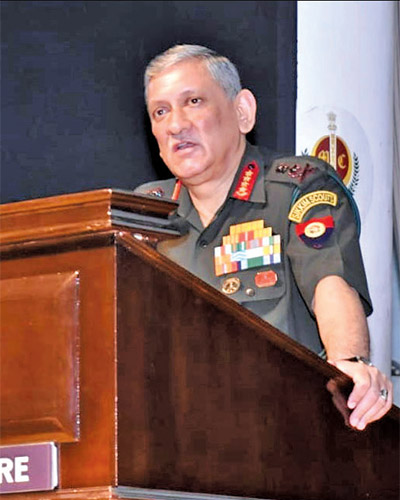
But PLA is not the Pakistan military. It should have been obvious that a new template for warfare is needed to address or counter China. What works with Pakistan will not work here. Surely, the PLA will not fight to Indian Army’s strength which is battle-hardened manpower. It would instead fight to its own strength: technology. When the CDS threatened China, he betrayed ignorance of PLA’s modern war-fighting capabilities. It was also lost on him and most analysts that the 2017 Doklam and the Ladakh crisis are as dissimilar as chalk and cheese.
Assuming that General Rawat is reckless and decides to execute his manpower-centric plan by opening up a new front on the 3,488km long LAC to put pressure on the PLA to evict occupied territory in eastern Ladakh; once the first shot is fired from the Indian side, an instant response from the PLA with two likely simultaneous actions based on its capabilities is certain.
One, there could be a massive cyber offensive culminating in cyberwar involving the whole-of-nation way beyond the designated battlespace. Since Chinese companies are embedded in India’s telecommunications, power, information and communications, and defence grids, it is anyone’s guess what a cyberwar (the world has never seen this) in virtual battlespace would do. There would be panic, fear, and frenzy in commercial and financial sectors with the government at its wit’s end.
Two, the PLA would unleash its ‘systems destruction’ strategy by its two organisations which report directly to the Central Military Commission, China’s highest military policy making body. These are the Strategic Support Force comprising cyber, space, electronic and psychological capabilities, and the Rocket Force which has under it all ballistic, cruise and hypersonic missiles. Given this, India’s space satellites would be hit by cyber malware, PLA’s sub-orbital kill satellites and anti-satellite capabilities. Also hit would be command centres, various field headquarters and airfields to name a few critical information nodes. The overall PLA objective would be to deny information to Indian military for timely decision-making. This would result in the PLA getting ahead on the decision-making loop, allowing it faster responses. Importantly, the PLA has fielded AI technology enabler into its warfare. This would affect all aspects of war-fighting—quicker and better Intelligence, Reconnaissance and Surveillance (ISR), early decision-making and accurate and stand-off responses.
Two examples would help show the uses of AI, which is still in early stages of development, in war. The PLA is known to have AI in its weapons including cruise missiles. This means that cruise missile would be autonomous and intelligent, capable of identifying targets and destroying them without help from ground controller. Moreover, the PLA has demonstrated capability of one ground station controlling large numbers of drones or unmanned aerial vehicles. It is certain that Indian military’s trained manpower pitted against technology would not achieve its objective of evicting the PLA from occupied territories. This is what makes General Rawat’s warning unreal.
It is a good thing that the foreign minister S. Jaishankar was quick to underplay Gen. Rawat’s military option. He understands that talks are the only option. But talks at the present level have reached their limit of deliverance. The government needs to raise the talks to the highest political level. Perhaps, time to invoke the spirit of Wuhan.






 VIDEO
VIDEO