With increasing threats and rapid development of technology, efficient surveillance has become paramount in keeping countries safe. Maritime and coastal surveillance are as important as guarding the land borders of a country. The horrific terror attack on Mumbai on 26 November 2008 exposed the vulnerability of the Indian continent via the sea route. Immediately after, the ministry of home affairs (MHA) planned to integrate the entire coastline into one radar network which can seamlessly monitor movements in the sea. The government entrusted Bharat Electronics Limited (BEL) with the responsibility of establishing a chain of 46 static radar sensors along the coastline in Phase-I of the project. Out of these, 36 were planned to be implemented on the mainland while the remaining 10 were to be set up on the islands.
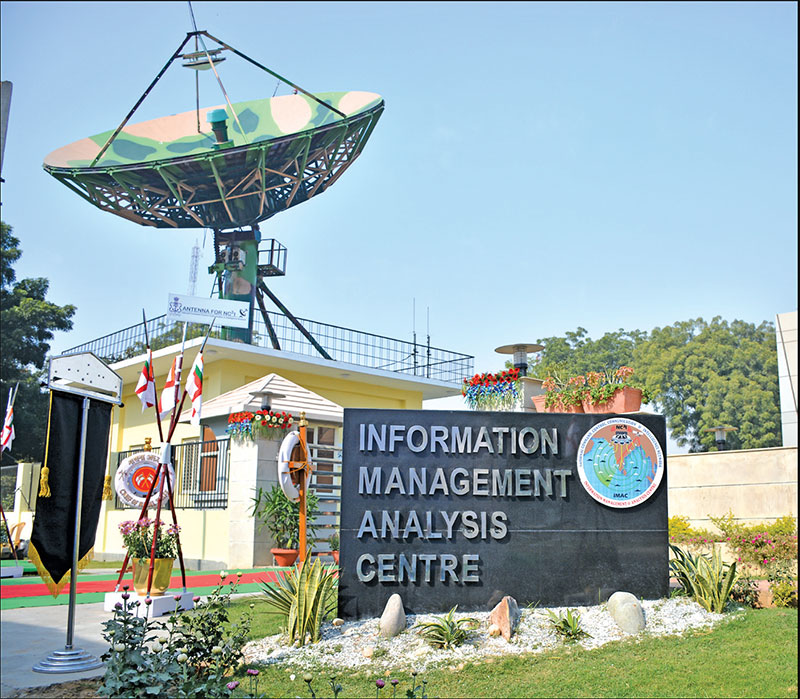
The Information Management and Analysis Centre (IMAC) in Gurugram, Haryana
The National Committee for Strengthening Maritime and Coastal Security (NCSMCS) was formed shortly after 26/11 and the government implemented an electronic surveillance system augmented via a chain of coastal radars forming the Coastal Surveillance Network (CSN). After the Mumbai attacks, it became essential to ensure that the security of coasts was on par with that of border outposts. Coastal radar systems, sensors and electronic surveillance systems have been installed over the decade to monitor maritime traffic.
MHA implemented a comprehensive Coastal Security Scheme (CSS) to strengthen the security infrastructure in the coastal states in India. CSS was launched in 2005 across all nine coastal states and four coastal Union Territories (UTs). The main objective of the scheme was to strengthen infrastructure of the marine police force in order to improve patrolling and surveillance of the coastal areas, especially the shallow areas close to the coast.
In August 2017, Rajya Sabha was informed by the minister of state for defence Dr Subhash Bhamre that along the Indian coastline, coastal radars had been established under the project — Coastal Surveillance Network (CSN). In Phase-I, 45 radars were made operational. The project, CSN, comprises Chain of Static Sensors (CSS) including radar, Automatic Identification System (AIS), Long-Range Identification and Tracking (LRIT), Day & Night cameras and communication systems. The Vessel Traffic Management System (VTMS) radars in ports along the coastline also facilitate surveillance of port areas.








 VIDEO
VIDEO