In defence, the information domain is inherently dependent on several dissimilar systems wherein, it is difficult for a military commander to obtain a complete picture and then decide. His insight and planning are hampered by proprietary systems viz Command and Control, Communications, Computers, Intelligence, Surveillance, Target Acquisition, Reconnaissance, weapons and sensor systems with each focusing on only a limited area.
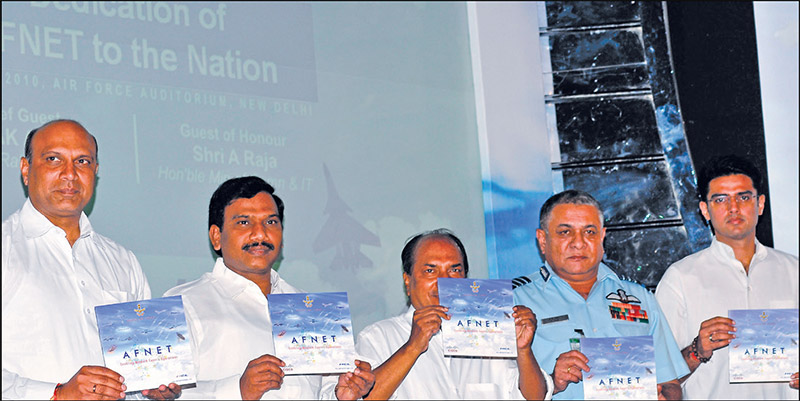
IAF’s launch of the AFNET digital information grid on 14 September 2010
In such a situation, decision-makers’ inability to acquire accurate situational awareness, can lead to catastrophic results. To overcome this dilemma and to shorten the sensor to shooter link, the air forces across the world are shifting to Net Centric Warfare (NCW) tools. In this regard, the Integrated Air Command and Control Systems (IACCS) is a significant step taken by the IAF towards NCW. The media reports suggest that in our neighbourhood too, both Pakistan and China have automated/ informationised their air operations. Hence, progressing in this direction is a paramount requirement to face their individual/collusive challenge.
The concept of NCW originated in America in the late Nineties in a paper titled ‘System of Systems’ published by the Institute for National Security Studies. Later, this found a place in a ‘Joint vision 2010’ document issued by Joint Chief of Staff which essentially laid stress on the information superiority achieved with the application of full spectrum dominance. Thereafter, department of navy in its publication titled ‘Copernicus: C4ISR for the 21st century’ explained the importance of networking of sensors and shooters, which leads to a flattened hierarchy and resulting in faster reaction ability, enhanced precision and increase in speed of the command. US strategist David S. Albert later articulated the concept in greater details in his book titled, Net Centric Warfare: Developing and Leveraging the Information Superiority. We are aware that the US has employed this concept of network-centric operations with great advantage in Iraq and Afghanistan.








 VIDEO
VIDEO