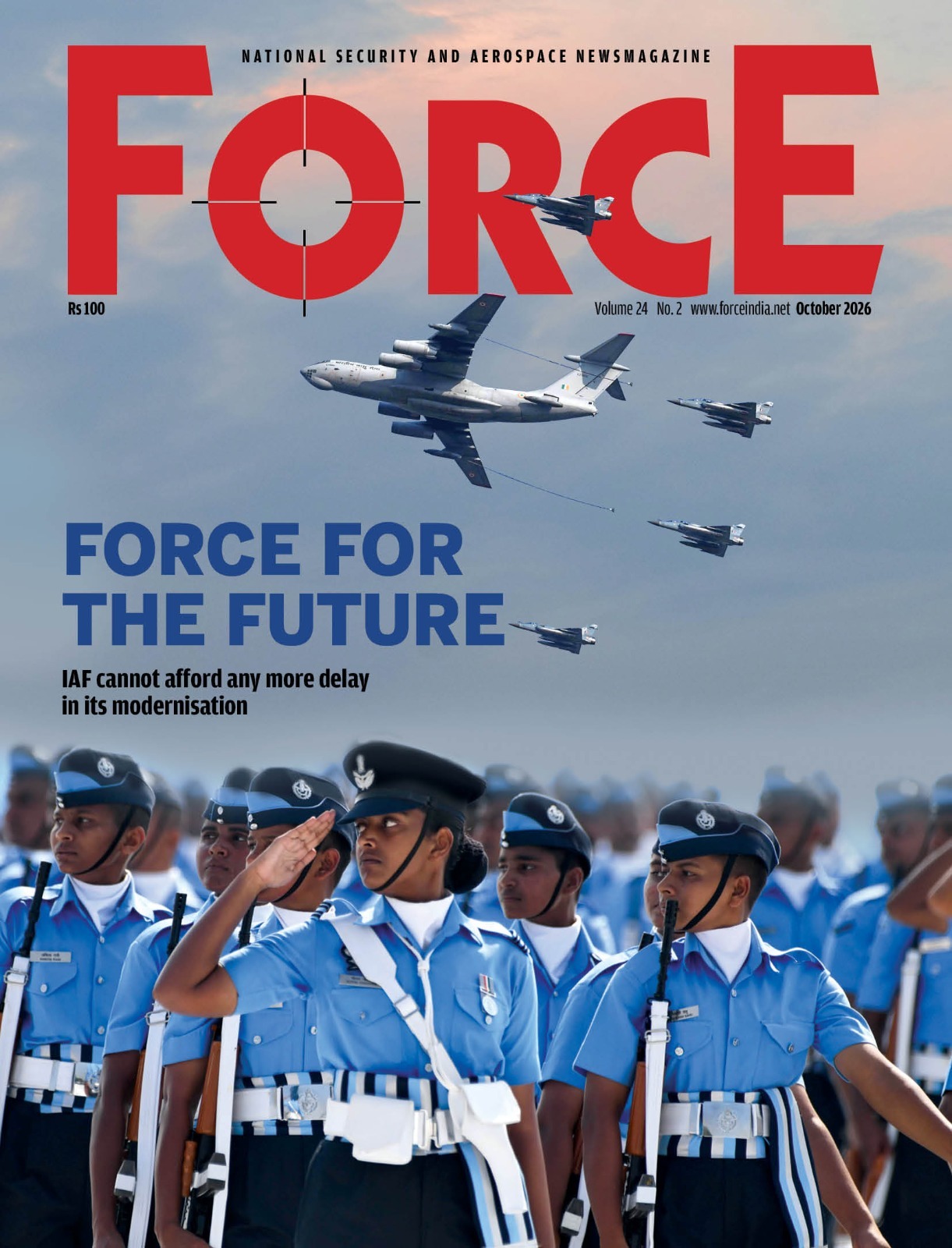
The Indian Air Force (IAF) will be 88 years in the service of the nation on October 8 this year. A journey which began with the enactment of the Indian Air Force Act 1932, stipulating its auxiliary status to the Royal Air Force in British India, today the IAF is acknowledged as the fourth largest in the world, modern, technology-intensive and distinguished by its commitment to excellence and professionalism.
Realising the primacy of air power to protect India’s security interests extending from the Persian Gulf to the Straits of Malacca, the IAF had presented a vision 2020 document to the government in 1999, envisaging a 55-squadron force. The composition was to be 16 multi-role squadrons, 18 strike squadrons, 16 air defence and a few for reconnaissance and electronic warfare. The government cleared a force structure of 42-45 squadrons to be raised by the end of Thirteenth Plan period i.e. 2027. The prevailing trend, however, does not indicate that the IAF will be able to get the approved force levels in the stipulated time frame.
Over the last two decades, the IAF’s story has been one of steadily weakening in strength and diminishing in war-fighting potential, owing to constrained budgets, a sluggish acquisition programme and overabundance of red tape. Two main factors have been responsible for the IAF being at an all-time low of 30 fighter squadrons:
For the MMRCA, the government had floated a tender in 2007 and shortlisted the Rafale, however the deal could not materialise as envisaged. Subsequently, 36 aircraft were bought in 2016. The LCA programme sanctioned in August 1983, with a cost of Rs 560 crore, overshot the time frame and budget estimates by a huge margin. Only now in 2020, after 37 years, has it attained full operational clearance for induction. In the bargain, the IAF has not only depleted in strength but has also been compelled to stretch the service life of some the ageing fleets, thereby losing its deterrence against China and Pakistan.
With a 30-squadron fleet, the IAF is increasingly ill-equipped to fight a two-front war. In a rare public admission in 2018, Air Chief Marshal B.S. Dhanoa, while briefing the media on the eve of Exercise Iron Fist, a fire power demonstration of the IAF had stated that “numbers were not adequate to execute a full air campaign in a two-front scenario”. The IAF has a Plan B though, of multiplexing the use of its 30 squadrons on both fronts by centrally orchestrating the air campaign. However, this could get into jeopardy if it gets divided into a three-theatre command structure, being envisaged by the Chief of Defence Staff (CDS). This quagmire of piecemeal fragmentation into theatres, in a situation of quantitative and qualitative asymmetry is disquieting. It gets even more worrying since both China and Pakistan, have made concerted efforts to ensure that their air power poses a formidable challenge.
The Chinese Air Force, PLAAF, has transformed itself into a highly trained modern force with high-tech 4th and 5th Gen aircraft. It is likely to field 40 to 50 squadrons of the 4/4.5 Gen Su-30, Su-35, J-10Cs, J-11 (licenced version Su-27), J-16 (licenced version of Su-30) and 5th Gen J-20B and J-31 along with advanced precision-guided munitions, force multipliers and a networked command and control system. With the induction of the 5th Gen J-20 which began in February 2018 and J-31 which is likely to enter in 2021, China will be the second country in the world, after the US, to field an operational fifth-generation stealth aircraft.





 VIDEO
VIDEO