The discovery on March 23 this year by an Indonesian fisherman of an autonomous undersea vehicle (the Hai Yi UUV, designed by the Shenyang Institute of Automation, under the Chinese Academy of Sciences) on the east coast of Bintan Island, near Singapore, south of the South China Sea, has since confirmed that this, as well as similar such incidents since early 2014, have been part of a systematic campaign by the People’s Liberation Army’s Navy (PLAN) to accurately map the seabed of all areas of operation that are deemed vital for the PLAN’s undersea warfare planners.
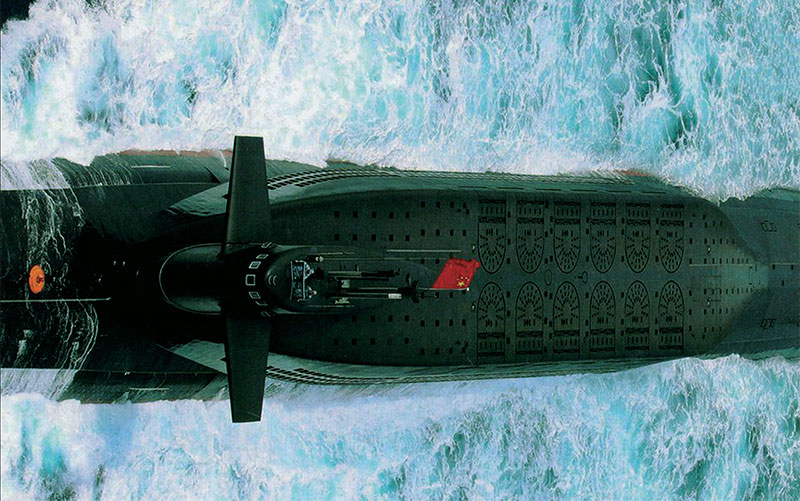
Type 09-IV SSBN
Such UUVs are typically launched from 90 metre-long Type 927 catamarans featuring small waterplane-area twin hulls (SWATH), six of which have to date been built by the Guangzhou-based Huangpu Shipyard and the Wuhan-based Wuchang Shuangliu Shipyard. SWATH vessels are both extremely stable and quiet, especially when outfitted with electric motors for propulsion. Their stability and quiet make them especially useful for hydrographic surveying and research utilising sonar and other sensitive acoustic equipment contained with UUVs, and for locating submarines.
In a related development, such catamarans have since 2017 been conducting undersea surveys of the Benham Rise east of the Philippines since early 2017, raising concerns that the PLAN has been violating the Philippines’ economic rights in the area. But Benham Rise also holds a strategic location near the approaches to the major route that US warships and submarines would take to get from the Western Pacific ocean into the South China Sea, raising the possibility that the surveys are in support of undersea warfare operations and especially pertain to the mapping of undersea trenches and ridgelines to be used for acoustic masking purposes by the PLAN’s noisy attack submarines (SSN) and ballistic missile-carrying submarines (SSBN).
Wu Riqiang, a Chinese scholar at Renmin University, has used open sources to find out that the low-frequency noise-level (100 hertz) — a widely used indicator of submarine quietness — attributed to the PLAN’s Type 09-IV Jin-class SSBN — is significantly higher than that of Russia’s Eighties vintage Project 667BDRM Delfin (Delta-IV) SSBN. To make matters worse, China’s SSBNs may be even noisier than Wu has concluded, given certain operating parameters. His assessment that the 09-IV-class SSBN is too noisy to be survivable is based on the average ambient low-frequency noise-levels in the shelf region of the northern South China Sea.






 VIDEO
VIDEO