

Befriend the Forest
Spring is one of the most beautiful seasons in India. While the duration of this season varies in different parts of the country, in most parts the months of February to March are regarded as Spring. April is the month of cruelty as it puts to sleep all the glorious blooms of Spring, ushering in the heat of summer.
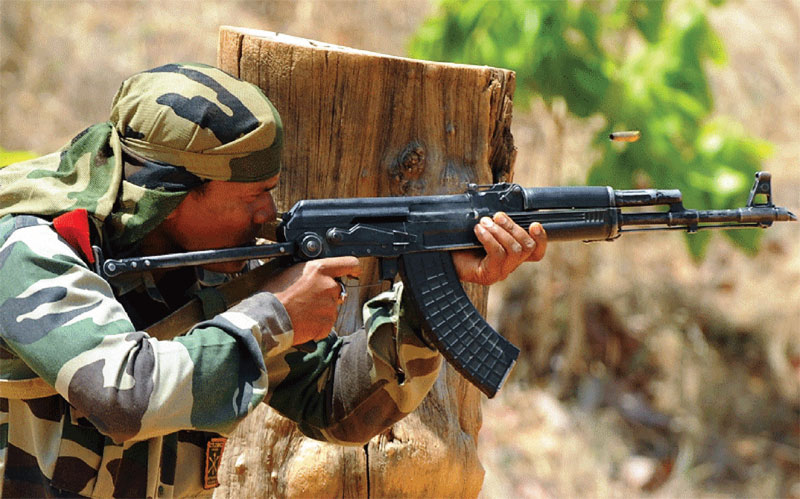
A CRPF personnel during warfare
This year, the cruelty of April was also announced in the forests of Chhattisgarh. On April 3, the combined team of CRPF and the state police walked into an ambush laid by the Maoists in the Bastar region of the state. 22 soldiers were killed; 31 were injured. One CoBRA commando of the CRPF was taken hostage, though subsequently he was released. The heat had begun.
The state of Chhattisgarh is among the poorest in India but sits on unimaginable reserves of natural wealth. In the heart of India, the state spreads over 135,191sqkm of area, of which, almost half is under forest cover (44.21 per cent). This pristine state with low hills, plateaus and plains is home to dense forests, inhabited by several indigenous tribes. While the river Mahanadi is the lifeline of Chhattisgarh, several other rivers like Indravati, Sabari, Leelagar, Hasdo, Pairi, Shivnath, Arpa and Sondur crisscross through this state. However, there are four catchment areas--Mahanadi, Ganga, Godavari and Narmada.
The natural resources of Chhattisgarh have made the state the battleground of conflicting interests. It is also the strongest bastion of the Communist Party of India (Maoist), also referred to as Left-Wing Extremists. As summer sets in, the Maoists, who are waging an armed insurgency against the Union of India (and run a parallel government of their own), launch their Tactical Counter Offensive Campaign (TCOC). Operationally, this is their most active period. They use TCOC to spread their reach, as well as to recruit new foot-soldiers and put them through their paces.
Speaking to FORCE on the condition of anonymity, a senior CRPF officer says, “Being the residents of the forests, Naxals launch the TCOC in this period because they understand the terrain and know that the humidity of the forest reduces the efficiency levels of the security forces as they are not acclimatized to this weather. They know that the personnel get exhausted when they return from long range patrol and their energy levels dip. Obviously, this impacts their alertness too.”
Hence, the Naxals are able to mount successful attacks. The fallen leaves because of the weather also works to their advantage. “While the visibility becomes high, the sound of leaves crushing under the shoes of the soldiers gives away their movement. Add to this the humidity, which makes walking even small distances tiring, forcing the security forces to take multiple halts. They also need a lot of water to keep themselves hydrated, which forces them to engage with the locals,” he says, adding that this is the primary reason why it appears that the security forces repeat the same mistakes all over again.
This is what happened on April 3 as well. The gun battle broke out when the security forces were returning after an anti-Naxal operations. More than 2,000 personnel from five camps in Sukma and Bijapur, comprising CRPF’s Commando Battalion for Resolute Action (CoBRA), District Reserve Guards (DRG) and the Special Task Force (STF) had gone into the forest around Tarrem in Bijapur district on a combing mission. While they were on their way back, the Naxals ambushed them.
A similar incident had happened last year too. In March 2020, the security forces and the Maoists had an encounter in the Chintagufa area of Sukma district. A total of 17 soldiers belonging to the joint security team were killed. Both attacks were carried out by the PLGA commander Madvi Hidma. In April 2017, a Maoist ambush in Burkapal in Sukma district killed 25 CRPF jawans. This year, just before the April incident, five policemen were killed and 13 were injured as Naxals blew up a bus in Chhattisgarh. The landmine explosion happened between Kanhargaon and Kadenar villages under the Dhaudai police station limits in the state’s Narayanpur district.
Subscribe To Force
Fuel Fearless Journalism with Your Yearly Subscription
SUBSCRIBE NOW
We don’t tell you how to do your job…
But we put the environment in which you do your job in perspective, so that when you step out you do so with the complete picture.






 VIDEO
VIDEO