For the first four decades of independent India, the smallest wing of its armed forces, the Navy, did not receive as much attention as the army and the air force. This was because all the wars fought by India against Pakistan and China were land wars, although the navy played an important part in the 1971 war.
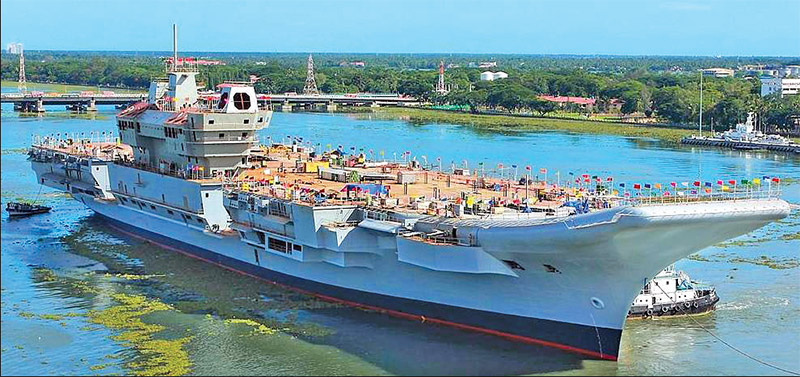
India’s indigenous carrier, IAC-1 Vikrant
The comparative neglect of Indian Navy by the defence planners was for two reasons. India shares land borders with its two acknowledged foes, Pakistan and China. In a conflict with either, the navy had a limited role to play. And in keeping with its importance, the navy received the smallest share of the defence budget.
But despite its comparatively smaller size, the Indian navy has punched above its weight. For decades, it enjoyed a reasonable level of superiority in the Indian Ocean. Thanks to its biggest and most prized assets – aircraft carriers.
In 1961, when the Majestic class carrier INS Vikrant was acquired from the British Navy, the Indian Navy became the sole operator of an aircraft carrier in the India Ocean. According to an anecdote, this was partly due to Lord Louis Mountbatten convincing erstwhile Indian Prime Minister Jawaharlal Nehru to buy an aircraft carrier.
Although Lord Mountbatten’s concern was not so much about strengthening the defence of a newly-independent country as the desperate need of a broke empire to sell war surplus accumulated during World War II, the good turn he did to the Indian Navy contributed to Indian superiority in the Indian Ocean in the following decades. INS Vikrant displaced 19,500 tonnes and came with British-made Sea Hawks and French manufactured Sea Alize aircraft.
Although acquired from Britain in 1961, INS Vikrant did not see action until the 1971 war in which the ship, despite all its structural problems – ruled the seas, denying space to the incipient Pakistan Navy. Despite its operational deficiencies and the fact that the Pakistan Navy had acquired Daphne class submarines, it did not deter the Indian Navy. The carrier’s success in the war to liberate Bangladesh left an indelible mark on Indian maritime war history.





 VIDEO
VIDEO