

Battle Hardened
The Land Warfare Doctrine-2018 released on December 19 by the Indian Army is a disappointing document. Its biggest drawback is that its drafters have read the wrong literature on warfare. Instead of lifting ideas from the American literature, they should have drawn upon China’s 2015 military reforms. To be sure, China is India’s bigger military threat. Had the Indian Army studied that closely, it would have identified its threats correctly. And, it would have felt embarrassed declaring that: ‘The Indian Army shall be the primary instrument of the overall deterrence capability of the nation.’
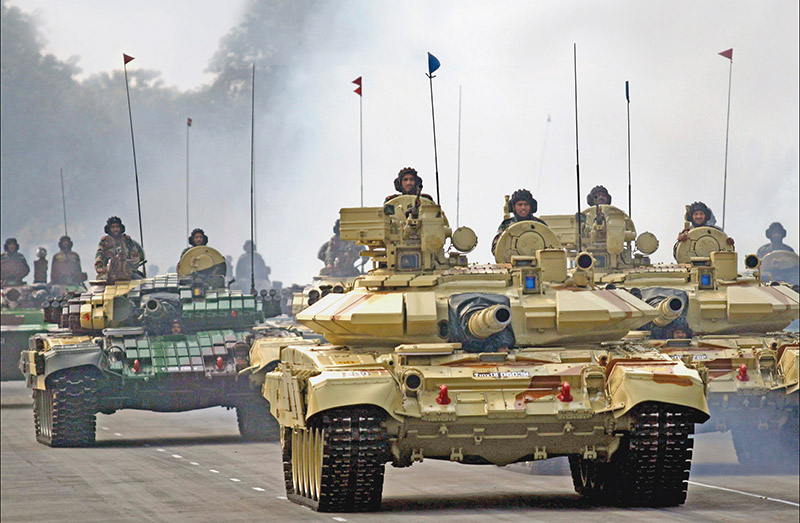
Indian Army tanks during Army Day parade
The military threat from China comes from its overall joint-ness at the strategic (policy-making) and warfighting (operational) levels. Joint-ness at the strategic level (which involves the Central Military Commission headed by the commander-in-chief, Xi Jinping) helps in strengthening political will since the topmost commander understands the war escalation ladder — from crisis to battles to war to seamless transition from conventional to nuclear domains. Or, the spectrum between credible deterrence and military coercion.
Without a robust political will, chances of a nation succumbing to military coercion increase exponentially. The case in point is April 2018 Wuhan informal summit, where Prime Minister Narendra Modi sought peace with President Xi Jinping subsequent to the June-August 2017 Doklam crisis. Once the People’s Liberation Army’s military build-up in its Western Theatre Command (WTC) facing India in the winter of 2017-2018 became apparent, Modi lost his nerve and hurriedly sought peace with China. His spin-doctors though softened the impact of national humiliation by calling it the reset strategy. The reality was that India, for the first time since Independence, had capitulated to military coercion. China won without firing a shot.
People’s Liberation Army’s (PLA’s) threat at the warfighting level comes from the joint-ness of its forces-in-being in the WTC combined with the capabilities (kinetic and non-kinetic) that can be brought to bear on India. The PLA’s impressive non-kinetic capability has been amalgamated under the newly-created Strategic Support Force (SSF). The SSF, comprising space, cyber, electronic, psychological and other technical capabilities, has two tasks: to support joint operations and to independently paralyse and sabotage enemy’s command, control, communication, computer and intelligence systems.
The PLA’s kinetic capabilities include its army, air force and navy domains, reinforced by precision long-range cruise and hypersonic missiles, unmanned combat aerial vehicles, and directed energy which it already has. These humongous capabilities are expected to be complemented by the second wave of technologies comprising Artificial Intelligence (AI), partially autonomous unmanned systems, robotics and human-machine interface under China’s New Generation AI Development Plan wherein it hopes to become ‘the premier global AI innovation centre’ by 2030. The AI will help the PLA increase its speed for conventional operation to overwhelm the enemy warfighting loop called the Observe-Orient-Decide-Act (OODA). This would ensure that the enemy would remain defensive and unbalanced, if not unhinged, in war.
The PLA had initiated these expansive 2015 military reforms once it decided to move its pivot of warfare from land-based territorial defence to extended power projection. The PLA did so because it does not consider Indian military to be of much consequence. Not because it is dismissive of India’s kinetic war capabilities as exemplified by its army, air force, navy and so on; but because it knows that the Indian defence services are its own worst enemy since they are unwilling to abandon archaic doctrinal thinking with little real joint-ness which is unsuited for modern warfare.
Subscribe To Force
Fuel Fearless Journalism with Your Yearly Subscription
SUBSCRIBE NOW
We don’t tell you how to do your job…
But we put the environment in which you do your job in perspective, so that when you step out you do so with the complete picture.






 VIDEO
VIDEO