

Balance of Power
India’s economic growth depends on its response to the changing nature of political threats, both internal and external
 Maj. Gen. Atanu Pattanaik (retd)
The war in Ukraine and thereafter the Iran war starting 28 February 2026 have caused severe disruptions in oil and gas flows apart from upending global supply chains. Dependent as it is on energy imports, India has deftly managed the crisis by switching to Russian oil despite American threats, sanctions and debilitating tariffs.
India is now witnessing a string of students-led protests amplified by coordinated social media narratives. They are nowhere near the ferocity of the street violence being witnessed in Paris, Milan, Tirana and Madrid which will be analysed in some detail later, but they are worrisome, nevertheless. These add to the anti-India noises emanating from Bangladesh and Maldives coordinated by Pakistan. The ghastly Pahalgam attack of 22 April 2025 and the Indian retribution through Operation Sindoor on 7-10 May 2025 has already redefined how India is going to respond to future cross-border terrorist attacks. But internal turmoil through externally sponsored agitations have acquired a dangerous mode in the last seven years starting with anti-CAA protests in December 2019.
With a 15,106.7 km land border and 7,516.6 km coastline, India thus faces the full spectrum of internal and external threats. The country has been grappling with domestic and transnational terrorism, insurgencies in the Northeast, Left-Wing Extremism (LWE), and the permanent threat from Pakistan and China. As threats persist, more concerted and decisive action is needed so that India can focus better on health, education, and development. This calls for modern techniques, integrated surveillance, digital systems and better coordination among armed forces and different security agencies to respond to border wars and terror attacks, and handle drug trafficking, arms smuggling, hawala networks and cybercrimes.
India’s ability to achieve stability in its land borders and prevent internal disturbances from going out of hand will be a major factor in propelling the Indian economy to initially a USD 5 trillion mark and thence to USD 10 trillion. A combination of external and internal situations has put our leadership on notice, forced to constantly juggle priorities to maintain peace with India’s hostile neighbours and resolve internal conflicts within the hinterland, without impeding our developmental goals of Viksit Bharat in 2047. India stares at interesting times.
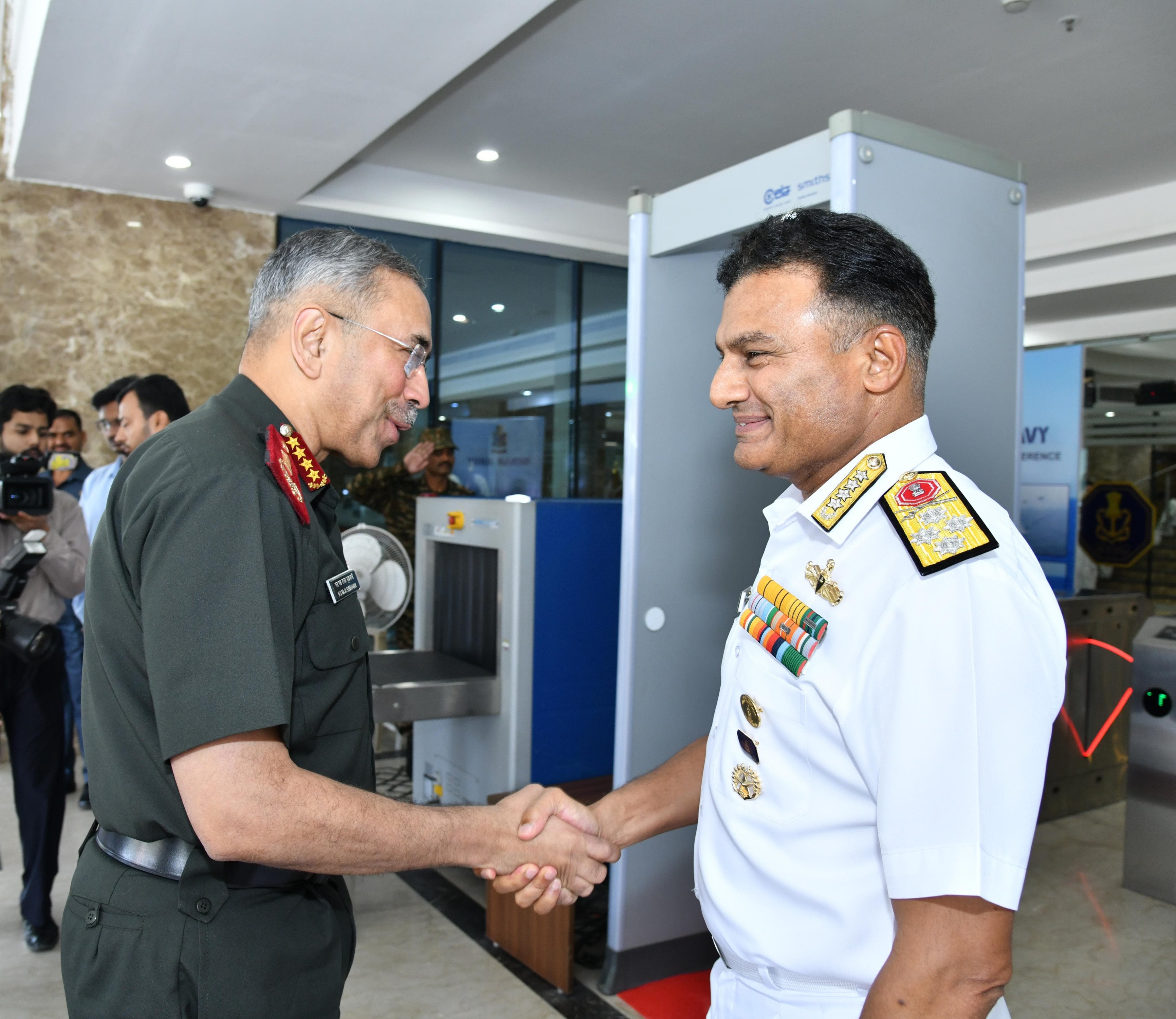
BELOW & RIGHT Chief of Defence Staff Gen. N.S. Raja Subramani at the recent Naval Commanders Conference;
scene from an attack on Ukraine by Russia
War Zones: What do They Tell Us?
Two theatres of war, one in the heart of Europe and the other engulfing the entire Middle East, give clear and distinct signals that something significant is changing in the character of warfare. The war in Ukraine involves US-led-North Atlantic Treaty Organization (Nato) backed Ukraine pitted against Russia and has dragged on into its fifth year. The other, stoked by the 7 October 2023 Hamas attack on Israel and the consequent Israeli onslaught on Gaza expanded initially into Hezbollah dominated Lebanon but has now spiralled into a regional inferno lighting up the entire Middle East after the US directly joined in support of Israel and bombarded Iran on February 28 this year.
Conventional war gaming models would suggest that Ukraine should have folded up long time back, considering overwhelming adverse combat power ratios vis-a-vis former super power Russia. Yet, while it has lost over 20 percent of its territory to Russia and a quarter of its population have fled the country, Ukraine has retained the capacity to deliver painful blows to Russian oil and gas infrastructure deep inside the country while also blasting warehouses and logistic centres of Russian supermarket chains.
Similar outcomes would have been predicted for Iran — to capitulate under the overwhelming air power of US-Israel combine in consort with a vastly superior US Navy menacingly lurking in the Arabian sea with two carrier strike groups. But eight months after the American attack which was possibly premised on Iran capitulating like Venezuela with a regime change, the situation is almost the opposite. Not only the theocracy survives and continues to call the shots, Iran has effectively blasted US bases in the region while imposing a blockade of the Hormuz Strait through which 20 percent of the global oil and gas flows. Iran-backed Houthis, a part of its ‘Axis of Resistance’, is demonstrating exceptional capacity to cause havoc to the US’ staunch ally Saudi Arabia and disrupt shipping through the Red Sea.
The situation is so dire that the US has reportedly been scaling back its troop presence at military bases across the Middle East in recent days due to ongoing regional threats from the Iran-backed Houthis and Iran. Meanwhile, the US State Department has directed some diplomats and their families to leave American missions in Saudi Arabia and is planning to pull family members out of several other diplomatic posts across the region, a clear sign of severe distress and miscalculation.
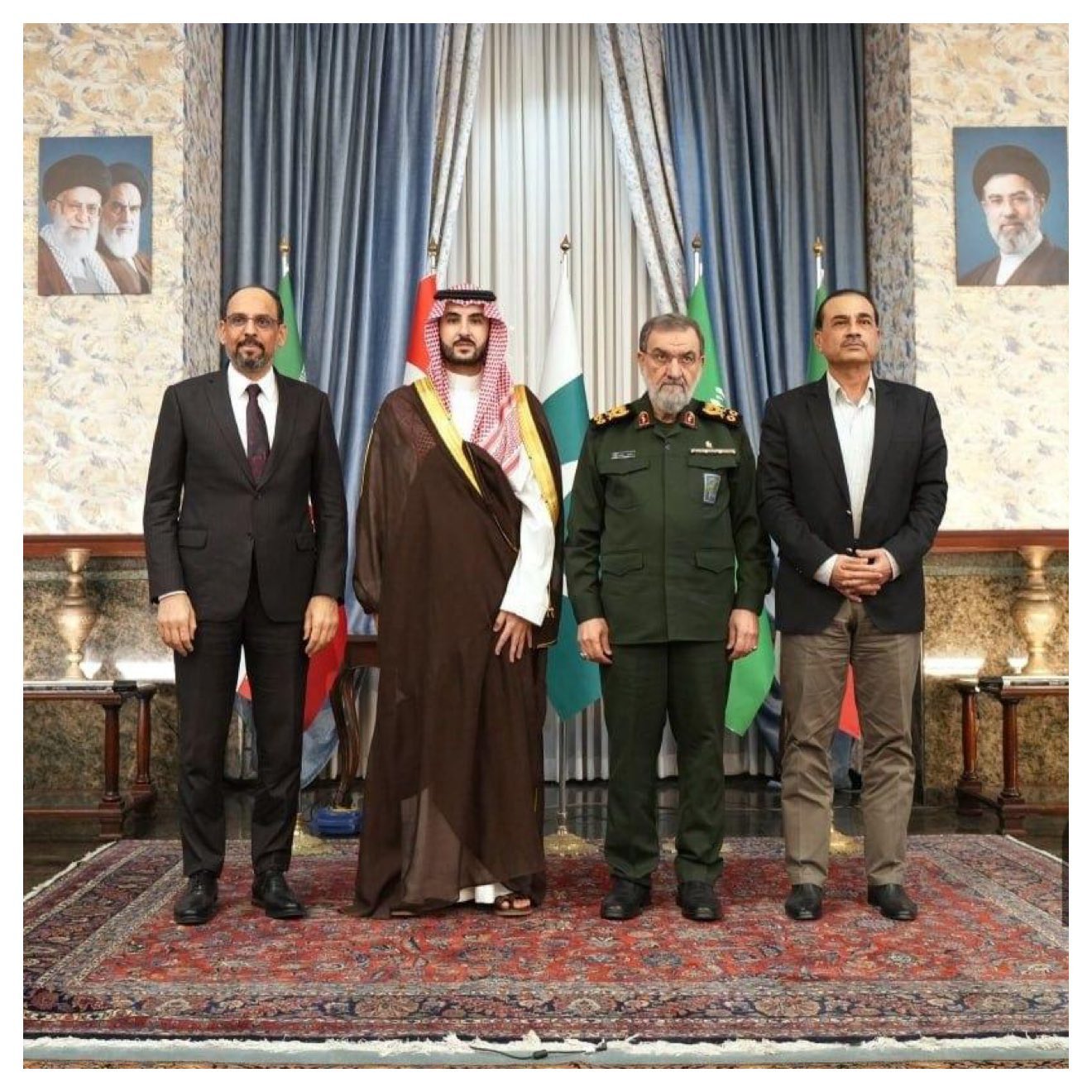
EMERGING WESt ASIAN QUAD Turkey’s National Intelligence Organisation director Ibrahim Kalin;
Saudi Arabia’s defence minister Prince
Khalid bin Salman; Iran’s Supreme National Security Council secretary
Mohsen Rezaei and Pakistan’s Chief of Army Staff Field Marshal
Asim Munir at a recent meeting in Tehran
While the Ukraine situation can be explained by the fact that it’s a proxy war between US-led Nato and Russia and hence the war lingers on with active support in intelligence sharing, supply of arms, munitions and air defence assets and military advisors on ground assisting Ukraine military in targeting Russian assets deep inside its territory. The West Asian situation, on the other hand, gives a very different signal. Iran’s capacity to wage a prolonged drones-missiles onslaught overwhelming the costly American-Israeli air defences was anticipated. But a relatively small non-state actor like Ansar Allah (popularly known as Houthis), possessing neither a sophisticated industrial base nor conventional military superiority, has acquired the ability to threaten international shipping, strike economic infrastructure and impose disproportionate costs upon powerful adversaries is consequential for military thinkers the world over.
Events and outcomes in both these theatres of war need close observation and analysis to draw appropriate and correct lessons by the military planners. But the escalation in the Red Sea and Saudi Arabia should be of special concern to India for reasons extending well beyond energy prices and maritime commerce. Traditional military superiority rests upon trained manpower, sophisticated weapons, industrial capacity, logistics and technological innovation. These remain indispensable, but the relationship between investment and destructive capability is changing, and the Ansar Allah of Yemen may be providing one of its clearest demonstrations. Russia provides satellite intelligence, Iran operational integration and Ansar Allah (boots on the ground), do the tactical reporting. The battlefield picture as well as the kinetics, all integrated by spatially separated players leveraging their strength towards a common goal, victory.
Commercial drones, increasingly accessible engineering software, satellite imagery and artificial intelligence can provide smaller organisations with capabilities previously associated with established military forces. AI may assist in analysing information, developing software, interpreting imagery and accelerating technical experimentation. It does not eliminate the difficulties of producing reliable weapons, but it can lower some barriers to acquiring expertise. The Ansar Allah using AI to engineer its missiles is a case in point.
Europe Erupts
Another battleground is emerging swiftly on the horizon. Not a classical war but something that is increasingly being recognised to be worse. The riots in France which has quickly spread further to Brussels, Italy, Spain and Albania with devastating implications on stability of these countries going forward compels military thinkers to agonise over whether internal security is becoming a bigger challenge than external threat. Should that be the dominant conclusion after thorough study, debate and analysis, the implications are far reaching on issues of security encompassing force structuring and command and control architectures that were hitherto considered well-crafted and capable to defend our sovereignty and territorial integrity.
France’s riots have become part of a wider international narrative of rebellion, a kind of ‘Chaos Inc.’, amplified by a transnational network of Communist and Socialist organisations stretching from Europe to Asia, Australia, Africa and South America and North America. A Fox News Digital investigation has identified 54 organisations and movements in France’s October student protests and their wider network of supporters and international amplifiers, including Communist parties, revolutionary Socialist groups, labour unions, environmental activists, Muslim student advocates, Palestinian-solidarity organisations and international media outlets.
Of the 54 organisations identified in the October protest ecosystem, 16 or only about one in three are student or youth organisations, including Communist youth groups and a Muslim student association. The remaining 38 include adult-led Communist groups, labour unions, political parties, revolutionary-left organisations, advocacy groups and international propaganda outlets. From the outset, far-left Socialist and Communist organisations helped organise and amplify France’s student revolt, using grievances over school conditions as a pretext to mobilise a broader political struggle against capitalism, government austerity, policing and military spending. These outfits are galvanising students and youth for a coordinated strike across 12 countries in Europe under the slogan ‘Fight for Our Future, Not Their Wars!’. There is a broader plan for expansion of this chaos to the US and India.
A Coordinated Response
So, while traditional military thinkers will be focused on the war in Ukraine and Iran to study their nuances and chart a roadmap to enhance operational readiness taking into account new facets of intelligence gathering, communications technologies (role of Star Link in Ukraine for example), advancements in drones, missiles and autonomous weapon systems, and new frontiers of cyber warfare (power blackouts and manipulating temperature settings thereby blowing up of food refrigeration systems in supermarket triggering shortages), the bigger threat emanating appears to be the conglomerations of NGOs, advocacy groups and social media warriors that are coordinating with inimical state forces to strike from within. The footprint of Hamas in the Pahalgam terror attack is a pointer to such transnational networking.
A number of internal security measures have strengthened the capacity to effectively counter the emerging nature of networked coordinated externally sponsored internal strife to derail economic growth and effect regime change. Beginning January 2020 when a central cybercrime hub the Indian Cyber Crime Coordination Centre (I4C), was established in Bangalore, many related steps like strengthening FCRA, operationalising a NATGRID, AI tool CCTN 2.0 for police data-sharing, CyMAC for cyber-threat intelligence coordination, NAFIS to enable fingerprints data search etc. apart from intelligence sharing and extradition agreements with a number of countries including known terror finance hubs like Dubai have helped in effectively countering networks that exchange messaging on protests and encourage wider mobilisation to create chaos.
Stalled Military Force Structuring Reforms?
The Kargil review committee had given a number of significant reforms to keep our armed forces nimble-footed and combat ready for all kinds of threat including hybrid warfare which somewhat explains the current spate of agitations to undermine governing institutions and convert our campuses into war zones. The Chief of Defence Staff (CDS) has been tasked to ‘facilitate restructuring of Military Commands for optimal utilisation of resources by bringing about jointness in operations, including through establishment of joint/theatre commands’.
That process has largely remained in limbo due to serious differences amongst the three services. In our case, the question which begs an answer is who is the theatre commander responsible to? Is it the President of India who is the Commander-in-Chief (C-in-C) but a titular head? Is it the Cabinet Committee on Security (CCS)? Is it the prime minister (PM)? Is it the CDS? Is it the National Security Agency (NSA)? Or is it the Chiefs of Staff Committee (COSC)? If we adopt the US model, we are looking at a chain of command running down from the PM to the theatre commander through the defence minister. If we adopt the Chinese model, it has to be PM through the CCS who has to be in direct chain of command and responsibility with all others in supportive roles. Either of the models has many downstream effects. None have any demonstrated any spectacular success.
Theaterisation may not be the panacea to all challenges. Each country adopts its own command structures designed around the political leadership construct. While the US has the President as the Commander-in-Chief directing the theatre commanders, Iran has demonstrated great success through a dispersed leadership model that has endured despite periodic loss of key leadership of Islamic Revolutionary Guard Corps (IRGC) in targeted American and Israeli bombardments. Considering how the Iran war is poised, it is quite apparent that there are no clear-cut answers.
Can desired jointness and optimal force application be achieved without theaterisation? Op Sindoor may have given some answers.
Way Forward
The longevity and course of the wars in Ukraine and the Middle East debunks the oft-quoted dictum repeated ad nauseam that future wars will be short, swift and devastating. Some characteristics of old ways warfighting have remained in place, like the kinetics of air warfare and importance of boots on the ground backed by sound logistics. But new attributes have inserted themselves that have obliterated frontlines and made combat power calculus which hitherto guided the construct of war machinery of great powers suddenly looking insufficient and inadequate, if not somewhat primitive.
Traditional structures retain the role, capacity and primacy in war-fighting but constant technology-driven improvisations responding to events and outcomes in the battlespace is crucial. Well defined command and control organisational structures are essential but astute leadership remains the key to victory.



 VIDEO