Modern-day aerial warfare is not just limited to air-to-air combat but also air-to-ground combat along with prolific intelligence gathering, surveillance, and reconnaissance elements. Modern fighter aircraft utilise an array of sensors to track, locate, and engage both aerial and ground targets at incredibly high altitudes and speeds.
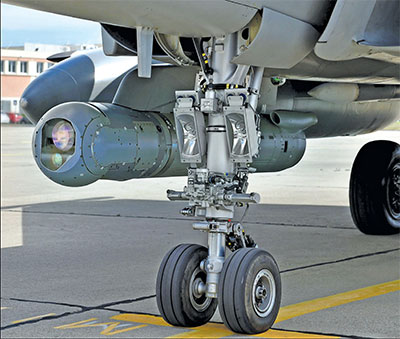
Thales’ TALIOS pod fitted on a Rafale
Presently, aircraft and helicopters alike utilise onboard radars and cameras to track targets. A pilot today is expected to not only be able to accurately track and engage aerial and ground targets, but also relay crucial intelligence and surveillance data back to ground stations and ground forces in real-time.
At its most basic level, fighter aircraft use an Infrared Search and Track (IRST) system which is basically an infrared energy detection device that is fitted in a spherical glass enclosure on the front of a fighter aircraft. These systems can scan the airspace ahead of the jet for heat signatures caused by aircraft engines and/or skin friction caused by the aircraft flying through the air. Once the system detects a target, it usually has an ability to lock that target up, or a way to facilitate the crew in slaving their fighter’s radar onto the point in space where that heat signature exists in order to attempt a radar lock. Modern variations of IRSTs can search out to intermediate ranges, track multiple targets and even engage other aircraft using its telemetry data alone. This is where optronic pods come in.
Optronic pods are the next step in the evolution of network-centric AI-driven tracking, targeting, and engagement systems. With fighter aircraft evolving and upgrading constantly alongside information technology, optronic pods are becoming a highly coveted addition to any fighter aircraft in today’s battlefield. In fact, quite a few Original Equipment Manufacturers (OEMs) are presently designing and manufacturing state-of-the-art optronic pods for fighter aircraft that are not only extremely accurate at seeking and tracking targets but also offer the versatility of being retrofitted to a plethora of existing aircraft.
Last year in May, the Defence Acquisition Council (DAC), approved the procurement of indigenously developed IRST systems for the IAF’s Su-30MKI squadrons. The government intends to develop ‘indigenous eyes in the sky’ to allow the Su-30MKIs to detect even the stealthiest of aircraft like China’s Chengdu J-20s.








 VIDEO
VIDEO