

At Ex Tarang Shakti, Rajnath Singh Talks About Modern Warfare & Self-Reliance
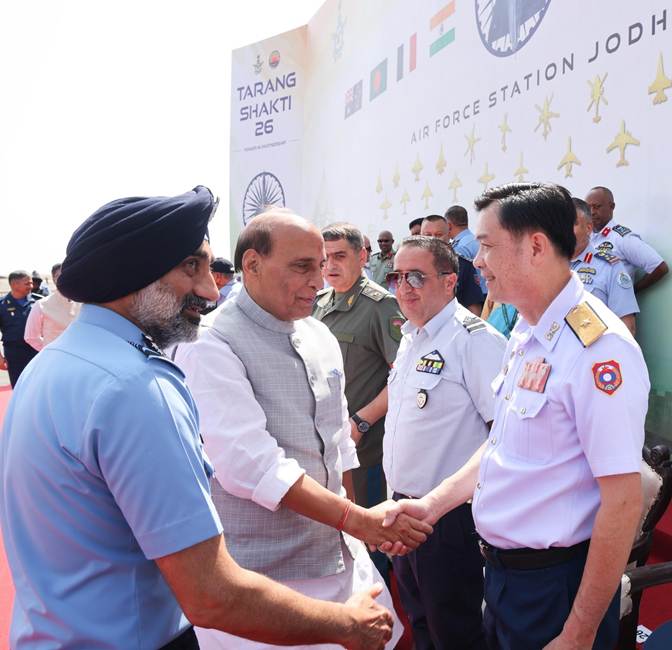
Addressing the participants of the second edition of Exercise Tarang Shakti at Air Force Station Jodhpur on October 10, defence minister Rajnath Singh observed that modern warfare was undergoing a profound transformation, extending beyond the traditional domains of land, sea and air to encompass space, cyber, the electromagnetic spectrum and the information domain. He highlighted the growing influence of unmanned systems, drones, artificial intelligence, electronic warfare and long-range precision weapons in shaping contemporary military operations.
“Future military power will be defined less by the number of platforms we possess. It will be determined by the speed of sensing, understanding, deciding, and acting,” he said, emphasising the need for continuous vigilance in view of the rapidly changing geopolitical environment and the uncertainties associated with technological advancements in the defence sector.
Hosted by the Indian Air Force (IAF) from 26 September to 12 October 2026, the multinational air exercise brought together air forces from seven friendly foreign countries (FFCs) including Australia, Bangladesh, France, Germany, Sri Lanka, the United Arab Emirates and the United States of America along with 32 observer nations.
Congratulating the IAF and all organisations and personnel involved in the successful conduct of the exercise, Singh noted that the presence of participating air forces had added significant value to the exercise and expressed hope that the contingents would return with valuable professional insights and a deeper understanding of India’s capabilities and perspectives.
Highlighting the importance of self-reliance in the defence sector, technological innovation and international partnerships in addressing the evolving challenges of modern warfare, Singh stressed that a nation must possess the capability to produce its own weapons and critical technologies to sustain itself during prolonged conflicts and periods of uncertainty.
He said that the Indian Air Force had evolved from a force operating with limited resources at the time of Independence into a modern aerospace power equipped with advanced aircraft, precision weapons, sophisticated sensors, integrated networks and increasingly advanced indigenous technologies. He emphasised that Aatmanirbhar Bharat did not mean isolation from the world, but the development of domestic capabilities to design, develop, manufacture, maintain and upgrade critical defence technologies.
Referring to India’s growing aerospace and defence manufacturing ecosystem, the Singh highlighted indigenous programmes and systems, including the Tejas fighter aircraft, helicopters such as Dhruv, Rudra, Prachand and the Light Utility Helicopter, the Akash air defence system, AESA radars, electronic systems, and emerging unmanned and aerospace technologies. He also referred to the Advanced Medium Combat Aircraft (AMCA) programme as an important step towards mastering fifth-generation stealth fighter technology and underscored the importance of advanced aero-engine development and co-production. He said that India was keen to explore cooperation with like-minded countries in research, co-development, co-production, maintenance, training and innovation.
Singh highlighted the significance of Exercise Tarang Shakti in translating the principles of capability, technology, interoperability and trust into operational experience. The exercise provided participating air forces an opportunity to operate alongside one another, exchange operational knowledge, assess procedures and understand different platforms, doctrines and approaches to mission planning.
Describing the spirit of the exercise, he said, “Different nations. Different aircraft. Different experiences. But one sky. That is the message of Tarang Shakti.”
The second edition of Exercise Tarang Shakti built on the success of its inaugural edition in 2024 and reinforced India’s commitment to constructive defence engagement and international cooperation. The exercise brought together diverse combat, transport, surveillance and air-to-air refuelling capabilities, providing opportunities for joint mission planning, operational learning and enhanced interoperability. The participation of indigenous platforms, including LCA Tejas and LCH Prachand, also highlighted India’s progress in indigenous aerospace design, engineering and manufacturing.
Beyond flying operations, the exercise featured professional engagements, industrial visits and cultural interactions. The Centre for Aerospace Power and Strategic Studies (CAPSS), together with the IAF, organised a seminar on the theme of ‘The Central Role of Air Power in the Evolving Battlespace,’ bringing together representatives of partner air forces, senior military leaders, academia, industry and the media on October 9 at the Air Force Auditorium in New Delhi.
Fresh from the operational experiences gained during this flying exercise, the teams carried forward their engagement to the conceptual level during the seminar. The seminar sought to identify doctrinal priorities and areas for future cooperation and encouraged informed dialogue among partner air forces.
Delivering the welcome address, director general, CAPSS, Air Marshal Nagesh Kapoor (retd) elucidated the role of air power in contemporary conflicts and highlighted the contribution of CAPSS in fostering it. Chief of the Air Staff Air Chief Marshal A.P. Singh delivered the inaugural address. The CAS underscored the need for integrated capabilities, operational resilience and enhanced interoperability to meet emerging challenges in air warfare. He stressed the concurrent development of manned and unmanned operations, guided by clear employment doctrines, and the integration of all sensors, weapon systems and unmanned platforms with communication and data networks from the outset.
He also called for strengthening supply chains, adopting innovative training methods and enhancing capacity to sustain prolonged operations. Highlighting air power’s role in humanitarian assistance, support to partner countries and advancing the nation’s international standing, he emphasized focused deliberations on information warfare and perception management, along with greater exchange of operational experience and enhanced cooperation among air forces to address common challenges.
The first working session looked at the transformation of air warfare in the 21st century and was chaired by former CAS ACM V.R. Chaudhari. The session explored the shift from air superiority to battlespace control, decision dominance and the role of media as a strategic weapon. The panellists argued that air power is no longer about owning the skies alone; it involves an entire operational ecosystem. The session engaged both traditional concepts as well as modern themes.
The second session was chaired by CAS, Royal Australian Air Force, Air Marshal Stephen Chappell. The session examined air power as a strategy of national power, covering deterrence, coercion, escalation control, and human capital development. This session debated the necessary reforms in air power to meet emergent and future requirements of the battlefield holistically. It also dissected the role of air power in deterrence and escalation control.



 VIDEO