

Assertive China
Beijing: “The situation in South China Sea is stable,” noted by China’s state councillor and minister of national defence, Gen. Wei Fenghe, was the most significant statement to come out of the 8th Beijing Xiangshan Forum held here between October 24 to 26.
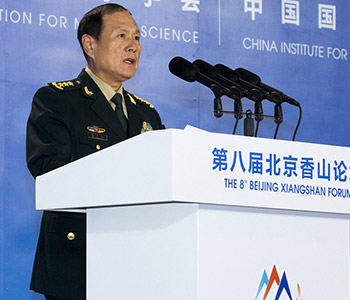
This implied that in Chinese assessment, the possibility of war between China and the US over China’s speedy land reclamation, occupation and militarisation of South China Sea (SCS) has receded, if not concluded. Said another way, the SCS has been lost by the US to China. The US has been left to ensure Freedom of Navigation (FON) patrols and overflights based on international rules and norms. How long they would do so remain an open question. China had commenced chasing and warning US ships coming within 12 nautical miles of Beijing’s baseline around its occupied island groups, which are illegal under the United Nations Convention on the Laws of the Sea.
Unlike the Obama administration, the Trump administration had increased FON patrols and overflights in SCS. It had sought to strengthen interoperability with allies for situational awareness, amphibious operations and anti-submarine warfare. Yet, the implications of Chinese victory — speak volumes of its political will — had not been lost on ASEAN and all major powers. This had given a boost to China’s new form of international relations and the new security framework for Asia-Pacific for ‘building a new type of security partnership of equality, mutual trust and win-win cooperation’ which was also the theme of the Beijing Xiangshan Forum. It was perhaps to underscore this win that China re-named the Forum prefixing it with the word Beijing. All earlier editions were called Xiangshan Forum.
As an invitee to the 2016 and the present Forum, this writer got a ringside view of how China had clutched victory from an ostensibly losing proposition. At the 6th Xiangshan Forum in October 2016, China’s Vice-Chairman, Central Military Commission, Gen. Fan Changlong had said, “We will not recklessly use force even when the issues affect our sovereignty.” China had, in August 2012, officially elevated the SCS as its core concern (over which it could go to war) to include Taiwan, Tibet, Hong Kong, and Diaoya Island with Japan.
At that time, China’s land reclamation in SCS had begun albeit with assurance from President Xi Jinping that militarisation would not happen. Moreover, the US had commenced its FON patrols in SCS which experts felt could lead to military clash; Vietnam and Philippines had protested vehemently against China’s territorial aggression; ASEAN member Malaysia had questioned China’s commitment to Code of Conduct (COC); China’s relations with Japan were in tailspin; Obama administration’s re-balancing or pivot to Asia was in full swing; and the Trans Pacific Partnership was being sold by the US as its support for prosperity in Asia-Pacific.
Facing hostility from within the ASEAN and by extra-regional powers, China had in October 2016 invited ASEAN defence ministers to a separate China-ASEAN defence ministers meeting to defuse regional tension coinciding with dates of the Forum so that they could participate in public diplomacy as well. The then Malaysian chief of defence forces, Gen. Tan Sri Dato’ Sri had disclosed that the then China’s defence minister, Chang Wanquan had proposed a confidence-building measure protocol in the form of joint drill with ASEAN nations for Code of Unplanned Encounters at Sea (CUES) to ward-off maritime miscalculations (the Chinese and the US’ Navy follow the CUES protocol). China also proposed building a community of common destiny for ASEAN nations by the end of the year. This is not all. China had offered to hasten joint efforts to advance the agreed DOC (Declaration on the Conduct of parties in the South China Sea) to COC (Code of Conduct for parties in the South China Sea).
Commenting on the Chinese offer, the then Malaysian chief of defence forces had said, “The major obstacle is that mutual trust has not occurred.” According to him, while the DOC between China and ASEAN was signed in 2002, it has yet not translated in an agreed and legally binding COC because of “the mismatch of philosophy of time of China and other nations.”
In stark contrast, the present Forum was different on two major counts: ASEAN had collectively been subdued, and Gen. Wei was assertive with newfound firmness and determination. Ironically, the US too had contributed to this perspective by President Donald Trump’s self-goals in the form of withdrawal from the TPP, re-negotiation of the North American and US-Japan free trade agreements, replacement of Americanism with globalisation and his clarion call of America First, all of which led to widespread doubts in the region about US’ trustworthiness.
At the 8th Forum, the ASEAN presented a united front, which was summed up well by Singapore defence minister, Ng Eng Hen. He said, “Today, ASEAN and China’s economies are deeply integrated. China has been the top trading partner of ASEAN for eight consecutive years, and accounts for 17 per cent of ASEAN’s total trade last year. In fact, China-ASEAN volume hit a record high last year, amounting to more than USD 515 billion dollars. The ASEAN-China free trade is one of the world’s largest and was upgraded in 2015.” However, what he did not say was that given ASEAN’s dependence on China for its prosperity, would it be pragmatic for it to hand over its security concerns to the US?
The answer to what the ASEAN felt on this issue was soon evident. ASEAN, it seemed had decided to be a part of China’s new security framework. In a first, 10-member ASEAN as a whole held a military exercise with a single country (China), which also became China’s first maritime exercise with ASEAN. Coinciding with the Forum dates, the maritime exercise was meant to exercise the CUES, search and rescue, and communications. According to Ng Hen, “They also practised Guidelines for encounter for Air Military Exercises (GAME), which is the counter-part of CUES but in the air.” He added, “This exercise was aimed to de-escalate tensions (between ASEAN and China).” Truly so, unlike 2016 when Vietnam and Philippines were not invited, this time around, Vietnam was represented by its defence minister, and Philippines by its under-secretary for defence operations, Cesar B. Yano.
This is not all. Ng Hen disclosed that the recently held 18-countries ASEAN Defence Ministers Meeting Plus (ADMM-Plus) held in Singapore had both agreed to meet once a year and to conduct more field training exercises. It was obvious that the ASEAN would not like to get sucked into the vortex of growing US-China confrontation, the nuclear threat on the Korean peninsula, and increased tensions in SCS. By adding as after-thought that ASEAN would conduct a collective exercise with the US in 2019, Ng Hen left no one in doubt that the ASEAN would do a balancing act until the power equations between the US and China became clearer.
Assertive China
Making his opening speech, Chinese defence minister, Gen. Wei Fenghe squarely blamed the US for tensions in SCS and worsening bilateral ties. According to him construction of defence facilities in SCS were self-defence measures meant to safeguard China’s sovereignty and had nothing to do with militarisation. Instead, “US’ FON and overflights are provocative since they do not abide by international rules and norms.”
Taking cue from President Xi Jinping who had told the visiting US defence secretary, James Mattis in May 2018 that not an inch of its territory handed over by its ancestors would be lost, Wei lambasted the US for, “Repeatedly challenging our bottom-line on Taiwan which is extremely dangerous… the Chinese military will take resolute action at any costs.” To make its displeasure apparent, no US official was invited to talk in plenary sessions at the Forum; the US two-star led-delegation was seated in the third row according to its status rather than its global clout.
The idea behind Gen. Wei’s fulminations against the US was meant to air his disapproval, but not to disrespect import of this bilateral relationship. For this reason, he emphasised that this relation was important for world peace, and China would be happy to meet the US ‘half-way’ to work together.
Gen. Wei said that the new type of security framework proposed by China was based upon the principles of mutual benefit, strategic communications and trust, cooperation in bilateral and global governance. According to him, China sought peaceful development, was opposed to alliances, external interference and threats, would not engage in any arms race, nor seek any sphere of influence or military bloc, hegemony or expansion. He added that “No nation has absolute security when its neighbours are in trouble. We cannot build fences when we desire shared future of mankind.” Strength, he said, comes not from muscle but by cooperation. Gen. Wei summed up China’s defence policy as Active-Defence seeking peaceful development and world peace.
Subscribe To Force
Fuel Fearless Journalism with Your Yearly Subscription
SUBSCRIBE NOW
We don’t tell you how to do your job…
But we put the environment in which you do your job in perspective, so that when you step out you do so with the complete picture.



 VIDEO
VIDEO